

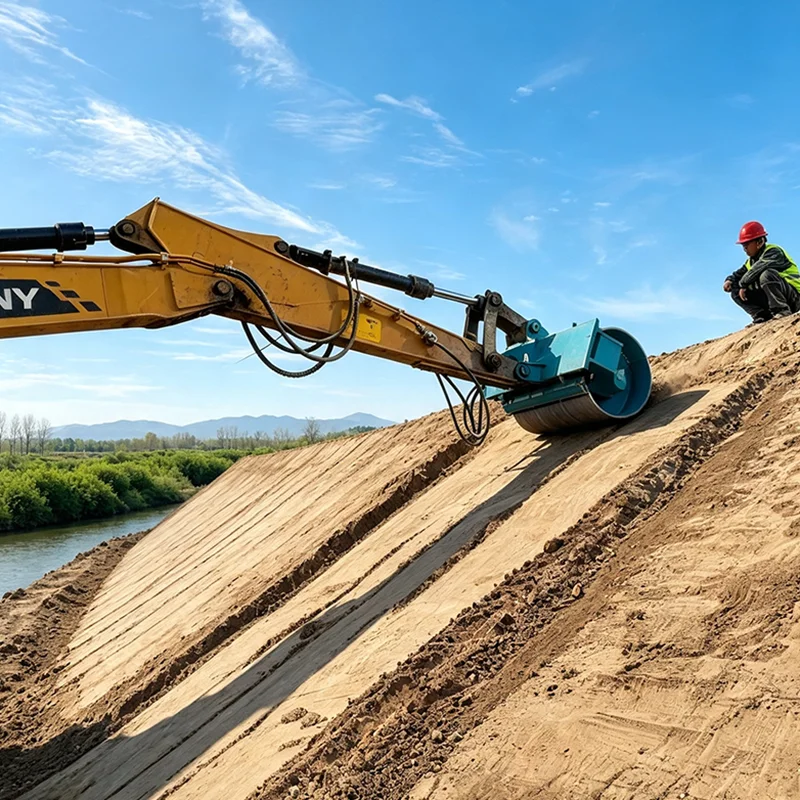
Drum Design Determines Compaction Efficiency
An excavator drum compactor's ability to compact soil depends on its drum design: the diameter, width, and surface texture of the rotating drum that vibrates against the ground. Get the drum design wrong and you either cannot achieve required compaction density, or you waste energy vibrating without densifying the soil.
Drum geometry for excavator compactors follows the vibratory drum design: a cylindrical steel drum (typically 800–1,500 mm diameter, 1,000–1,800 mm wide) that is mounted horizontally under the excavator arm. Inside the drum, an eccentric weight spins at high speed (1,500–2,500 RPM), creating vertical vibration that is transmitted through the drum shell to the soil below. The drum's weight (typically 500–1,500 kg for a 20-ton excavator attachment) provides static downward pressure that keeps the drum in contact with the soil, while the vibration breaks soil particle bonds and densifies the material.
Drum surface texture affects compaction on different soils. A smooth drum (plain steel surface) works well for granular soils — sand, gravel, crushed rock — where the vibration itself does the compaction, and the drum simply needs to transfer vibration efficiently. A padfoot drum (with protruding cleats or pads welded to the drum surface) works better for cohesive soils — clay, silt, and mixed soils — where the pads dig into the soil, breaking up clods and providing points of high contact pressure. Most excavator compactors use a smooth drum as standard — it handles most common soils adequately. For clay and silt-heavy soils, a padfoot shell kit (bolt-on pads that attach to the smooth drum) can be added in 30–60 minutes, converting the drum for cohesive soil work.
Drum width affects productivity per pass. A wider drum (1,500–1,800 mm) covers more area per pass, improving productivity on large open areas (embankments, road base). A narrower drum (800–1,200 mm) provides more compaction force per unit area (concentrated on a smaller width) and works better in confined spaces (trenches, around foundations). For general-purpose work (trenching, backfilling, light compaction), a 1,200 mm wide drum is the standard compromise — it fits in most trenches and covers adequate width for open-area work.
Compaction Force and Soil Types
A drum compactor's effective compaction force depends on centrifugal force (generated by the eccentric weight), drum weight, and soil type. Understanding these relationships helps estimate job costs and meet compaction specifications.
Centrifugal force (measured in kN) is the primary compaction mechanism. A typical drum compactor on a 20-ton excavator generates 150–300 kN of centrifugal force at 1,800–2,200 RPM. This force is transmitted as vertical vibration through the drum to the soil — each vibration cycle applies a downward impulse that densifies the soil particles. The static drum weight (500–1,500 kg) adds a baseline downward pressure that keeps the drum in contact with the soil between vibration cycles. Together, centrifugal force and static weight produce a compacting effect equivalent to a 5–8 ton walk-behind roller — but mounted on an excavator arm for access to confined and elevated areas.
Soil types affect how many passes are needed to achieve specified compaction. Granular soils (sand, gravel, crushed rock) compact quickly — 2–4 passes achieve 90–95 percent Proctor density at lift thickness of 200–300 mm. Cohesive soils (clay, silt) compact more slowly — 4–8 passes achieve 90–95 percent density, and lift thickness must be limited to 150–200 mm (clay does not compact well in thick lifts). Organic soils (topsoil, peat) cannot be compacted to construction specification — they should be removed and replaced with suitable fill material. For trench backfilling, the soil type and required density determine how many lifts and passes are needed — this is specified in the project's geotechnical report.
Lift thickness — the layer of soil compacted in one pass — is critical for achieving proper compaction. Too thick a lift (over 300 mm for granular soil, over 200 mm for cohesive soil) means the vibration cannot reach the bottom of the layer, leaving uncompacted soil at the base. Too thin a lift (under 100 mm) wastes time — you are making more passes than necessary. The standard approach: place soil in lifts of 200–250 mm, compact each lift with 3–5 passes, then add the next lift. This ensures compaction density throughout the soil profile, not just at the surface.
Applications: Trench Backfilling and Embankment Compaction
The drum compactor's primary advantage is its ability to compact soil in confined and elevated areas where a walk-behind roller or plate compactor cannot reach. This makes it essential in several applications.
Trench backfilling — after a utility trench is excavated and pipes installed, the trench must be backfilled and compacted to prevent settlement. A walk-behind roller cannot enter a narrow trench (typically 0.6–1.2 m wide), and a plate compactor is slow and limited in reach. The excavator-mounted drum compactor lowers into the trench, vibrates the backfill soil in lifts, and achieves specified density without workers entering the trench. This is safer (no workers in the trench) and faster (the compactor reaches deeper than a handheld tool). A drum compactor on a 20-ton excavator compacts 30–60 meters of trench per hour (at 1.0 m width, 200 mm lifts, 4 passes per lift).
Embankment and road base compaction — for larger open areas, the excavator-mounted compactor offers flexibility that a towed roller cannot match. The operator moves along the embankment, lowering the drum to the soil surface and vibrating as the excavator moves forward. This is common for access roads, temporary construction roads, and small embankment projects where bringing in a self-propelled roller is not cost-effective. A drum compactor on a 20-ton excavator compacts 100–200 m² of embankment surface per hour (at 1.2 m drum width, 4 passes per lift).
Around foundations and structures — when backfilling around foundation walls, around pipe trenches, or next to existing structures, a walk-behind roller cannot get close enough (risk of damaging the foundation). The excavator-mounted compactor reaches under and around structures, compacting soil in tight spaces. The operator can lower the drum alongside a foundation wall, vibrating the backfill soil without striking the wall itself. This is critical for basement backfilling, where proper compaction prevents future settlement and structural stress.
Maintenance That Prevents Bearing and Hydraulic Failure
Three components account for most drum compactor downtime. First, the eccentric bearing — the bearing that supports the spinning eccentric weight operates at 1,800–2,500 RPM under heavy vibration. Inspect weekly for play and temperature. A bearing that runs hot (over 75°C) or has excessive play needs immediate attention — continuing to run on a worn bearing will destroy the eccentric assembly and the drum shell. Repack the eccentric bearing with fresh high-temperature grease every 50 hours of operation — vibratory bearings run hot and lose grease quickly. Check bearing seals weekly for leakage — a leaking seal allows dust and grit into the bearing, causing rapid wear. For heavy-duty use (more than 4 hours per day of compaction), consider upgrading to sealed-for-life bearings that require no greasing but cost 2–3 times more.
Second, the drum shell and mounting brackets — inspect monthly for cracks and deformation. The drum shell operates under continuous vibration, and fatigue cracks can develop near the welds (where the drum mounts to the frame). Inspect the drum visually for hairline cracks — if found, stop using the compactor immediately and have the welds professionally repaired. Check mounting brackets (which connect the drum frame to the excavator arm) monthly for cracks and loose bolts. Tighten mounting bolts to the manufacturer's torque specification — loose bolts cause excessive vibration that accelerates bearing wear. Inspect hydraulic hoses monthly for chafing and wear — the hoses run alongside the vibrating drum, and rubbing against the drum shell can wear through the hose cover, leading to hydraulic fluid leaks.
Third, the hydraulic motor — the motor that spins the eccentric weight operates under continuous load. Inspect weekly for oil leaks at the motor shaft. A leaking seal indicates worn seals that will worsen under pressure. Check hydraulic oil temperature after 30 minutes of operation — if the oil temperature exceeds 80°C, the compactor may be consuming more flow than the excavator can supply, causing excessive heat buildup. Match the compactor's required hydraulic flow to your excavator's auxiliary circuit — an undersupplied motor runs hot and wears prematurely. Inspect drive belts (if equipped) monthly for tension and wear — loose belts slip under load, reducing vibration frequency and compaction effectiveness. Replace belts as a set every 1,500 hours.
Choose drum width for your trench size, match centrifugal force to your soil type and required density, and maintain the eccentric bearing, drum shell, and hydraulic motor religiously. That is the formula for a drum compactor that compacts trench backfill to 95 percent Proctor density — without workers entering the trench.