

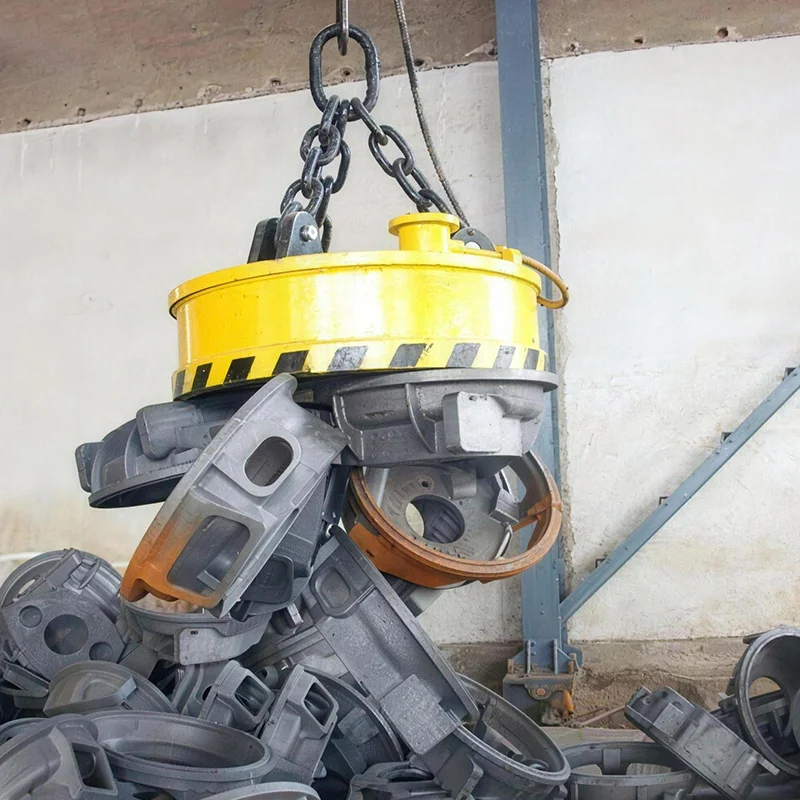
Magnet Design Determines Lifting Capacity
An excavator electromagnetic lifter's ability to lift scrap steel depends on its magnet design: the size, shape, and magnetic field strength of the electromagnet suspended from the excavator arm. The magnet's lifting capacity determines what kinds and quantities of scrap it can handle per cycle.
Magnet geometry for excavator-mounted lifters uses a circular flat electromagnet (typically 800–1,500 mm diameter) suspended from a chain or bracket under the excavator arm. The magnet consists of a steel casing with an internal coil of copper wire — when direct current (DC) flows through the coil, it creates a strong magnetic field that lifts ferrous (iron and steel) material. The bottom surface of the magnet is a flat steel faceplate that contacts the scrap material. The magnet's weight (typically 300–1,000 kg for a 20-ton excavator attachment) adds to the total load the excavator must lift.
Magnet diameter directly determines lifting capacity. An 800 mm diameter magnet on a 15-ton excavator lifts 300–600 kg of scrap steel per cycle (loosely piled, with varying density). A 1,200 mm diameter magnet on a 20–25 ton excavator lifts 600–1,200 kg per cycle. A 1,500 mm diameter magnet on a 30+ ton excavator lifts 1,000–2,000 kg per cycle. The actual lifted weight depends on scrap density — dense, compacted steel (clean I-beams, plate, bar) lifts near the theoretical maximum, while loose, fragmented scrap (shredded steel, mixed material) lifts less per cycle because air gaps reduce magnetic attraction.
Magnet face design affects performance on different scrap types. A flat-faced magnet (plain steel bottom) works well for clean, flat material (steel plate, sheet, flat bar) — the flat face maximizes contact area, maximizing magnetic attraction. A pole-teeth magnet (with raised poles protruding from the face) penetrates into loose, fragmented scrap — the teeth dig into the pile, contacting more individual pieces and lifting more per cycle. For mixed scrap yards (handling both flat plate and shredded material), a flat-faced magnet with optional pole extensions is the most versatile.
Power Supply and Control
An electromagnetic lifter requires a DC power supply — the excavator's hydraulic system drives a generator (alternator) that produces DC current for the magnet. The power supply and control system determine how quickly the magnet can turn on and off, and how consistently it holds its load.
Generator system — most excavator magnets use a hydraulic-driven generator (24–36 V DC, 300–600 A output) mounted on the excavator arm or body. The generator is driven by the excavator's auxiliary hydraulic circuit. The generator's output must match the magnet's power requirement — an undersized generator cannot provide enough current, causing weak magnetic attraction. An oversized generator wastes hydraulic power and generates excess heat. A typical 1,200 mm magnet requires a 5–8 kW generator — sufficient to produce a strong magnetic field without overloading the excavator's hydraulic system.
Control system — the operator controls the magnet from the excavator cab via a switch or joystick button. Pressing the switch energizes the magnet (lifts material); releasing it de-energizes the magnet (drops material). Quality systems include a fast-release function — when the switch is released, the generator briefly reverses polarity to demagnetize the magnet, ensuring all scrap drops cleanly (no material stuck to the magnet face). Without fast-release, residual magnetism can hold small pieces (nails, wire, fine scrap) to the magnet face, requiring the operator to manually knock them off between cycles. Fast-release also improves cycle time — the operator can dump material and immediately move to the next pile without waiting for residual magnetism to dissipate.
Cable and connectors — the electrical cable runs from the generator (on the excavator body) up the arm to the magnet. The cable must be flexible and durable — it moves with the excavator arm and is exposed to scrap metal, dirt, and weather. Quality systems use heavy-duty rubber-jacketed cable with strain relief at both ends. The cable connectors (between the arm-mounted segment and the magnet) should be waterproof and corrosion-resistant — a poor connector causes intermittent power loss, dropping the load unexpectedly.
Scrap Handling Productivity
An electromagnetic lifter's productivity is measured in tons of scrap moved per hour. This depends on magnet size, scrap density, and cycle time (time per lift-dump cycle).
A 1,200 mm magnet on a 20-ton excavator cycles (pick up, lift, swing, dump, return) in 15–25 seconds per cycle, depending on swing distance. At 20 seconds per cycle and 800 kg average load per cycle, the magnet moves 1,440 kg per minute — roughly 86 tons per hour of gross material movement. In practice, with positioning time and occasional cycles that lift less (loose, fragmented scrap), realistic productivity is 40–70 tons per hour. This is for loading scrap from a pile into a truck — the magnet swings from the pile to the truck, drops the load, and returns.
On a recent scrap yard operation, one contractor used a 1,200 mm electromagnetic lifter on a 22-ton excavator to load shredded scrap steel from a pile into 30-ton dump trucks. The scrap was shredded steel (car bodies, appliances, steel components) — loosely piled, mixed density. The contractor loaded an average of 4 trucks per hour (30 tons each), or roughly 120 tons per hour. The magnet cycled about 20 times per truck (1.5 tons per cycle on average), with a cycle time of about 18 seconds. The contractor estimated that using a grapple to load shredded scrap would have taken 8–10 hours to load the same volume — the magnet is faster because it picks up material from above without having to open and close a grapple. The magnet also reaches into the pile and grabs material from the bottom, which a grapple cannot do efficiently.
Maintenance That Prevents Coil and Cable Failure
Three components account for most electromagnetic lifter downtime. First, the magnet coil — the internal copper coil that creates the magnetic field is the heart of the magnet. Inspect the magnet casing monthly for cracks and damage — a cracked casing allows moisture and scrap debris to enter, damaging the coil. If the magnet loses lifting strength (lifts noticeably less than when new), the coil may be shorted or partially burned out — coil repair requires specialized rewinding, typically done by the magnet manufacturer. Keep the magnet casing painted to prevent rust — rust on the steel casing reduces magnetic efficiency. Inspect the magnet faceplate monthly for wear — a worn faceplate (less than 50 percent of original thickness) reduces magnetic flux to the material below. Replace the faceplate when worn through.
Second, the cable and connectors — inspect the electrical cable weekly for cuts, abrasion, and exposed wires. The cable runs alongside the excavator arm and is exposed to scrap metal and dirt. A damaged cable causes short circuits and power loss. Replace damaged cable sections promptly. Inspect cable connectors monthly for corrosion and tightness — a corroded connector causes intermittent power loss, dropping the load unexpectedly. Clean connectors with contact cleaner and tighten screws to the specified torque. Use cable guards (protective sleeves) where the cable passes near moving components — this prevents chafing and extends cable life.
Third, the generator and control system — inspect the generator monthly for belt tension and wear. Loose belts slip under load, reducing generator output and weakening the magnet. Replace belts as a set every 1,500 hours. Inspect the generator brushes (if serviceable) quarterly for wear — worn brushes cause inconsistent output. Check generator output voltage (using a multimeter at the magnet terminals) monthly — output should be within the manufacturer's specification (typically 24–36 V DC). Low output indicates worn brushes, weak generator, or a failing voltage regulator. Inspect the control switch and relay (in the cab) quarterly for proper operation — a failing switch causes intermittent magnet activation.
Choose magnet diameter for your scrap type and excavator size, ensure the generator matches the magnet's power requirement, and maintain the coil, cable, and generator religiously. That is the formula for an electromagnetic lifter that loads 120 tons of scrap per hour — and never drops a load unexpectedly.