

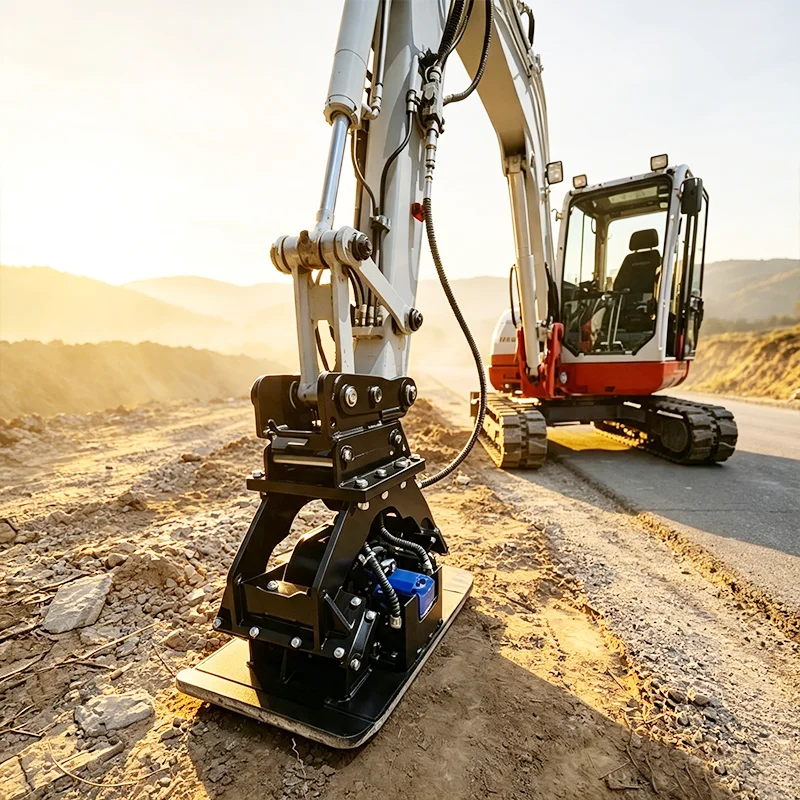
Plate Design Determines Compaction Coverage
An excavator plate compactor's effectiveness depends on its plate design: the size, shape, and mounting of the flat steel plate that vibrates against the soil. The plate must be large enough to cover adequate area per cycle, yet compact enough to fit in confined spaces.
Plate geometry for excavator compactors uses a flat steel plate (typically 600–1,000 mm square or rectangular) mounted to the bottom of a vibrating head. The plate is typically made from 10–20 mm thick steel plate, reinforced with ribs underneath to prevent flexing. The plate sits flat on the soil surface, and the vibrating head above it delivers high-frequency impacts (vibration frequency 2,000–3,000 RPM) that densify the soil below. The plate's weight (typically 100–300 kg for a 10–20 ton excavator attachment) provides static downward pressure, while the vibrating mechanism provides dynamic compaction force.
Plate size and shape affect coverage and access. A larger plate (800–1,000 mm square) covers more area per cycle, improving productivity on open areas. A smaller plate (600–700 mm square) provides better access to tight spaces — narrow trenches, around foundations, and alongside curbs. The plate's shape also matters: a square plate covers evenly in all directions, while a rectangular plate (narrower in one dimension) fits in narrower trenches. For general-purpose work (trenching, backfilling, around foundations), a 700×800 mm rectangular plate is the standard compromise — it fits in most utility trenches and covers adequate width for open-area work.
Plate wear and replaceability affect total cost of ownership. The bottom surface of the plate contacts the soil directly and wears gradually — after 500–1,000 hours of use, the plate bottom becomes concave (worn thinner at the center than at the edges). A worn plate does not sit flat on the soil, reducing compaction uniformity. Most excavator plate compactors use a replaceable wear plate (bolt-on, 10–15 mm thick) that takes the wear — when it wears through, you replace just the wear plate rather than the entire compactor frame. For high-abrasion work (compacting crushed rock and gravel), consider a hardened steel wear plate (40–45 HRC) that lasts 2–3 times longer than standard mild steel plate.
Impact Force and Soil Types
A plate compactor's effective compaction force depends on centrifugal force (generated by the vibrating mechanism), plate area, and soil type. Understanding these relationships helps estimate job costs and meet compaction specifications.
Centrifugal force (measured in kN) is the primary compaction mechanism. A typical plate compactor on a 15-ton excavator generates 10–25 kN of centrifugal force at 2,500–3,000 RPM. This force is distributed across the plate area (0.4–0.8 m²), producing a contact pressure of 15–40 kPa. This is sufficient to compact granular soils (sand, gravel, crushed rock) to 90–95 percent Proctor density in 3–5 passes at 150–200 mm lift thickness. For cohesive soils (clay, silt), the plate compactor is less effective — vibration alone does not break clay bonds as efficiently as kneading action. For clay, a sheepsfoot roller or padfoot drum compactor is preferred. The plate compactor handles mixed soils (sand and clay) adequately, but lift thickness must be reduced to 100–150 mm.
Compaction passes depend on soil type and required density. For granular soils requiring 90 percent Proctor density: 2–3 passes at 200 mm lift. For granular soils requiring 95 percent density: 4–6 passes at 150 mm lift. For mixed soils: 4–6 passes at 100–150 mm lift. The operator should overlap each pass by 50 percent (half the plate width) to ensure uniform compaction across the area. Overlapping prevents uncompacted strips between passes.
Vibration frequency affects which soil particle sizes compact most efficiently. Higher frequency (2,500–3,000 RPM) excites smaller particles (sand, silt), causing them to rearrange and densify. Lower frequency (1,500–2,000 RPM) excites larger particles (gravel, cobbles), causing them to settle. Most excavator plate compactors operate at a single fixed frequency (typically 2,500 RPM) that works well for mixed granular soils. For specialized work (compacting fine sand or coarse gravel), variable-frequency compactors are available — but they cost more and are rarely needed for general construction work.
Applications: Trenching and Around Foundations
The plate compactor's primary advantage is its ability to compact soil in tight, confined spaces — narrow trenches, around foundations, alongside curbs — where larger equipment cannot reach.
Narrow trench compaction — utility trenches are typically 0.6–1.0 m wide, too narrow for a walk-behind plate compactor (which is 0.5–0.7 m wide) and much too narrow for a roller. The excavator-mounted plate compactor lowers into the trench, vibrates the backfill soil in lifts, and achieves specified density. The plate (700×800 mm) fits easily in a 1.0 m wide trench, with room for the excavator arm to maneuver. This is faster and safer than hand-operated plate compactors (which require workers to be in the trench) and achieves better density consistency. A plate compactor on a 15-ton excavator compacts 20–40 meters of narrow trench per hour (at 0.8 m width, 150 mm lifts, 4 passes per lift).
Around foundations and structures — when backfilling around foundation walls, next to basement walls, or around pipe penetrations, a walk-behind compactor cannot get close enough without risking damage to the structure. The excavator-mounted plate compactor reaches under overhangs, alongside walls, and around obstructions, compacting soil in tight spaces. The operator controls the plate position precisely — the plate can be placed 50–100 mm from a foundation wall without striking it. This is critical for basement backfilling, where proper compaction next to the wall prevents future settlement and structural stress.
Pavement sub-base preparation — for small paving projects (driveways, sidewalks, parking lots), the plate compactor prepares the sub-base (gravel or crushed rock) to required density before asphalt or concrete is placed. A walk-behind plate compactor can handle small areas, but the excavator-mounted version is faster on larger areas (500–2,000 m²) and reaches under curbs and around drainage structures. The plate compactor also works well for repairing sub-base failures — compacting gravel under new pavement in localized areas where the old sub-base has settled.
Maintenance That Prevents Bearing and Hydraulic Failure
Three components account for most plate compactor downtime. First, the vibrating bearing — the bearing that supports the eccentric weight operates at 2,500–3,000 RPM under heavy vibration. Inspect weekly for play and temperature. A bearing that runs hot (over 75°C) or has excessive play needs immediate attention. Repack the vibrating bearing with fresh high-temperature grease every 40 hours of operation — plate compactors run hotter than drum compactors (higher frequency, smaller mass) and lose grease faster. Check bearing seals weekly for leakage. For heavy-duty use (more than 4 hours per day), consider sealed-for-life bearings that require no greasing.
Second, the wear plate — inspect the bottom wear plate weekly for thinning and deformation. A worn wear plate (less than 5 mm thickness remaining) flexes under impact, reducing compaction efficiency and accelerating frame fatigue. Replace the wear plate when worn to 30 percent of original thickness — it is bolt-on, taking 15–30 minutes to swap. Inspect the plate mounting bolts weekly for tightness — loose bolts allow the plate to vibrate excessively, causing frame cracks. Tighten bolts to the manufacturer's torque specification.
Third, the hydraulic motor and hoses — the motor that drives the eccentric weight operates under continuous load. Inspect weekly for oil leaks at the motor shaft. Check hydraulic oil temperature after 30 minutes of operation — if the oil temperature exceeds 80°C, the compactor may be consuming more flow than the excavator can supply. Match the compactor's required hydraulic flow to your excavator's auxiliary circuit. Inspect hydraulic hoses monthly for chafing — the hoses run near the vibrating plate, and rubbing can wear through the hose cover. Use protective sleeves on hoses where they pass near vibrating components.
Choose plate size for your trench width, match centrifugal force to your soil type and lift thickness, and maintain the vibrating bearing, wear plate, and hydraulic motor religiously. That is the formula for a plate compactor that compacts narrow trench backfill to 95 percent density — without workers entering the trench.