

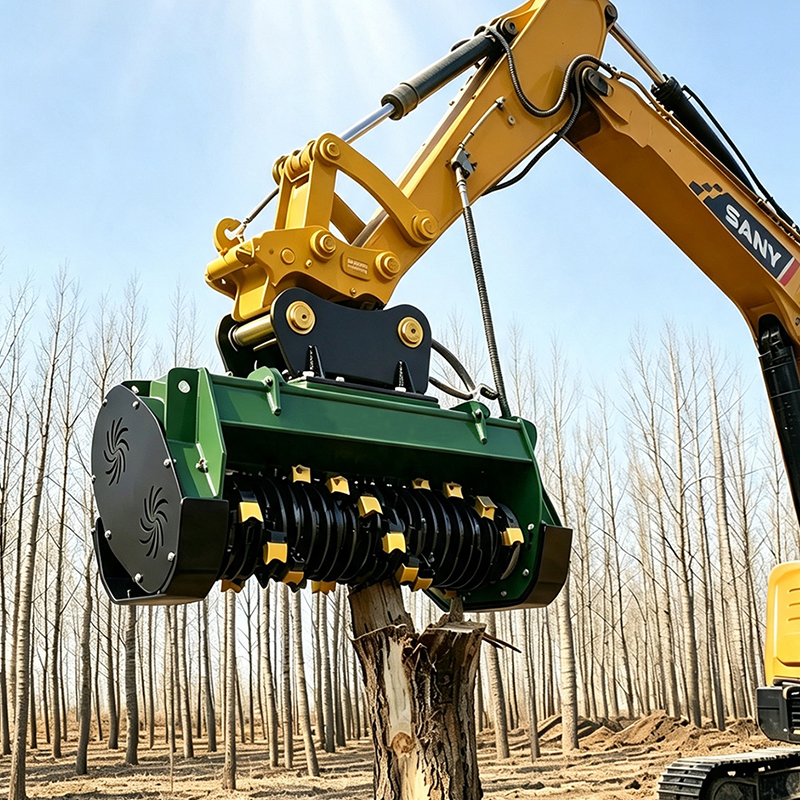
What Actually Determines Mulcher Production
Buyers ask about horsepower first. But on the job, a 120 hp mulcher matched to the right drum and hydraulic flow routinely outproduces a 150 hp machine that is mismatched. Three variables drive acre-per-hour output: drum tooth configuration, hydraulic flow and pressure matching, and terrain. Get any one wrong and you give up 30 to 50 percent of your potential production.
Drum Tooth Configuration: Three Options
Fixed chisel teeth — hardened steel (45–55 HRC) bolted in a helical pattern. Aggressive chopping action handles brush and trees up to 150 mm, leaving coarse 50–100 mm mulch. Lowest cost ($10–20 per tooth), but chips on rock. Best for clean soil and brush-heavy land.
Carbide-tipped teeth — tungsten carbide tips (88–92 HRA) stay sharp 3–5× longer in abrasive sandy or rocky ground. Slicing action produces finer 20–50 mm mulch. At $30–80 per tooth, the premium pays back in reduced downtime on high-production jobs. Best for trees 150–300 mm and abrasive soil.
Hammer flail teeth — individually pinned hammers that swing back on rock impact instead of breaking. Finest mulch (10–30 mm), but less aggressive on large trees. Best for rocky terrain, orchards, and anywhere fine mulch is desired as ground cover.
The Flow Matching Mistake
A mulcher runs on the excavator's auxiliary hydraulics. Most buyers confirm their flow falls within the mulcher's stated range — 80 to 150 L/min, for example — and assume that is sufficient. It is not. If your machine delivers 80 L/min while the mulcher is optimized for 120–150, drum speed drops 30–40 percent below target. Teeth stop cutting cleanly, the drum stalls in dense material, and you effectively run at half power.
Match the mulcher to the upper 60–70 percent of your flow range. With 100–150 L/min available, choose a mulcher optimized for 120–140. And verify pressure — most mulchers require 200–300 bar; an older circuit limited to 180 bar loses 20–40 percent torque at the drum.
Real Production Rates
A 20-ton excavator with a properly matched 700 mm carbide-tipped mulcher clears roughly 1 acre per hour on moderate brush — trees 50–100 mm, gentle terrain. Dense vine cover or 100–150 mm trees halves that to 0.5 acre per hour. Rocky ground requires lighter skim passes to avoid tooth damage, reducing output further.
On a recent 15-acre residential clearing, one operator finished in two days — 8 acres the first day, 7 the second — at $3,500 rental cost, versus a quoted $12,000 for bulldozing, hauling, and landfill. Mulch left on site served as ground cover, saving an additional $1,500 in erosion control.
Maintenance That Determines Service Life
Three habits separate a mulcher that lasts 3,000 hours from one that fails at 500. First, inspect teeth daily and replace any chipped or missing tooth immediately — a missing tooth unbalances the drum and accelerates bearing failure. Second, keep the radiator and hydraulic oil cooler clear of wood dust; overheating is the leading cause of hydraulic motor failure. Third, at 100 hours replace all teeth as a set and inspect drum bearings; at 500 hours plan for a full overhaul including bearings, motor seals, hoses, and drum inspection.
Match the drum to your vegetation, match the flow to your excavator, and keep up with daily tooth checks. That is the formula for a mulcher that pays for itself in one clearing season.