

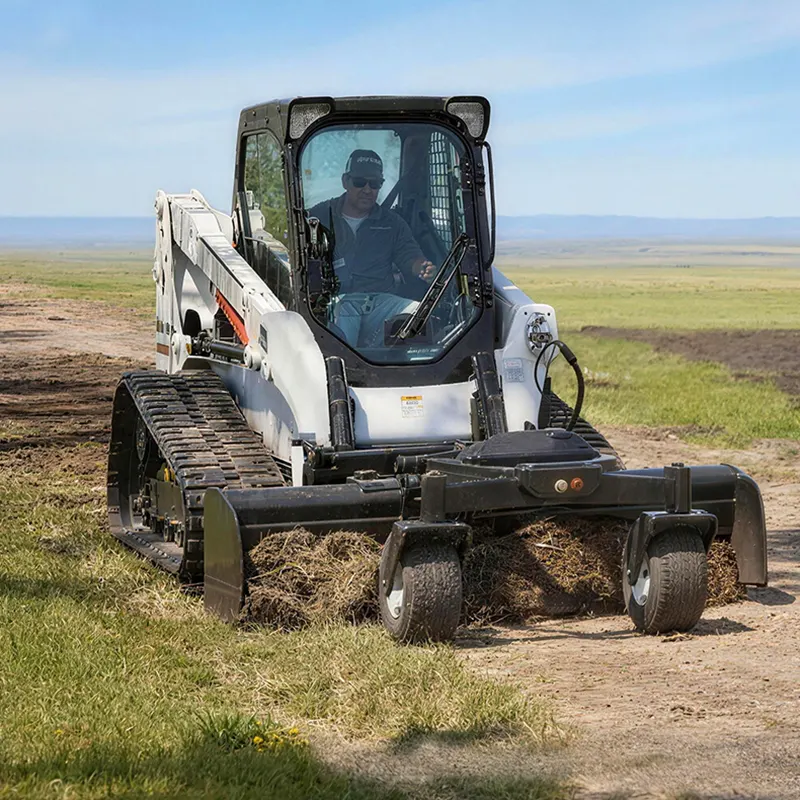
Blade Angle and Cutting Depth Determine Grading Precision
A soil leveler's ability to produce a flat, uniform surface depends on two interrelated variables: blade angle and cutting depth. Get either one wrong and you will either leave high spots untouched or dig too deep, creating a wavy surface that requires multiple passes to correct. The right combination lets an experienced operator grade to within 2–3 cm of target elevation in a single pass — accuracy that directly affects irrigation efficiency, drainage, and construction quality.
Blade angle refers to the angle at which the cutting edge meets the soil. A steeper angle (more vertical) cuts more aggressively, removing high spots faster but also more likely to dig in unexpectedly in soft soil. A shallower angle (more horizontal) skims the surface, removing less material per pass but providing finer control for finish grading. Most levelers operate at a blade angle of 45–60 degrees from horizontal for general grading work. For rough grading in uneven terrain, a steeper angle (60–75 degrees) removes material faster. For finish grading to tight tolerances, a shallower angle (30–45 degrees) provides the fine control needed.
Cutting depth is controlled by the operator through the excavator's arm and boom movements. The key is consistency — maintaining a uniform cutting depth across the entire grading area. Inconsistent depth is the most common cause of wavy, uneven surfaces. An experienced operator uses the excavator's boom and arm in a coordinated motion to maintain constant blade depth, while the leveler's own weight and the excavator's downforce provide the cutting pressure. For most soil types, a cutting depth of 2–5 cm per pass is optimal for finish grading. For rough grading of heavily uneven terrain, depths of 5–15 cm per pass may be necessary, but this requires more skill to maintain consistency.
Fixed vs Adjustable Angle: Matching Design to the Job
Soil levelers come in two main configurations: fixed-angle and adjustable-angle. The choice depends on the variety of grading work you do and the precision required.
Fixed-angle levelers have the blade welded or bolted at a set angle, typically 45–55 degrees from horizontal. They are simpler, less expensive, and more rigid — no moving parts means less maintenance and fewer failure points. The fixed angle works well for general-purpose grading where the soil type and grading requirements are consistent. The downside: you cannot adjust the angle for different soil conditions or grading stages. If you primarily grade one type of soil (e.g., loam for farmland) at one stage (e.g., finish grading), a fixed-angle leveler is sufficient and offers better value.
Adjustable-angle levelers use a hydraulic cylinder or manual pin adjustment to change the blade angle, typically ranging from 30 to 75 degrees from horizontal. This versatility lets one attachment handle both rough grading (steep angle, fast material removal) and finish grading (shallow angle, fine control) with a single machine. Adjustable-angle levelers are also better for varying soil types — you can steepen the angle for hard, compacted soil and shallow it for soft, loose soil. The downsides: cost (30–50 percent more than fixed-angle), complexity (hydraulic cylinder, hoses, pivot points), and potential for angle drift under load if the locking mechanism is not robust. For contractors who handle a variety of grading work — farmland one week, building pads the next, road shoulders the week after — an adjustable-angle leveler is worth the extra investment.
Some levelers also offer side tilt (also called "angle tilt" or "cross slope") adjustment, which allows the blade to tilt left or right to create cross slopes for drainage. This is particularly useful for road construction, where a 2–3 percent cross slope is needed for water runoff, and for farmland grading where surface drainage is critical. Side tilt adds another layer of complexity and cost, but for road and drainage work it is often essential.
Laser and Slope Control: Automation for Consistent Grades
For high-precision grading work — building pads, sports fields, golf courses, and precision farmland leveling — manual depth control may not be sufficient. Laser and slope control systems automate the blade height, maintaining a consistent grade across the entire working area with minimal operator input.
Laser grading systems use a rotating laser transmitter set up at a known elevation, and a laser receiver mounted on the leveler blade. The receiver detects the laser plane and sends signals to a hydraulic control valve that automatically raises or lowers the blade to maintain the target elevation. Laser systems can maintain grade to within 1–2 cm across the entire working area, far more consistent than manual control. They are particularly useful for large, flat areas — building pads, parking lots, sports fields — where consistent elevation is critical. The setup time is 15–30 minutes per job site, and the system requires line-of-sight between the transmitter and receiver (trees, buildings, or terrain can block the signal).
Slope control systems (also called "sonic" or "ultrasonic" systems) use ultrasonic sensors mounted on the blade to measure distance to a reference surface — typically the already-graded ground or a string line. The system automatically adjusts blade height to maintain a consistent slope relative to the reference. Slope control is useful for road construction (maintaining a consistent cross slope) and for contour grading (following existing terrain at a consistent offset). Unlike laser systems, slope control does not require line-of-sight, making it better for work in obstructed areas or on curved alignments.
Both laser and slope control systems require a hydraulic control valve on the leveler (or excavator) that can automatically adjust blade height. Most modern excavator-mounted levelers can be retrofitted with these systems, but the installation cost ($3,000–$8,000 for the control valve and receiver) should be factored into the purchase decision. For contractors doing high-precision grading work regularly, the productivity gain (20–40 percent faster grading with fewer rework passes) typically pays for the system within one season.
Production Rates and Real-World Expectations
A properly matched soil leveler on a 15–20 ton excavator, grading farmland to a 2–3 cm tolerance, achieves 1,500–3,000 m² per hour — roughly one hectare (10,000 m²) in 4–7 hours of actual grading time. This includes rough grading (removing high spots and filling low spots) and finish grading (final smoothing to tolerance). For construction site grading (building pads, parking lots) to a 1–2 cm tolerance, production drops to 800–1,500 m² per hour because the tighter tolerance requires more passes and finer control. For road shoulder and drainage grading (where a consistent cross slope is more important than absolute elevation), production can reach 2,000–4,000 m² per hour.
On a recent farmland leveling project, one contractor using a 20-ton excavator with an adjustable-angle leveler graded 12 hectares of uneven farmland (elevation variation of 15–20 cm across the field) to a uniform 2 cm tolerance in 5 working days — roughly 2.4 hectares per day, or about 3,000 m² per hour over an 8-hour shift. The project included rough grading (removing 10–15 cm from high spots and filling low spots), finish grading, and final compaction. The contractor estimated that using a standard excavator bucket for the same work would have taken 10+ days, because the bucket cannot maintain a consistent cutting depth and requires multiple passes to achieve a flat surface.
The leveler's key advantage over a standard bucket is consistency: the wide blade (typically 2–3 m wide) covers a large area per pass, and the fixed or adjustable blade angle maintains a consistent cutting depth. A standard bucket, by contrast, has a narrow cutting edge (0.5–1 m) and relies entirely on operator skill to maintain depth — even an experienced operator will produce a slightly wavy surface that requires additional passes to correct.
Maintenance That Prevents Blade and Pivot Failure
Three components account for most soil leveler downtime. First, the cutting edge — the hardened steel strip along the bottom of the blade that actually cuts the soil. Inspect daily for wear, cracks, or missing bolts. A worn cutting edge (less than 50 percent of original thickness) does not cut cleanly, causing the blade to ride over high spots instead of removing them. A cracked or broken cutting edge can damage the blade body if not replaced promptly. Replace the cutting edge when worn to 50 percent of original thickness — continuing to use a worn edge increases grading time and may cause the blade to "chatter" (vibrate) across the surface, creating a rippled finish. Cutting edges are typically bolted on for easy replacement, and most levelers use standard sizes that are readily available.
Second, pivot pins and bushings — the pins that connect the leveler frame to the excavator arm and (for adjustable-angle models) the blade angle pivot operate under constant load and movement. Inspect weekly for wear — try to move the blade side to side; any play beyond 1 mm indicates pin or bushing wear. A worn pivot allows the blade to misalign, causing uneven grading and accelerated wear on the cutting edge. Replace worn pins and bushings promptly. Pivot pins should be greased daily (2–3 pumps per pin) using a high-pressure grease rated for heavy loads and wet, dirty conditions. The angle adjustment pivot (on adjustable-angle models) should be greased after every angle change to prevent binding.
Third, the blade body and moldboard — the main structural component that holds the cutting edge and directs the cut soil. Inspect weekly for cracks, bends, or excessive wear, particularly at the weld joints where the blade attaches to the frame. A cracked blade can fail catastrophically under load, potentially causing the leveler to separate from the excavator. A bent blade produces uneven grading and may cause the cutting edge to wear unevenly. Replace or repair a cracked or severely bent blade immediately — do not attempt to weld a cracked blade in the field, as the weld may not hold under the constant stress of grading work. Minor surface rust can be wire-brushed and painted, but structural cracks require professional repair or replacement.
Match blade angle and cutting depth to your grading tolerance, choose fixed or adjustable angle based on job variety, consider laser or slope control for high-precision work, and maintain the cutting edge, pivots, and blade body religiously. That is the formula for a soil leveler that grades 3,000 m² an hour to 2 cm tolerance — and lasts 4,000 hours instead of 800.