

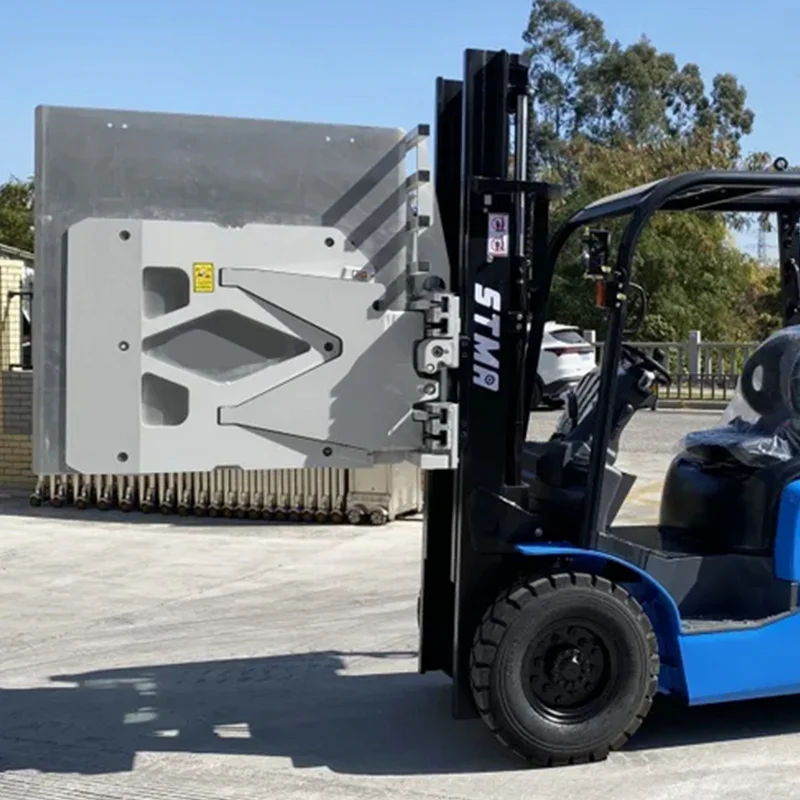
Clamping Force Is the Difference Between Damage and Disaster
A carton clamp looks simple — two pads that squeeze a load of boxes and lift it. But the clamping force is the most critical parameter, and getting it wrong causes either crushed boxes or dropped loads. Too much force and the clamp crushes the cartons, damaging the product inside and creating costly claims. Too little force and the load slips, potentially dropping hundreds of kilograms of product from several meters height — a serious safety hazard.
The optimal clamping force depends on three factors: load weight, coefficient of friction between the pad and the carton, and acceleration/deceleration during handling. As a rule of thumb, the clamp must generate enough friction force to hold 1.5–2 times the load weight under maximum acceleration. For a 1,000 kg load of boxes with a rubber pad (coefficient of friction 0.6–0.8), the required clamping force is roughly 2,000–3,000 kg. For the same load with a polyurethane pad (coefficient 0.4–0.6), the required force is 3,000–5,000 kg.
Most carton clamps offer adjustable clamping force through a pressure relief valve or a force control valve. The operator or maintenance technician sets the maximum clamping pressure based on the typical load weight and pad material. A well-adjusted clamp handles 95 percent of loads without damage or slippage. A poorly adjusted clamp either crushes every load or drops one eventually. The key is to set the clamping force for the heaviest, most slippery load you handle, then use the clamp's proportional control to apply less force for lighter, more fragile loads.
Some advanced clamps offer automatic force control — a sensor measures the load weight (through hydraulic pressure in the lift circuit) and automatically adjusts clamping force to match. Automatic force control eliminates operator error and reduces product damage by 30–50 percent compared to manual force adjustment. The system adds $1,000–3,000 to the clamp cost but pays for itself in reduced damage claims within 6–12 months in high-throughput operations.
Pad Material: Rubber vs Polyurethane vs Specialized Coatings
The clamp pads are the only point of contact between the clamp and the load, and their material determines both friction (holding power) and damage potential (marking or crushing the carton). Three pad materials dominate the market.
Rubber pads — the most common pad material, made from natural or synthetic rubber (typically 60–70 Shore A hardness). Rubber pads offer the highest coefficient of friction (0.6–0.8) against corrugated cardboard, providing excellent holding power with relatively low clamping force. Rubber is also gentle on cartons, minimizing marking and crushing. The downsides: rubber wears relatively quickly (500–1,500 hours in high-throughput operations), especially when handling abrasive loads or rough cartons. Rubber also degrades over time from UV exposure, ozone, and oil contamination, becoming hard and brittle. Rubber pads are the best choice for general carton handling — appliances, food and beverage, consumer goods — where holding power and carton protection are both important.
Polyurethane pads — made from cast or extruded polyurethane (typically 80–95 Shore A hardness). Polyurethane pads are more durable than rubber, lasting 2,000–4,000 hours in similar conditions. They are also more resistant to oil, grease, and chemical contamination, making them suitable for industrial environments where rubber would degrade rapidly. The downsides: polyurethane has a lower coefficient of friction (0.4–0.6) against cardboard, requiring 30–50 percent more clamping force to hold the same load. The higher force increases the risk of carton crushing, especially with fragile loads. Polyurethane pads are also more likely to mark or scuff cartons, especially when the load shifts during handling. Polyurethane pads are the best choice for heavy, durable loads — building materials, industrial parts, bottled beverages in shrink wrap — where durability and oil resistance matter more than maximum friction.
Specialized coatings — some clamps offer pads with specialized surface coatings designed for specific applications. Diamond-textured rubber pads have a raised pattern that increases friction by 10–20 percent compared to smooth rubber, useful for slippery loads like plastic-wrapped pallets or glazed cartons. Non-marking rubber pads use a special compound that does not leave black marks on white or light-colored cartons, essential for food and pharmaceutical products where appearance matters. Felt-backed pads have a soft felt layer that provides maximum carton protection for fragile loads like electronics or glassware, at the cost of reduced friction and durability. Specialized coatings add 20–50 percent to pad cost but are essential for specific applications where standard rubber or polyurethane would cause damage.
Pad replacement is a routine maintenance task — worn pads (less than 50 percent of original thickness) reduce friction and increase clamping force requirements, accelerating wear on the clamp frame and hydraulic system. Replace pads before they wear through to the backing plate — a backing plate contacting the carton causes severe damage and can scratch or score the load.
Hydraulic Configuration: Single vs Double Acting, Proportional Control
A carton clamp's performance depends on the forklift's hydraulic system, and the configuration determines both handling speed and control precision.
Single-acting clamp — one hydraulic line provides pressure to close the clamp, and a spring opens it when pressure is released. Single-acting clamps are simple and inexpensive but have significant limitations: the opening speed is determined by spring force, which may be slow or inconsistent, especially with heavy pads. More importantly, single-acting clamps cannot actively hold the load — if hydraulic pressure is lost (e.g., a hose failure), the spring opens the clamp and drops the load. Single-acting clamps are suitable only for light-duty, low-height applications where load drop risk is minimal.
Double-acting clamp — two hydraulic lines provide pressure to both close and open the clamp, giving the operator full control over clamping and opening speed. Double-acting clamps also provide positive load holding — even if hydraulic pressure is lost, the clamp remains closed (the oil is trapped in the close circuit by a check valve), preventing load drop. Double-acting is the standard for most carton clamp applications, providing safety, control, and speed. Double-acting requires a fourth hydraulic function on the forklift (beyond lift, tilt, and side shift) — either a dedicated fourth valve or a diverter valve.
Proportional control — a proportional hydraulic valve allows the operator to modulate clamping force and speed continuously, rather than just open/close. With proportional control, the operator can apply gentle clamping force for fragile loads (e.g., a stack of empty cartons) and full force for heavy, dense loads (e.g., a stack of canned goods), all from the same control lever. Proportional control reduces product damage by 20–40 percent compared to on/off control, because the operator can "feather" the clamp to find the minimum force needed to hold the load. Proportional control also reduces cycle time by allowing faster opening and closing when handling uniform loads. A proportional valve adds $500–1,500 to the clamp cost but is standard on most modern carton clamps and highly recommended for any high-throughput operation.
Hydraulic flow determines clamp closing/opening speed. A typical carton clamp requires 20–50 L/min at 150–250 bar. Most forklifts' auxiliary circuits deliver 30–80 L/min, which is sufficient. However, if the auxiliary circuit is shared with other attachments (e.g., a side shifter), the available flow may be reduced, slowing clamp operation. A dedicated hydraulic circuit with a priority valve ensures consistent flow to the clamp regardless of other functions — important for high-throughput operations where clamp speed directly affects cycle time.
Production Impact and Damage Reduction
Carton clamps are one of the highest-ROI attachments in warehouse operations, but the ROI comes primarily from damage reduction rather than labor savings. In a typical distribution center handling cartoned goods, product damage from forklift handling costs 1–3 percent of annual sales — for a $50 million operation, that is $500,000–1.5 million per year. A carton clamp, properly adjusted and operated, can reduce handling damage by 50–80 percent, saving $250,000–1.2 million per year.
The damage reduction comes from three factors. First, the clamp distributes clamping force across the entire load face, rather than concentrating force at two fork points (as with fork-through handling). This eliminates fork punctures and corner damage, which account for 40–60 percent of carton handling damage. Second, the clamp holds the load securely, eliminating load shift and collapse during transport — a common cause of damage when handling tall or unstable stacks of cartons. Third, the clamp allows the operator to handle loads without pallets, eliminating pallet-related damage (broken boards, nails, splinters) and reducing the need for pallet exchange and repair.
Labor savings are also significant. A carton clamp allows one operator to handle a full stack of cartons (up to 2,000 kg) in one move, rather than requiring multiple fork moves or manual handling. In a typical beverage distribution center, a clamp-equipped forklift handles 30–50 percent more loads per shift than a standard forklift, because the clamp can handle full stacks without pallets and does not require the operator to align forks with pallet pockets. At 100 loads per shift, that is 30–50 additional loads handled — roughly $100–200 per shift in labor savings, or $25,000–50,000 per year per forklift.
The key to maximizing ROI is proper training and adjustment. A carton clamp is only as good as the operator using it — an untrained operator using excessive clamping force can cause more damage than a standard forklift. Invest in operator training (4–8 hours of hands-on instruction), set the clamping force correctly for your typical loads, and inspect pads and hydraulic system weekly. A well-maintained, well-operated carton clamp pays for itself in 3–6 months and delivers years of damage-free handling.
Maintenance That Prevents Pad and Frame Failure
Three components account for most carton clamp downtime. First, clamp pads — inspect weekly for wear, damage, and contamination. Pads worn below 50 percent of original thickness reduce friction and increase clamping force requirements, accelerating wear on the frame and hydraulic system. Replace pads before they wear through to the backing plate. Clean pads daily with a damp cloth — accumulated dust, cardboard fibers, and product residue reduce friction and can mark cartons. Check pad mounting bolts weekly — loose bolts allow the pad to shift, causing uneven clamping and potential load drop. Torque pad bolts to the manufacturer's specification (typically 80–120 Nm).
Second, clamp frame and arms — the frame and arms that support the pads operate under high clamping force and frequent cycling. Inspect the frame monthly for cracks, especially at weld joints and stress concentration points (arm pivots, pad mounting brackets). A cracked frame can fail catastrophically under load, dropping the load and potentially injuring the operator or bystanders. If cracks are found, stop using the clamp immediately and have it repaired by a qualified welding shop — do not attempt a temporary repair. Inspect arm pivot pins and bushings monthly for wear — excessive play (more than 1 mm) allows the arms to misalign, causing uneven clamping and accelerated pad wear. Replace worn pins and bushings promptly.
Third, hydraulic system — the hydraulic cylinders, hoses, and valves that control clamping force and movement. Inspect hydraulic cylinders weekly for rod damage (scoring, pitting, chrome plating wear) and seal leakage. A damaged cylinder rod will destroy the rod seal in hours, causing hydraulic fluid leakage and loss of clamping force. Replace a damaged cylinder immediately. Inspect hydraulic hoses weekly for abrasion, kinks, or leaks — the hoses to the clamp flex with every arm movement and clamp cycle, accelerating wear. Replace all clamp hoses as a set every 2,000 hours, even if they look intact. Check the clamping pressure relief valve monthly — verify that the maximum clamping pressure is set correctly for your typical loads. An incorrectly set relief valve (too high or too low) is the most common cause of carton damage or load drop.
Set clamping force correctly for your loads, choose the right pad material, use double-acting hydraulic with proportional control, and inspect pads, frame, and hydraulics weekly. That is the formula for a carton clamp that handles 100 loads per shift without damage — and lasts 10,000 hours instead of 2,000.