

Continuous Rotation vs 360-Degree: What You Actually Need
Fork rotators are among the most misunderstood forklift attachments. Buyers often assume "more rotation is better" and pay a premium for continuous 360-degree rotation when a 180-degree or 270-degree rotator would serve their application just as well — at lower cost, lower weight, and higher load capacity.
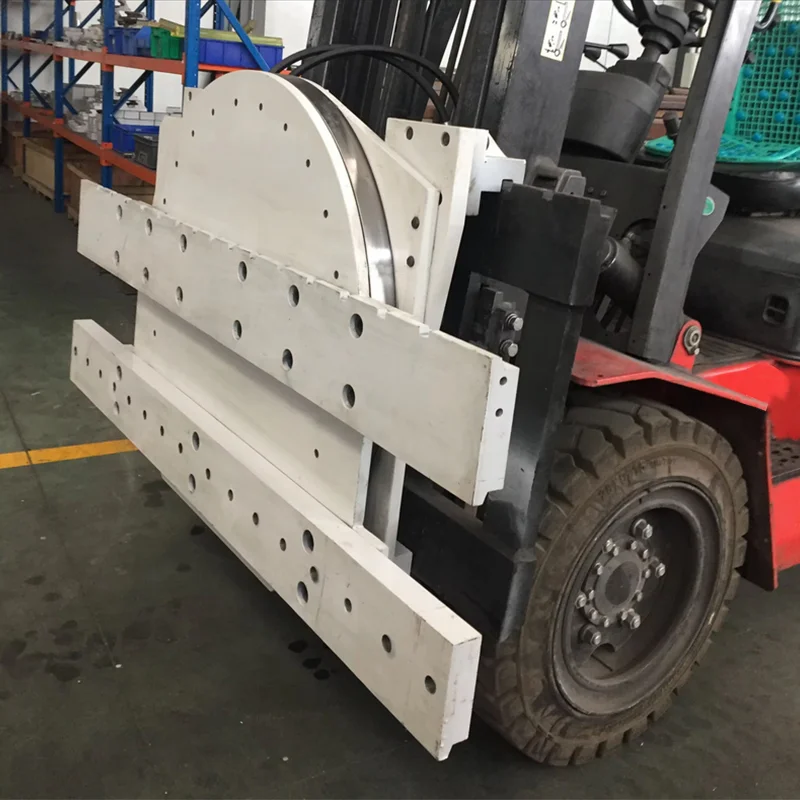
Continuous 360-degree rotation — the rotator can spin indefinitely in either direction, powered by a hydraulic motor driving a pinion gear that engages a slew ring (also called a turntable bearing). Continuous rotation is essential for applications where the load must be dumped or emptied — for example, rotating a bin or hopper to discharge contents, or inverting a container to remove parts. The slew ring provides smooth, continuous rotation with no dead spots. The downsides: cost (30–50 percent more than a limited-rotation rotator), weight (the slew ring and pinion gear add 50–100 kg), and reduced load capacity (the extra weight reduces the forklift's residual capacity by 10–20 percent). Continuous rotation also requires a hydraulic motor and valve, adding complexity and maintenance points.
Limited rotation (180 or 270 degrees) — the rotator uses hydraulic cylinders driving a rack-and-pinion or crank mechanism to rotate the fork carriage through a fixed arc. Limited rotation is sufficient for most handling applications — rotating a pallet to align with a conveyor, turning a load for better access, or repositioning forks without moving the forklift. The advantages: lower cost (30–50 percent less than continuous rotation), lighter weight (50–100 kg less), and higher residual load capacity (10–20 percent more than continuous rotation at the same load center). The downside: limited rotation means the operator must plan ahead — if the load needs to rotate more than 180 or 270 degrees, the operator must reposition the forklift or manually reorient the load. For applications that only require occasional rotation (aligning pallets, repositioning loads), limited rotation is the more efficient choice.
The decision comes down to one question: do you need to dump or empty the load? If yes, continuous 360-degree rotation is required. If no — if you only need to rotate the load for positioning or alignment — a limited-rotation rotator is the better value, offering higher load capacity and lower cost with sufficient rotation for most handling tasks.
Load Center Matching: The Mistake That Causes Tip-Overs
Every forklift has a rated load capacity at a specified load center — typically 500 mm from the fork heel (the point where the fork meets the carriage). When you add a rotator, the load center increases because the rotator adds distance between the fork heel and the load. A typical rotator adds 150–250 mm to the load center, moving it from 500 mm to 650–750 mm. This increase reduces the forklift's residual capacity significantly — often by 20–40 percent.
For example, a 3,000 kg forklift rated at 500 mm load center may have only 2,000–2,400 kg residual capacity with a rotator at 700 mm load center. If the operator assumes the forklift can still lift 3,000 kg and attempts to lift a 2,800 kg load with the rotator, the forklift may tip forward — a serious safety hazard that can cause injury, equipment damage, and load destruction.
The correct approach is to calculate residual capacity before purchasing or using a rotator. Every forklift has a load capacity chart (also called a data plate or nameplate) that shows rated capacity at various load centers and lift heights. Find the capacity at the rotator's effective load center (original load center plus rotator thickness) and at the maximum lift height you will use. That is your actual working capacity — not the number on the forklift's door. Operators must be trained to understand that adding an attachment changes the forklift's capacity, and they must respect the reduced limit.
Some rotator manufacturers offer "low-profile" designs that minimize the added load center — typically 100–150 mm instead of 150–250 mm. Low-profile rotators cost 10–20 percent more but preserve 10–15 percent more residual capacity, which can be the difference between safely handling a load and tipping. If your forklift is already near its capacity limit with standard forks, a low-profile rotator is worth the extra investment.
Hydraulic Configuration: Single vs Double Acting, Flow and Valve Requirements
A rotator's performance depends on the forklift's hydraulic system. Two configurations are common, and choosing the wrong one results in slow, jerky rotation or inability to hold position under load.
Single-acting rotation — one hydraulic line provides pressure to rotate in one direction, and a spring or gravity returns the rotator to center. Single-acting is simple and inexpensive but only rotates in one direction under power — the return stroke is unpowered and may be slow or inconsistent, especially under load. Single-acting is suitable only for light-duty, infrequent rotation where precise control is not required.
Double-acting rotation — two hydraulic lines provide pressure to rotate in both directions, giving the operator full control over rotation speed and direction. Double-acting is the standard for most rotator applications, providing smooth, controlled rotation in both directions under load. Double-acting requires a fourth hydraulic function on the forklift (beyond lift, tilt, and side shift) — either a dedicated fourth valve or a diverter valve that shares an existing function. If your forklift does not have a fourth hydraulic function, adding one costs $500–1,500 for parts and installation. A diverter valve is cheaper ($200–500) but means you cannot use the diverted function (e.g., side shift) while rotating — an inconvenience in high-throughput operations.
Hydraulic flow determines rotation speed. A typical rotator requires 20–60 L/min at 150–250 bar. Most forklifts' auxiliary circuits deliver 30–80 L/min, which is sufficient for most rotators. However, if the auxiliary circuit is shared with other attachments (e.g., a side shifter or fork positioner), the available flow may be reduced, slowing rotation. A dedicated hydraulic circuit with a priority valve ensures consistent flow to the rotator regardless of other functions — important for high-throughput operations where rotation speed directly affects cycle time.
Rotation speed is typically 5–15 RPM (revolutions per minute) for continuous rotators, or 2–5 seconds for a full 180-degree rotation on limited-rotation models. Faster rotation reduces cycle time but increases the risk of load swing and instability — especially with tall or unstable loads. Most operators find 8–10 RPM (continuous) or 3–4 seconds (180-degree) to be the optimal balance of speed and control. A flow control valve (also called a speed regulator) allows the operator to adjust rotation speed to match the load and application — fast for stable, low loads, slow for tall or unstable loads.
Production Impact and Real-World ROI
A fork rotator is one of the few attachments that can pay for itself in under a year — but only in the right application. The ROI comes from reduced cycle time, reduced labor, and reduced product damage.
In a typical warehouse or distribution center, a rotator can reduce load handling time by 30–50 percent compared to manual repositioning. For example, rotating a pallet to align with a conveyor or racking takes 5–10 seconds with a rotator, versus 30–60 seconds for the operator to dismount, manually reposition the load, and remount. At 100 pallet moves per shift, that is 40–80 minutes saved per shift — roughly 10–15 percent of an 8-hour shift. At $25/hour operator cost, that is $100–200 per shift, or $25,000–50,000 per year (250 working days). A rotator costs $3,000–8,000 installed, giving a payback period of 1–4 months in high-throughput operations.
In manufacturing and assembly, rotators reduce product damage by allowing precise, controlled rotation of fragile or awkward loads. A parts bin that must be inverted to access components can be rotated smoothly with a rotator, eliminating the risk of dropping or damaging parts during manual handling. In one automotive parts warehouse, installing rotators on three forklifts reduced product damage claims by 60 percent — saving $15,000 per year in replacement costs, in addition to the labor savings.
The key is to match the rotator to the application. A continuous 360-degree rotator is overkill for pallet positioning — a limited-rotation model costs less and offers higher capacity. A limited-rotation rotator is inadequate for bin dumping — a continuous model is required. Choosing the right rotator for the job maximizes ROI and avoids the frustration of an attachment that does not do what you need.
Maintenance That Prevents Gearbox and Slew Bearing Failure
Three components account for most rotator downtime. First, slew bearing (continuous rotation models) — the large turntable bearing that supports the rotating carriage and transmits the full load. The slew bearing is the most expensive component on a continuous rotator ($1,000–3,000 to replace), and its life depends entirely on lubrication. Grease the slew bearing daily before operation (5–10 pumps through the grease fitting), using a high-pressure grease rated for heavy loads and slow rotation. Inspect the slew ring monthly for play — grab the fork carriage and try to move it side to side; any play beyond 1 mm indicates bearing wear. A worn slew bearing allows the carriage to wobble, accelerating gear wear and creating a safety hazard. Replace the slew bearing at the first sign of play — continuing to use a worn bearing can cause catastrophic failure under load.
Second, hydraulic motor and pinion gear (continuous rotation models) — the hydraulic motor drives a pinion gear that engages the slew ring's internal gear teeth. Inspect the pinion gear monthly for wear — the teeth should be sharp and well-defined, not rounded or chipped. A worn pinion gear causes jerky rotation and accelerates slew ring gear wear. Replace the pinion gear when tooth wear exceeds 20 percent of original tooth height. Check the hydraulic motor for leaks weekly — a leaking shaft seal allows oil to contaminate the gearbox and slew bearing, accelerating wear. Replace the motor seal at the first sign of leakage.
Third, hydraulic cylinders and hoses (limited-rotation models) — the cylinders that drive the rack-and-pinion or crank mechanism operate under high pressure and frequent cycling. Inspect cylinder rods weekly for scoring, pitting, or chrome plating damage — a damaged rod score will destroy the rod seal in hours, causing hydraulic fluid leakage and loss of rotation force. Replace a damaged cylinder immediately. Inspect hydraulic hoses weekly for abrasion, kinks, or leaks — the hoses to the rotator flex with every carriage movement and rotate continuously, accelerating wear. Replace all rotator hoses as a set every 2,000 hours, even if they look intact.
Match rotation type to your application, calculate residual capacity before lifting, ensure adequate hydraulic flow and valve configuration, and lubricate the slew bearing or inspect cylinders daily. That is the formula for a rotator that handles 100 loads per shift without downtime — and lasts 10,000 hours instead of 2,000.