

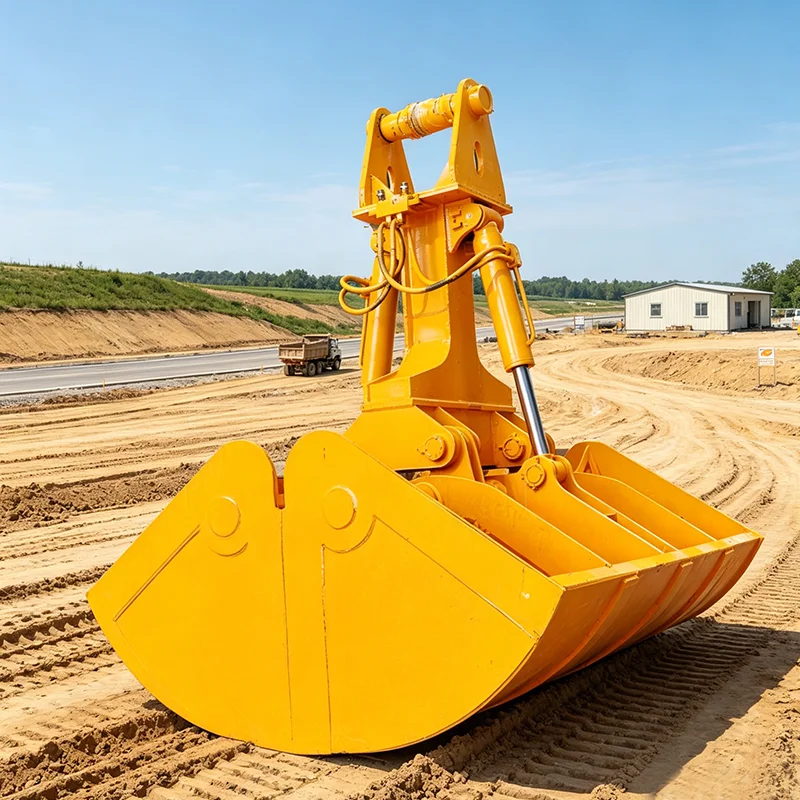
When a Standard Bucket Cannot Dig Straight Down
A standard excavator bucket digs by curling — the bucket rotates as it fills, following an arc rather than a vertical path. This works for most excavation tasks — digging trenches, basements, and slopes — but it cannot dig a straight vertical shaft. When you need to excavate a deep, narrow hole — a foundation pier, a caisson, a shaft, or a deep utility pit — a standard bucket cannot reach the bottom without also widening the top. The result is a funnel-shaped hole that requires more material removal, more shoring, and more concrete to fill.
A clamshell bucket (also called a grab bucket or shell bucket) solves this problem. It consists of two half-shells that open and close vertically, like a clamshell. The bucket is lowered into the hole with the shells open, then the shells close to grab a load of material, which is lifted vertically out of the hole. Because the shells open and close vertically rather than curling, the clamshell can dig a straight vertical shaft with minimal over-excavation at the top. For deep foundation work, this is not a convenience — it is a necessity.
Clamshell buckets are available in two main configurations: single-cylinder (also called center-pivot) and double-cylinder (also called independent-shell). The choice depends on the application, the material being excavated, and the required grab force.
Single Cylinder vs Double Cylinder: Grab Force and Design Tradeoffs
Single-cylinder clamshell — one hydraulic cylinder mounted in the center of the bucket, connected to both shells through a pivot mechanism. When the cylinder extends, both shells close simultaneously; when it retracts, both shells open. Single-cylinder design is simpler and less expensive — fewer components, fewer hydraulic lines, lower maintenance. The center pivot ensures that both shells close with equal force, providing balanced grabbing. The downsides: the single cylinder must provide all the closing force, which limits maximum grab force for a given cylinder size. The center pivot also occupies space in the middle of the bucket, reducing the effective bucket volume by 10–15 percent compared to a double-cylinder design of the same external dimensions. Single-cylinder clamshells are best for general-purpose excavation — soil, sand, gravel, and mixed material — where maximum grab force is not critical and simplicity and cost are priorities.
Double-cylinder clamshell — two hydraulic cylinders, one mounted on each shell, allowing independent opening and closing of each half-shell. When both cylinders extend, both shells close; when both retract, both open. Because each cylinder only needs to move one shell, the cylinders can be smaller and lighter while providing the same or greater total grab force. Double-cylinder design also eliminates the center pivot, increasing effective bucket volume by 10–15 percent. The downsides: cost (20–40 percent more than single-cylinder), complexity (two cylinders, two sets of hydraulic lines, more maintenance points), and potential for uneven closing if one cylinder is weaker or has more wear. Double-cylinder clamshells are best for heavy-duty excavation — compacted soil, clay, rock, and demolition debris — where maximum grab force and bucket volume are critical. They are also preferred for deep shaft excavation where every liter of bucket volume matters.
For most general foundation and utility work, a single-cylinder clamshell is sufficient and offers better value. For heavy-duty or high-production deep excavation, a double-cylinder clamshell is worth the extra investment.
Cylinder Force: What Determines Grab Power
The grab force of a clamshell bucket is determined by the hydraulic cylinder's bore diameter, the system pressure, and the mechanical advantage of the shell pivot geometry. The formula is straightforward: cylinder force = pressure × area (π × bore² / 4). A 100 mm bore cylinder at 250 bar generates roughly 19,600 N (2,000 kgf) of force. A 120 mm bore at the same pressure generates 28,300 N (2,900 kgf) — 44 percent more force for a 20 percent increase in bore diameter.
The mechanical advantage of the shell pivot multiplies or divides this force. If the cylinder is attached close to the pivot point, the mechanical advantage is high (the shell closes with more force but travels a shorter distance). If the cylinder is attached farther from the pivot, the mechanical advantage is lower (less force but longer shell travel). Most clamshells are designed with a mechanical advantage of 2:1 to 4:1, meaning the shell closing force is 2–4 times the cylinder force. A 100 mm cylinder at 250 bar with 3:1 mechanical advantage provides roughly 6,000 kgf of closing force per shell — sufficient for most soil and gravel excavation. For compacted clay or rock, 8,000–12,000 kgf per shell may be required, necessitating a larger cylinder (120–150 mm bore) or higher system pressure (300–350 bar).
The common mistake is selecting a clamshell based on bucket volume alone, without considering cylinder force. A 0.5 m³ clamshell with a 80 mm cylinder at 200 bar may look adequate on paper, but in compacted soil it will not close fully — the shells will skid over the material rather than penetrating and grabbing. The result: partial fills (0.2–0.3 m³ instead of 0.5), increased cycle time, and frustration. Always match cylinder force to the hardest material you expect to excavate, not the easiest. If you primarily dig sand and topsoil, a smaller cylinder is fine. If you dig compacted clay, glacial till, or demolition debris, invest in a larger cylinder and higher pressure rating.
Depth, Production Rates and Real-World Expectations
Clamshell buckets are capable of excavating to significant depths — 10–30 m is common with a standard excavator and long boom, and depths of 50+ m are possible with specialized equipment. The limiting factor is not the clamshell itself but the excavator's boom length and the hydraulic hose length (the hoses must reach from the excavator's main valve to the clamshell cylinder at full depth).
Production rates depend on depth, material, and bucket size. A 0.5 m³ clamshell on a 20-ton excavator, digging 5 m deep in sand or gravel, achieves 8–15 m³/hour of excavated material — roughly 16–30 bucket loads per hour (each load takes 2–4 minutes, including lowering, closing, lifting, and dumping). At 10 m depth, production drops to 5–10 m³/hour because the lowering and lifting time increases. At 20 m depth, expect 3–6 m³/hour. In compacted clay or rock, production is 30–50 percent lower than in sand because the clamshell takes longer to penetrate and close, and may require multiple attempts to get a full load.
On a recent foundation project requiring 12 vertical piers (1.2 m diameter, 8 m deep) in compacted sandy clay, one contractor using a 0.4 m³ clamshell on a 25-ton excavator completed the excavation in 3 days — roughly 4 piers per day, or 36 m³ of material excavated per day. The same contractor's previous approach, using a standard bucket with a narrow trenching attachment, would have required over-excavating each pier to a 2 m diameter at the top (to allow the bucket to curl at depth), generating 2–3 times more material and requiring significantly more concrete to fill the piers. The clamshell approach saved an estimated $8,000 in material removal and concrete costs on a single project.
Maintenance That Prevents Cylinder and Pin Failure
Three components account for most clamshell bucket downtime. First, hydraulic cylinders — the cylinders that open and close the shells operate under high pressure and frequent cycling, often in abrasive conditions (dust, dirt, water). Inspect cylinder rods daily for scoring, pitting, or chrome plating damage — a damaged rod score will destroy the rod seal in hours, causing hydraulic fluid leakage and loss of closing force. Replace a damaged cylinder immediately. Check cylinder seals weekly for leaks — even a small leak indicates seal wear that will worsen rapidly under load. Grease cylinder pivot pins daily before operation (2–3 pumps per pin) using a high-pressure grease rated for heavy loads and wet conditions.
Second, shell pivot pins and bushings — the pins that connect the shells to the bucket frame and to the cylinder operate under extreme load and constant movement. Inspect pivot pins weekly for wear — grab the shell and try to move it side to side; any play beyond 1 mm indicates pin or bushing wear. A worn pivot allows the shell to misalign, causing uneven wear on the cutting edges and reduced grab force. Replace worn pins and bushings promptly — continuing to use a worn pivot can cause the pin to seize or break under load, potentially dropping a full bucket of material from height. Pivot pins should be greased daily (2–3 pumps per pin) and inspected for wear monthly.
Third, cutting edges and teeth — the cutting edges along the bottom of each shell are the parts that actually penetrate and cut the material. Inspect cutting edges weekly for wear, cracks, or missing teeth. A worn cutting edge (less than 50 percent of original thickness) does not penetrate effectively, increasing cycle time and reducing bucket fill rate. Replace cutting edges before they wear through to the shell body — a worn-through edge allows material to abrade the shell plate, requiring expensive shell repair or replacement. For rocky or abrasive conditions, consider clamshells with replaceable tooth segments (also called "digging teeth") along the cutting edge — these can be replaced individually for a fraction of the cost of a full cutting edge, and they provide better penetration in hard material.
Match cylinder force to your hardest material, choose single-cylinder for general work or double-cylinder for heavy-duty, verify depth capacity and production rates before starting, and maintain cylinders, pivot pins, and cutting edges religiously. That is the formula for a clamshell that digs straight vertical shafts efficiently — and lasts 3,000 hours instead of 500.