

Drum Tooth Spacing Determines Cut Quality and Production
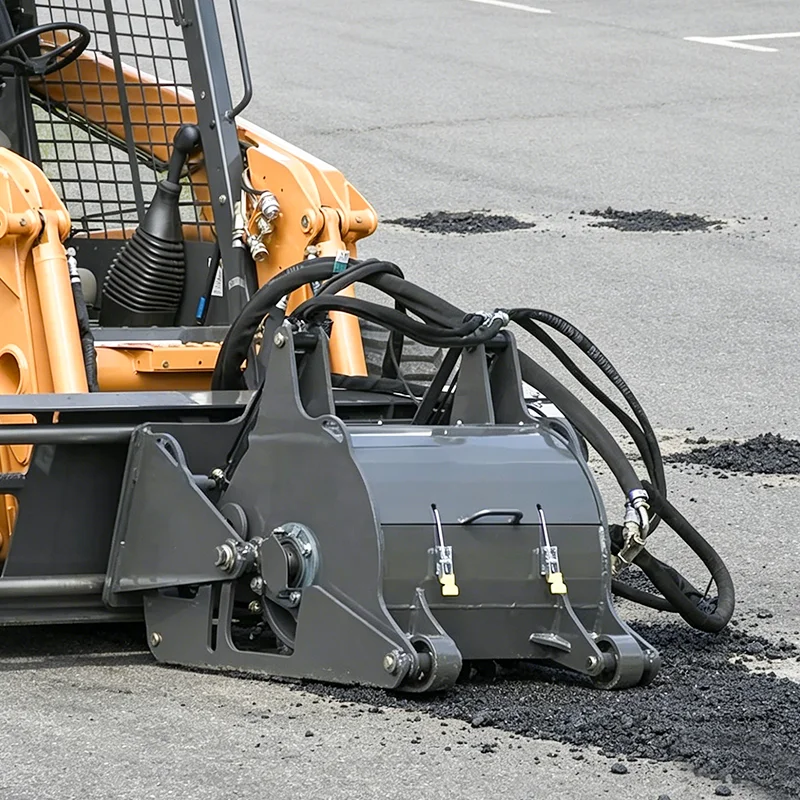
A cold planer (also called an asphalt planer or road mill) uses a rotating drum with carbide-tipped teeth to mill asphalt or concrete. The most important design parameter is tooth spacing — the distance between adjacent teeth on the drum, measured in mm. Tooth spacing determines both the quality of the milled surface and the production rate.
Fine spacing (8–12 mm) — teeth are closely spaced, producing a smooth, uniform milled surface with minimal ridge height (1–3 mm). Fine spacing is required for surface preparation where a smooth finish is critical — for example, milling before a thin overlay (20–40 mm), or milling bridge decks where surface smoothness affects ride quality. The downside: fine spacing means more teeth per drum (40–60 teeth on a 600 mm drum), increasing tooth replacement cost and reducing the amount of material each tooth removes per pass. Production rates are 20–40 percent lower than with coarse spacing.
Medium spacing (15–20 mm) — the most common spacing, balancing cut quality and production. Medium spacing produces a moderately smooth surface (ridge height 3–6 mm) suitable for most asphalt removal applications — full-depth milling, pothole repair, and utility trench restoration. With 25–40 teeth on a 600 mm drum, medium spacing offers good production rates with acceptable surface quality. This is the default choice for contractors who handle a mix of asphalt removal jobs.
Coarse spacing (25–40 mm) — teeth are widely spaced, producing a rough, textured surface (ridge height 6–12 mm) with maximum material removal per tooth. Coarse spacing is ideal for full-depth asphalt removal where the milled surface will be covered by new asphalt — surface smoothness is irrelevant because it will be buried. With 15–25 teeth on a 600 mm drum, coarse spacing offers the highest production rates (30–50 percent higher than fine spacing) and the lowest tooth replacement cost. The downside: the rough surface may require additional milling passes if a smoother finish is needed, and the large chunks of milled material may be harder to collect and load.
Many contractors use interchangeable drums — fine spacing for overlay preparation, medium for general work, coarse for full-depth removal. Drum swap takes 30–60 minutes with basic tools. If your work covers multiple applications, an interchangeable drum system is worth the investment.
Cutting Depth: Over-Milling Is the Costliest Mistake
Every 5 mm of extra milling depth means 10–15 percent more material to remove, collect, and haul away — plus additional new asphalt to place. On a 1,000 m² milling job, milling 50 mm instead of 45 mm generates an extra 5 m³ of milled material (roughly 12 tonnes) and requires an extra 5 m³ of new asphalt. At $80/tonne for hauling and disposal and $120/tonne for new asphalt, that 5 mm over-mill costs roughly $2,000 on a single job.
Modern cold planers offer several depth control systems. The simplest is a manual depth gauge — a pointer or scale mounted on the planer frame that shows current depth relative to the drum position. The operator adjusts the excavator arm to maintain the desired depth. This requires constant operator attention and is prone to over-milling on uneven pavement.
Better systems use depth skids or gauge wheels — pads or wheels that ride on the existing pavement surface on either side of the cutting drum, maintaining a fixed distance between the pavement surface and the drum. As the pavement rises or falls, the skids follow it, keeping cutting depth constant without operator input. Depth skid systems reduce over-milling to less than 3 mm and improve production by 15–25 percent because the operator can focus on forward speed rather than depth adjustment.
The most advanced systems use laser or GPS grade control — a receiver mounted on the planer communicates with a laser transmitter or GPS base station, automatically adjusting the boom angle to maintain a precise depth and grade. These systems are standard on large road milling projects where grade accuracy is critical, but are increasingly common on utility and repair projects where consistent depth reduces material waste and ensures proper asphalt thickness.
Hydraulic Flow Matching and Production Rates
A cold planer drum rotates at 100–200 RPM, driven by a hydraulic motor through a planetary gear reduction. The motor speed is proportional to hydraulic flow, and the gear reduction multiplies torque. Most planers require 80–200 L/min at 250–350 bar. A high-flow auxiliary circuit is strongly recommended — a standard-flow circuit (60–100 L/min) may not deliver enough oil to achieve full drum speed and torque, effectively running the planer at 50–60 percent capacity.
The common mistake is mounting a planer designed for 120–180 L/min on an excavator that delivers 80–100 L/min. The planer will run, but drum speed drops to 60–70 percent of rated, and torque drops proportionally. The teeth rub instead of cut, generating heat and wearing teeth 2–3x faster than normal. Production drops to 30–50 percent of rated. Match the planer to the upper 60–70 percent of your excavator's auxiliary flow range — with 100–150 L/min available, choose a planer optimized for 120–140.
Production rates vary by material and depth: a 600 mm wide planer on a 20-ton high-flow excavator, milling 50 mm deep asphalt, achieves 80–150 m²/hour for an experienced operator. In concrete, expect 40–80 m²/hour (concrete is harder and more abrasive, reducing tooth life and production). At 100 mm depth, production drops to 50–100 m²/hour in asphalt. A mismatched planer on a low-flow excavator may achieve only 30–60 m²/hour even in good conditions.
On a recent 2,000 m² asphalt milling project (50 mm depth, full removal before resurfacing), one contractor using a 600 mm planer on a 25-ton high-flow excavator (with depth skids and medium-spacing drum) completed the job in 18 hours — roughly 110 m²/hour. The same contractor's previous planer, mounted on a standard-flow 15-ton machine without depth control, would have taken an estimated 40–50 hours at 40–50 m²/hour, with significantly higher tooth replacement cost.
Maintenance That Prevents Drum and Bearing Failure
Three components account for most cold planer downtime, and all three are preventable. First, cutting teeth — the carbide-tipped teeth are the consumable part of the planer. Inspect teeth daily for wear, cracks, or missing tips. A worn tooth (less than 50 percent of original carbide remaining) does not cut effectively, generating heat and accelerating drum wear. Replace worn teeth immediately — at $15–40 per tooth, the cost is trivial compared to the damage a worn tooth can do to the drum body. Tooth life varies by material: 20–40 hours in asphalt, 5–15 hours in concrete, 2–8 hours in abrasive aggregate. Always carry a full set of spare teeth on the truck — a broken tooth stops the planer completely, and replacing one takes 5 minutes if you have a spare, or ends the shift if you do not.
Second, drum bearings — the drum rotates on heavy-duty bearings that operate under extreme load (the drum weighs 100–300 kg and generates high cutting forces). Check bearing play weekly — grab the drum and try to move it side to side; any play beyond 1 mm indicates bearing wear. Replace bearings at the first sign of play — a failed bearing can seize the drum, potentially damaging the hydraulic motor and gearbox. Grease bearings daily before operation (2–3 pumps per bearing) using a high-temperature grease rated for heavy loads.
Third, hydraulic motor and gearbox — the gearbox reduces motor speed and increases torque to drive the drum. Check gearbox oil level daily and change every 200 hours. The gearbox generates significant heat during milling, and overheated oil causes gear and bearing failure. Keep the hydraulic oil cooler clear of dust and milled material — milling generates fine dust that clogs coolers rapidly. Inspect hydraulic hoses weekly for abrasion, kinks, or leaks — the hoses to the planer flex with every arm movement and vibrate continuously. Replace all planer hoses as a set every 500 hours.
Match tooth spacing to your application, use depth control to prevent over-milling, verify hydraulic flow and pressure, and inspect teeth and bearings daily. That is the formula for a cold planer that mills 150 m² an hour instead of 50 — and lasts 2,000 hours instead of 500.