

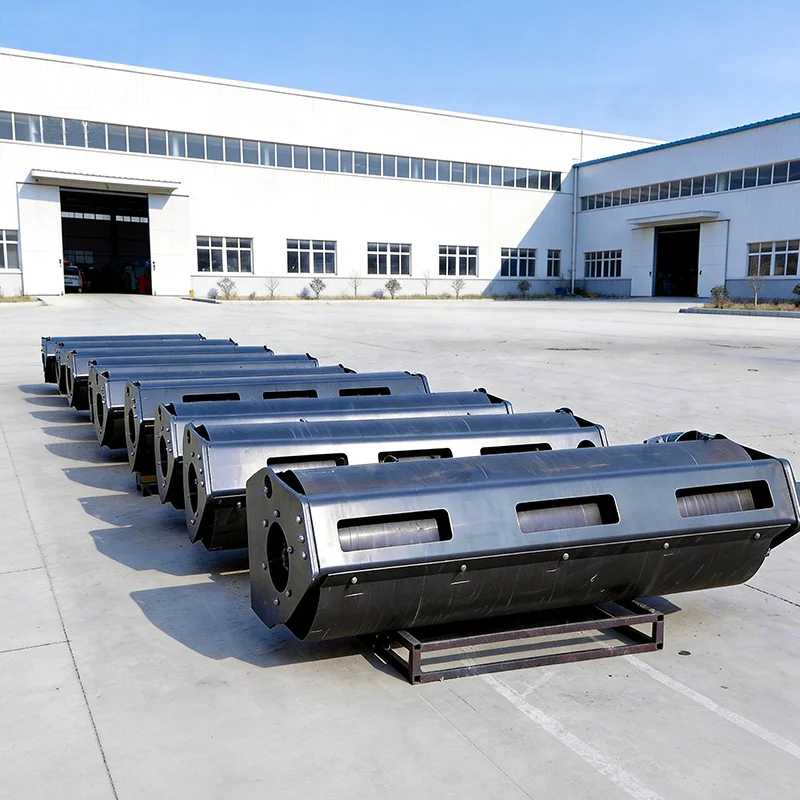
Why the Same Roller Achieves 85% or 95% Compaction
Two contractors use the same vibratory roller on the same soil. One achieves 95 percent Proctor density — the standard for structural fill. The other achieves 85 percent — unacceptable for any load-bearing application. The difference is not the machine. It is how the machine is configured and operated.
Vibratory compaction works by transmitting vibration energy into the soil, causing soil particles to rearrange and settle into a denser configuration. The energy is generated by eccentric weights rotating inside the roller drum. Two parameters determine how that energy is delivered: frequency (how fast the weights rotate, measured in Hz or vibrations per second) and amplitude (how far the drum moves with each vibration, measured in mm). Together, frequency and amplitude determine both the depth of compaction and the degree of density achieved.
High frequency (40–60 Hz) with low amplitude (0.5–1.5 mm) delivers rapid, shallow compaction — ideal for the top 100–150 mm of fine-grained soils (silt, clay) where surface smoothness is critical. Low frequency (20–35 Hz) with high amplitude (1.5–3.0 mm) delivers slower, deeper compaction — ideal for thick lifts (200–300 mm) of granular soils (sand, gravel) where deep compaction is required. Using the wrong combination — high frequency on a thick gravel lift, for example — results in surface compaction only, with loose soil below that will settle over time, causing cracking and structural failure.
Soil Type Matching: Granular vs Cohesive
The most common compaction mistake is treating all soil the same. Granular soils and cohesive soils respond to vibration very differently, and using the wrong settings for either one produces inadequate compaction.
Granular soils (sand, gravel, crushed stone) — particles are large and angular, with relatively low surface area. Vibration causes particles to slide past each other and settle into a denser configuration. Granular soils respond best to high amplitude (1.5–3.0 mm) and moderate frequency (25–40 Hz). The high amplitude provides the energy needed to move large particles, while moderate frequency allows time for particles to rearrange between vibrations. Granular soils also benefit from moisture — a small amount of water (5–10 percent by weight) lubricates particle surfaces and improves compaction. Too much water (above 15 percent) causes liquefaction, where the soil loses all strength and the roller sinks rather than compacts.
Cohesive soils (clay, silt, clay-gravel mixtures) — particles are small and flat, with high surface area and strong interparticle bonds (electrostatic and van der Waals forces). Vibration alone is less effective on cohesive soils because the interparticle bonds resist rearrangement. Cohesive soils respond best to a combination of vibration and static weight — the roller's weight provides the force needed to break interparticle bonds, while vibration helps particles settle. Use low to moderate amplitude (0.5–1.5 mm) and high frequency (40–60 Hz) for cohesive soils. The high frequency provides rapid energy input to break bonds, while low amplitude prevents the roller from bouncing on the resilient clay surface. Moisture is critical for cohesive soils — too dry and the soil is hard and brittle, resisting compaction; too wet and the soil becomes plastic and smeared, with weak shear strength. The optimal moisture content for clay is typically 15–25 percent by weight, near the soil's plastic limit.
Mixed soils (glacial till, sandy clay, gravel with silt binder) — most construction sites encounter mixed soils rather than pure granular or cohesive material. For mixed soils, start with moderate amplitude (1.0–2.0 mm) and moderate frequency (30–45 Hz), then adjust based on field density tests. If the top 100 mm is compacting well but deeper layers remain loose, increase amplitude and decrease frequency. If the surface is bouncing or cracking, decrease amplitude and increase frequency. A nuclear density gauge or sand cone test every 500 m² provides the data needed to optimize settings for the specific soil on site.
Pass Count: More Is Not Always Better
Every contractor has heard the advice: "If it is not compacted, make another pass." But beyond a certain point, additional passes do not increase density — they may even decrease it by over-compacting the surface layer, causing crushing and degradation of soil particles. The optimal pass count depends on soil type, lift thickness, and roller configuration.
For granular soils (sand, gravel) in 200 mm lifts with a properly configured vibratory roller, 4–6 passes typically achieve 95 percent Proctor density. The first 2–3 passes achieve the majority of compaction (85–90 percent), with each additional pass adding 1–2 percent. Beyond 6 passes, density gains are negligible (less than 0.5 percent per pass), and the risk of over-compaction increases.
For cohesive soils (clay, silt) in 150 mm lifts, 6–8 passes are typically required to achieve 95 percent density. Cohesive soils compact more slowly because interparticle bonds must be broken before particles can rearrange. The first 3–4 passes achieve only 80–85 percent density, with significant gains continuing through pass 6–7. Beyond 8 passes, density gains are negligible.
Over-compaction is a real risk, especially on granular soils. When the soil reaches maximum density, additional vibration energy has nowhere to go — it bounces back from the compacted surface, causing the roller to "hop" or "chatter." This bouncing can crush and degrade surface particles, reducing the soil's shear strength and creating a weak layer at the surface. If the roller begins to bounce or chatter, stop — additional passes will not improve compaction and may damage the soil.
The best practice is to determine the optimal pass count through field testing: make a test strip with increasing pass counts (2, 4, 6, 8 passes), measure density after each, and identify the point where density stops increasing. Use that pass count for the rest of the project. This approach ensures adequate compaction without wasting time on unnecessary passes or risking over-compaction.
Production Rates and Real-World Expectations
A 1.5 m wide vibratory roller on a 15–20 ton excavator, compacting 200 mm lifts of granular soil at 4–6 passes, achieves roughly 300–500 m² per hour of compacted area — or 60–100 m³ per hour of compacted volume. For cohesive soils at 6–8 passes, expect 200–350 m²/hour. A 2 m roller on a 30 ton excavator achieves 500–800 m²/hour on granular soils.
On a recent 10,000 m² structural fill project (200 mm lifts of sandy gravel, requiring 95 percent Proctor density), one contractor using a 1.5 m excavator-mounted vibratory roller completed the compaction in 25 hours — roughly 400 m²/hour, including time for density testing and lift placement. The contractor's previous approach, using a hand-operated plate compactor (0.5 m² plate, 2 passes per 100 mm lift), would have taken an estimated 200+ hours for the same project.
Maintenance That Prevents Bearing and Eccentric Weight Failure
The vibratory drum is a harsh environment — eccentric weights spinning at 2,000–4,000 RPM generate high centrifugal forces (5–15 g), and the bearings supporting the eccentric shaft operate under extreme load. Three maintenance habits prevent the most common and costly failures. First, drum bearing lubrication — the eccentric shaft bearings are typically lubricated by oil bath or grease. Check oil level daily and change every 200 hours. For grease-lubricated bearings, grease daily before operation (2–3 pumps per bearing) and purge old grease weekly. Overheated or contaminated oil causes bearing failure within hours, and a seized bearing can cause the eccentric shaft to break at speed — a catastrophic failure that requires full drum replacement. Second, eccentric weight inspection — the eccentric weights are bolted or keyed to the shaft. Inspect monthly for loose bolts, cracks, or corrosion. A loose eccentric weight can shift position, changing the amplitude and causing severe vibration imbalance that damages bearings and the excavator arm. A cracked weight can break apart at speed, destroying the drum from inside. Third, hydraulic motor and hose inspection — the hydraulic motor drives the eccentric shaft through a gear reduction or direct coupling. Check motor oil level daily and change every 200 hours. Inspect hydraulic hoses weekly for abrasion, kinks, or leaks — the hoses to the roller flex with every arm movement and vibrate continuously, accelerating wear. Replace all roller hoses as a set every 500 hours, even if they look intact.
Match frequency and amplitude to your soil type, determine optimal pass count through field testing, and maintain the drum bearings and eccentric weights religiously. That is the formula for a roller that achieves 95 percent compaction consistently — and lasts 3,000 hours instead of 500.