

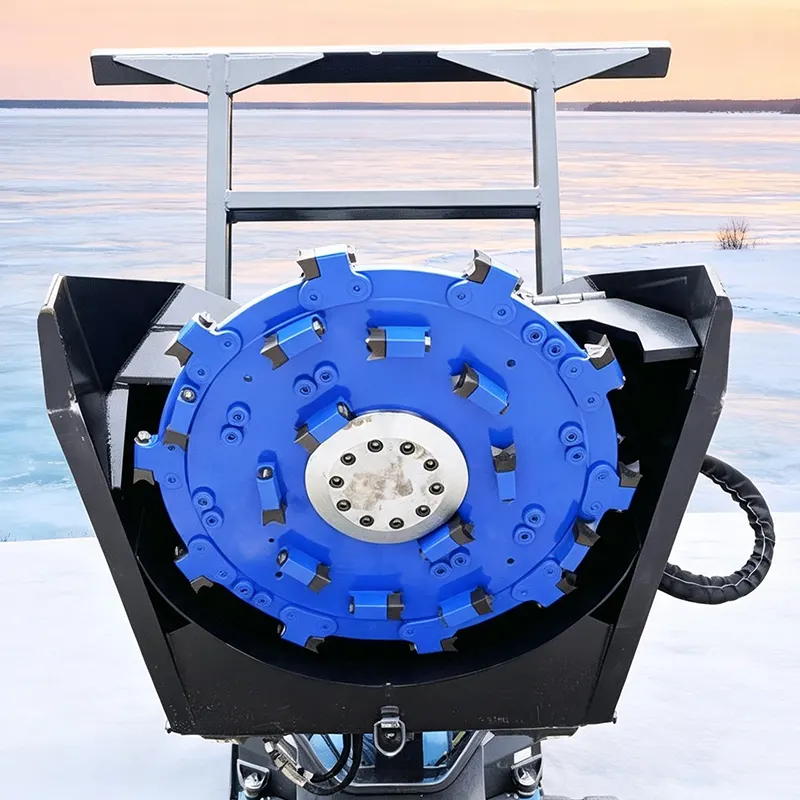
Disc Diameter and Blade Count Determine Chipping Capacity
A disc wood chipper's ability to process wood depends on two primary design variables: disc diameter and blade count. The disc is the rotating platform that carries the cutting blades — larger diameter discs and more blades handle larger wood and process it faster, at the cost of more hydraulic power and higher capital cost. Matching the disc to your wood size and carrier machine is the most important purchasing decision.
Disc diameter determines the maximum log diameter the chipper can process. A 600 mm diameter disc typically handles logs up to 150 mm in diameter. An 800 mm disc handles up to 250 mm. A 1000 mm disc handles up to 350 mm. The relationship is not linear — disc area grows with the square of diameter, so a 1000 mm disc has nearly twice the capacity of a 700 mm disc for only 43 percent more diameter. But larger discs also require more hydraulic power to rotate — an 800 mm disc needs roughly 40–60 kW of hydraulic power, while a 1000 mm disc needs 60–90 kW. For excavators in the 15–20 ton range (typically 70–100 kW hydraulic power), an 800 mm disc is the sweet spot — large enough to handle most brush and small timber, small enough to be powered by the carrier.
Blade count on the disc directly affects chip size and processing speed. A 2-blade disc produces larger chips (25–40 mm) and processes material faster because each blade clears the disc opening before the next blade engages. A 4-blade disc produces smaller chips (10–20 mm) but requires more power per cut and processes material slightly slower. For landscape mulch and biomass fuel, smaller chips (10–20 mm) are preferred — they decompose faster and burn more efficiently. For animal bedding and ground cover, larger chips (25–40 mm) are acceptable and process faster. Most operators choose a 4-blade disc as a compromise — it produces chips small enough for most applications while still maintaining good throughput.
Blade material is equally important. Chipper blades operate under extreme impact and wear conditions — each blade strike compresses and cuts through wood fiber, generating heat and abrasion. Mild steel blades dull quickly (50–100 hours) and must be replaced frequently. Quality blades are made from hardened tool steel (typically D2 or equivalent) with a hardness of 58–62 HRC at the cutting edge. Hardened blades stay sharp 5–10 times longer than mild steel, typically 300–500 hours between sharpening. For high-volume operations, the cost savings from fewer blade changes far outweigh the initial premium for hardened blades.
Feed Rate and Chip Size Control
Once the disc and blades are matched to your wood size, the next variables are feed rate and chip size control. These determine how fast you can process material and how consistent the output is.
Feed rate is the speed at which wood is fed into the chipper. Most excavator-mounted disc chippers use a hydraulic feed roller that pulls branches and logs into the disc opening at a controlled rate. A faster feed rate processes more material per hour but risks jamming the disc if the wood is too large or too dense. A slower feed rate prevents jams but reduces throughput. The ideal feed rate depends on wood size and density — for small branches (under 100 mm) and softwood (pine, poplar), a fast feed rate works well. For large logs (over 200 mm) and dense hardwood (oak, maple), a slower feed rate is necessary to avoid stalling the disc. Most operators adjust feed rate manually based on the wood being processed — the feed roller's hydraulic flow is controlled by the operator through the excavator's auxiliary hydraulics.
Chip size control is achieved through the blade setting and the anvil (also called the "bed knife"). The blade cuts against the anvil as it passes, and the gap between blade and anvil determines chip length. A smaller gap produces smaller chips; a larger gap produces larger chips. Most disc chippers allow adjustment of the blade-anvil gap in 5 mm increments, typically from 10 mm to 40 mm. Setting the gap correctly is critical — too small and the blades rub against the anvil, causing premature wear and excess heat. Too large and the wood is torn rather than cut, producing inconsistent chip sizes and putting excessive stress on the blades and disc. For most applications, a 15–20 mm gap produces a consistent, uniform chip size suitable for mulch, biomass, and most industrial uses.
Some disc chippers also include a screen or grate behind the disc that regulates chip size — chips must pass through the screen holes to exit the chipper. This ensures consistent chip size even if the blade-anvil gap is slightly off. Screens are available in various hole sizes (20 mm, 30 mm, 40 mm) and can be changed quickly. For operations producing chips for a specific market (e.g., biomass fuel requires 20–30 mm chips), a screen is worth the investment — it eliminates the need to sort chips after chipping.
Production Rates and Real-World Expectations
A properly matched excavator disc chipper (800 mm disc, 4 blades) processing brush and small timber (50–200 mm diameter) into 20 mm chips achieves 3–8 cubic meters of chips per hour — depending on wood size, species, and moisture content. For small-diameter brush (under 100 mm) and softwood (pine, poplar), production reaches 6–10 m³/h. For medium-diameter timber (100–250 mm) and mixed hardwood, production drops to 3–6 m³/h. For large logs (over 250 mm) and dense hardwood, production drops further to 2–4 m³/h.
On a recent forestry cleanup project, one contractor used a 20-ton excavator with an 800 mm 4-blade disc chipper to process 15 hectares of storm-damaged woodland — approximately 400 tons of brush and small timber (mixed pine and oak, average diameter 120 mm). The entire job took 6 working days — roughly 67 tons of wood per day, or about 8.4 tons per hour over an 8-hour shift. At an average wood density of 0.5 tons/m³ (mixed pine and oak), this equates to roughly 17 m³ of wood processed per hour, producing approximately 25–30 m³ of chips per hour (chips have lower density than solid wood). The contractor estimated that using a portable gasoline-powered chipper (typically 20–30 cm capacity) would have taken 20+ days for the same volume, because the portable chipper could not handle the largest oak logs and required manual feeding of each branch.
The excavator-mounted chipper's key advantage is material handling: the excavator picks up whole trees and large branches and feeds them directly into the chipper without manual handling. This eliminates the need for workers to feed the chipper by hand, reducing labor from 2–3 workers (for a portable chipper) to one operator. It also allows the chipper to follow the logging operation through the forest — no need to transport branches to a stationary chipper location. For forestry and land clearing operations where the excavator is already on site for tree felling and loading, adding a chipper attachment for on-site processing is far more efficient than transporting whole trees to a central processing facility.
Maintenance That Prevents Blade and Bearing Failure
Three components account for most disc chipper downtime. First, the chipper blades — inspect daily for sharpness, chips, and cracks. A dull blade does not cut cleanly — it tears the wood fibers, producing inconsistent chip sizes and putting excessive stress on the disc and drive system. A chipped or cracked blade can fail catastrophically at full disc RPM (typically 800–1200 RPM), sending metal fragments flying at dangerous speeds. Replace a chipped or cracked blade immediately — do not attempt to weld or sharpen a cracked blade, as the repair will not hold under impact loading. Sharpen blades when they start producing ragged, inconsistent chips, or after every 30–50 hours of operation (whichever comes first). Most disc chippers use standard-size blades that can be sharpened with a bench grinder or sent out for professional sharpening. Replace blades when the cutting edge has been ground down to 70 percent of original width — beyond this point, the blade is too thin to hold an edge effectively and may crack under load.
Second, the disc bearings — the bearings that support the rotating disc operate at high RPM (800–1200 RPM) under heavy impact loads. Inspect weekly for play — try to move the disc shaft side to side; any play beyond 0.5 mm indicates bearing wear. Worn bearings cause the disc to wobble, creating inconsistent blade-to-anvil clearance and accelerated blade wear. They also increase vibration, which can loosen disc bolts and damage the drive system. Replace worn bearings promptly — continuing to run on worn bearings can cause the disc to seize, potentially destroying the gearbox and hydraulic motor. Repack bearings with fresh grease every 50 hours of operation, or more frequently in dusty conditions. Check bearing temperature after every 4 hours of operation — if a bearing is too hot to touch (over 70°C), shut down and inspect for insufficient lubrication or misalignment.
Third, the drive system — the hydraulic motor, gearbox, and drive belts (if equipped) that transfer power from the excavator to the disc operate under continuous heavy load. Inspect weekly for oil leaks at the motor and gearbox. A leaking motor seal indicates worn shaft seals that will worsen under pressure. Check gearbox oil level monthly — low gearbox oil causes rapid gear wear and eventual failure. Change gearbox oil every 500 hours using the manufacturer-recommended gear oil. For belt-driven chippers, inspect belt tension weekly — loose belts slip under load, reducing disc speed and processing capacity. Replace drive belts as a set every 1,500 hours, even if they look intact. Inspect the disc mounting bolts weekly for tightness — the constant vibration of chipping can loosen bolts over time, creating a dangerous situation where the disc could detach from the drive shaft.
Match disc diameter and blade count to your wood size, control feed rate and chip gap for consistent output, and maintain blades, bearings, and the drive system religiously. That is the formula for a disc chipper that processes 8 m³ of wood an hour with consistent chips — and lasts 3,000 hours instead of 500.