

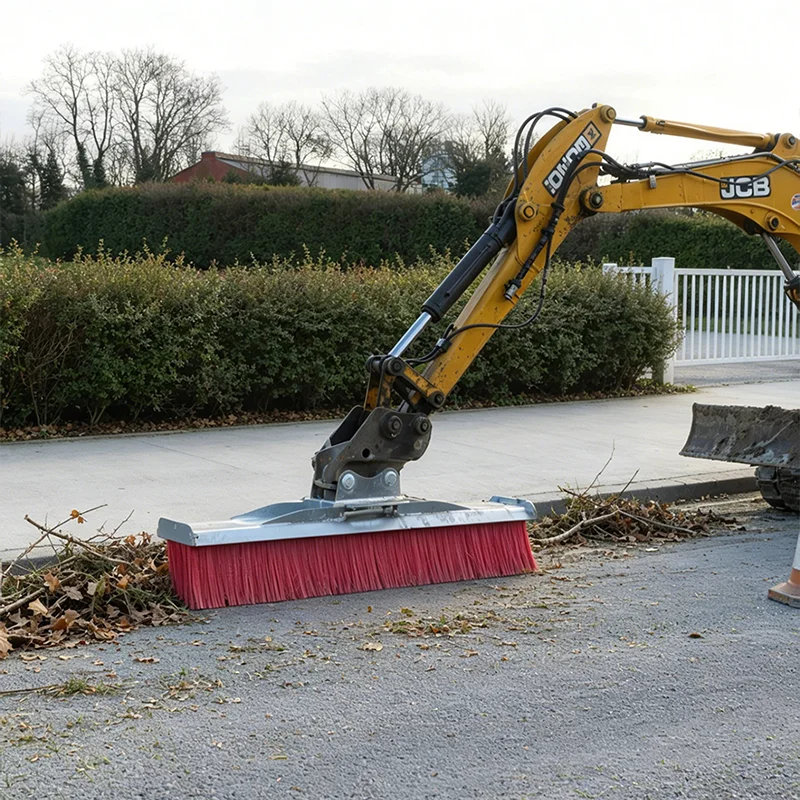
Bristle Material Determines What You Can Clean
An excavator broom's ability to clean a surface depends almost entirely on its bristles. The wrong bristle material will either fail to dislodge stuck-on debris or wear out in hours. The right bristle matches the material you are cleaning and the surface you are cleaning it off — getting this combination right is the single most important purchasing decision.
Polypropylene (PP) bristles are the most common general-purpose choice. They are flexible, resistant to moisture and chemicals, and inexpensive. PP bristles work well for light-to-medium debris — dust, sand, loose gravel, sawdust, and general construction site cleanup. They do not wear out quickly on soft surfaces (asphalt, concrete) and hold their shape well. The downside: PP bristles are not aggressive enough for heavy debris — wet clay, caked mud, or embedded gravel. For those materials, the broom will skate over the surface rather than dislodge it. PP bristles are best for regular maintenance cleanup, light debris, and delicate surfaces that could be scratched by harder bristles.
Nylon bristles are stiffer and more durable than PP, providing more aggressive cleaning while still being gentle enough not to scratch most surfaces. Nylon bristles handle medium-weight debris — damp soil, wet gravel, road dust accumulation — better than PP. They also wear more slowly, typically lasting 2–3 times longer than PP in the same application. The downside: cost (30–50 percent more than PP) and a tendency to become brittle in very cold weather (below -10°C), which can cause bristles to snap. Nylon bristles are a good middle ground for year-round use in moderate climates.
Steel wire bristles are the most aggressive option, designed for heavy-duty cleaning — caked mud, embedded gravel, road salt residue, and cleaning concrete surfaces before sealing. Steel wire bristles dislodge almost anything, but they also scratch and gouge softer surfaces (asphalt, painted surfaces, delicate concrete finishes). They also wear quickly on hard surfaces — a set of steel bristles may last only 50–100 hours on concrete, compared to 500–1,000 hours for nylon. Steel wire bristles are best for heavy industrial cleanup — demolition sites, road maintenance after excavation, and cleaning heavily soiled surfaces where scratching is not a concern.
Hybrid bristles (also called "mixed" or "combination" bristles) combine PP or nylon with wire filaments in a single tuft. This design offers the aggressive cleaning of steel wire with the gentler sweeping of synthetic bristles. Hybrid bristles handle medium-to-heavy debris while being less likely to scratch surfaces than pure steel wire. They are becoming increasingly popular for road maintenance and construction site cleanup, where you need to dislodge embedded gravel without damaging the road surface. Hybrid bristles typically last 200–400 hours in mixed-duty service.
Sweep Width and Rotation Speed: Productivity vs Effectiveness
Once you have the right bristle material, the next variables are sweep width and rotation speed. These determine how fast you can clean and how thoroughly you can clean it.
Sweep width is the width of the broom brush — typically 1.5–2.5 meters for excavator-mounted models. A wider broom covers more surface per pass, increasing productivity. But a wider broom also requires more hydraulic power to rotate, and may be too wide to maneuver in tight spaces (along curbs, around obstacles, in confined work areas). For open areas (parking lots, large construction sites, wide roads), a 2.0–2.5 m broom maximizes productivity. For confined spaces (along curbs, between buildings, on narrow paths), a 1.5–1.8 m broom offers better maneuverability. Many operators choose a 2.0 m broom as a compromise — wide enough for good productivity in open areas, narrow enough to fit along most curbs and obstacles.
Rotation speed is the speed at which the broom brush spins, typically measured in RPM (revolutions per minute). Most excavator brooms operate at 60–120 RPM. A faster rotation speed (100–120 RPM) dislodges debris more effectively — each bristle strikes the surface more times per second, providing more aggressive cleaning. The downside: faster rotation also wears bristles faster and requires more hydraulic power. A slower rotation speed (60–80 RPM) extends bristle life and uses less power, but may not dislodge heavier debris. For light maintenance cleanup (daily dust and loose debris), 60–80 RPM is sufficient and maximizes bristle life. For heavy cleanup (after excavation, removing wet or embedded debris), 100–120 RPM provides the cleaning power needed.
Most excavator brooms use a fixed gearbox that runs at a set speed determined by the excavator's hydraulic flow. Some models offer two-speed gearboxes (high speed for heavy debris, low speed for light cleanup and extended bristle life), but these are more expensive and require additional hydraulic circuits. For most operators, a single-speed broom at 80–100 RPM is sufficient — it handles both light and medium debris adequately without the added cost and complexity of a two-speed system.
Production Rates and Real-World Expectations
A properly matched excavator broom, cleaning loose debris on a flat surface, achieves 3,000–6,000 m² per hour — roughly one hectare in 2–3 hours. This includes sweeping at a walking pace (1–3 km/h) with a 2.0 m broom, covering 2.0 m × 2–3 km = 4,000–6,000 m² per hour. For light dust and loose sand, production can reach 6,000–10,000 m² per hour at faster travel speed. For heavy debris (wet mud, embedded gravel), production drops to 1,500–3,000 m² per hour because the operator must slow down and may need multiple passes to clean thoroughly.
On a recent road construction project, one contractor used a 20-ton excavator with a 2.0 m PP/nylon hybrid broom to clean 12 km of newly paved road (3.5 m wide) before final inspection. The cleanup removed construction debris, sand, and gravel left over from paving operations. The entire 42,000 m² surface was cleaned in 2 working days — roughly 21,000 m² per day, or about 2,600 m² per hour over an 8-hour shift. The contractor estimated that using a dedicated road sweeper truck would have cost 2–3 times more in mobilization and operation, and would have required waiting for the truck to be available. The excavator broom, already on site for other work, was deployed immediately and completed the cleanup without additional equipment rental.
The excavator broom's key advantage over a dedicated sweeper truck is availability: the excavator is already on the construction site for grading, excavation, or loading. Adding a broom attachment for cleanup at the end of the day requires only a quick attachment change (10–15 minutes) — no mobilization of a separate vehicle, no waiting for scheduling, and no additional operator. For contractors who already own an excavator, the broom attachment pays for itself within a few jobs by eliminating the need to rent or schedule a dedicated sweeper.
Maintenance That Prevents Bristle Wear and Bearing Failure
Three components account for most broom attachment downtime. First, the bristles — inspect daily for wear, bristle loss, and bristle breakage. Worn bristles (less than 50 percent of original length) do not clean effectively — they ride over the surface instead of dislodging debris. A missing bristle tuft creates a gap in the cleaning pattern, leaving streaks of uncleaned debris. Replace worn or missing bristle tufts promptly. Most brooms use replaceable bristle segments (also called "blocks" or "holders") that bolt onto the drum — each segment contains 20–50 bristles and can be replaced individually in minutes. For PP/nylon bristles, replace when bristle length drops below 50 mm (from a typical 100–150 mm new length). For steel wire bristles, replace when wire length drops below 30 mm. Rotate the broom drum periodically (quarter turn every 50 hours) to distribute wear evenly across all bristle segments, extending total bristle life by 20–30 percent.
Second, the drum bearings — the bearings that support the rotating drum operate continuously at high speed, often in dusty, dirty conditions. Inspect weekly for play — try to move the drum side to side; any play beyond 1 mm indicates bearing wear. Worn bearings cause the drum to wobble, creating uneven bristle contact and accelerated bristle wear. They also increase friction, reducing rotation speed and wasting hydraulic power. Replace worn bearings promptly — continuing to run on worn bearings can cause the drum to seize, potentially damaging the gearbox and hydraulic motor. Bearing seals should be inspected weekly for leaks — a leaking seal allows dust and debris into the bearing, causing rapid wear. Repack bearings with fresh grease every 200 hours of operation, or more frequently in dusty conditions.
Third, the hydraulic motor and gearbox — the motor that drives the drum rotation and the gearbox that reduces motor speed to broom RPM operate under continuous load. Inspect weekly for oil leaks at the motor and gearbox seals. A leaking motor seal indicates worn shaft seals that will worsen under pressure. A leaking gearbox seal indicates worn input or output shaft seals. Check gearbox oil level monthly — low gearbox oil causes rapid gear wear and eventual failure. Change gearbox oil every 500 hours (or annually, whichever comes first) using the manufacturer-recommended gear oil. Inspect hydraulic hoses monthly for abrasion, kinks, or leaks — the hoses to the broom flex with every movement of the excavator arm and are exposed to dust and debris. Replace all broom hoses as a set every 1,500 hours, even if they look intact.
Match bristle material to your debris and surface, choose sweep width and rotation speed for your productivity needs, and maintain bristles, bearings, and the drive train religiously. That is the formula for a broom attachment that cleans 5,000 m² an hour for 500 hours before needing bristle replacement — and lasts 3,000 hours instead of 500.