

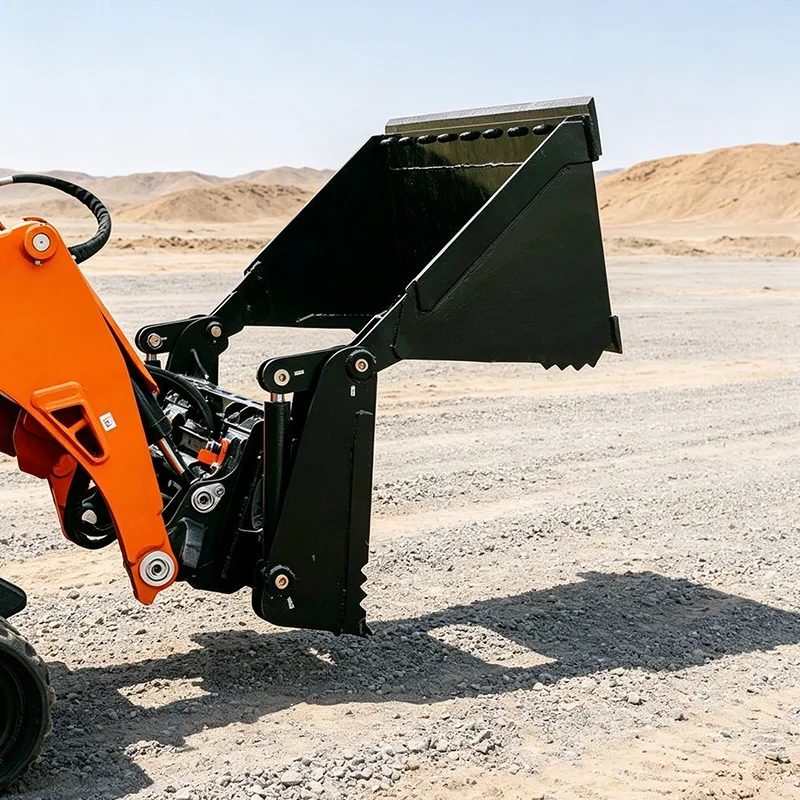
How the Clamp-and-Dump Design Enables Four Functions
A 4-in-1 bucket (also called a combination bucket or multipurpose bucket) uses a clam-shell design — the bucket splits into two halves that open and close hydraulically — to perform four distinct functions with one attachment: digging, grading, grabbing, and dozing. The two halves are hinged along one edge, with a hydraulic cylinder opening and closing them like a clam shell.
Digging function — with both halves closed and locked, the 4-in-1 bucket behaves like a standard digging bucket. The cutting edge at the front digs into material, and the closed shell holds the load. The digging capability is comparable to a standard bucket of the same size — the hinge and cylinder add some weight, but this is offset by the rigid clam-shell structure that resists twisting. Most 4-in-1 buckets on 20-ton excavators have a capacity of 0.8–1.2 m³ — slightly less than a standard bucket of the same bucket width, because the hinge and cylinder take up space inside the bucket shell.
Grading function — with the bucket held flat (both halves closed), the operator uses the bucket's flat back surface to grade material, similar to a dozer blade. The bucket's flat top (the back of the clam shell) scrapes across the surface, pushing material ahead. This is particularly useful for spreading backfill, leveling road base, and finishing lawns — the 4-in-1 bucket does not require switching to a dedicated dozer blade. Grading accuracy depends on operator skill and machine stability — the 4-in-1 bucket grades best in straight passes, not on curves or tight angles.
Grabbing function — with the bucket partially open, the operator uses the two halves as a grapple to pick up irregular, bulky material — logs, demolition debris, scrap metal, pipes. The two halves close around the material, holding it securely for transport. The grabbing capability is not as strong as a dedicated grapple (the halves are flat shells, not toothed fingers), but it handles most light-duty grabbing tasks without switching attachments. For heavy-duty demolition and scrap handling, a dedicated grapple is still preferred — but for mixed-duty work (digging one minute, grabbing the next), the 4-in-1 bucket is highly convenient.
Dozing function — with the bucket held flat and the two halves closed, the operator uses the bucket as a dozer blade to push material ahead — pushing soil, gravel, and snow. The bucket's flat front edge pushes material, while the open-top design lets material spill over the top when the bucket is filled to capacity. This is useful for light dozing work — spreading topsoil, pushing gravel piles, and clearing snow — without a dedicated dozer blade. The 4-in-1 bucket is not a replacement for a real dozer (which has dedicated tracks, a large blade, and hydraulic controls), but it handles light dozing tasks adequately.
Applications Across Mixed-Duty Work
The 4-in-1 bucket's value is its versatility — one attachment handles four tasks, eliminating the need for multiple attachments and the time spent swapping them. This makes it particularly valuable for contractors who handle a mix of tasks on the same job site.
Utility and construction work — utility contractors use the 4-in-1 bucket to dig trenches (digging function), backfill the trench (grading/dozing function), pick up and move pipes and fittings (grabbing function), and clean up the site (grading function). Without a 4-in-1 bucket, the contractor would need a digging bucket, a grapple, and a grading bucket — three attachments that require two quick coupler changes per day. The 4-in-1 bucket does all three jobs with one attachment, reducing attachment changes and improving productivity.
Landscaping and lot clearing — landscape contractors use the 4-in-1 bucket to dig holes for trees and shrubs (digging function), move boulders and landscape timbers (grabbing function), spread topsoil and grade lawns (grading/dozing function), and clean up debris. The grabbing function is particularly useful for picking up irregular landscape material — boulders, logs, stumps — that a standard bucket cannot hold securely. The grading function produces a smooth lawn finish without a dedicated grading bucket.
Agricultural and farm work — farmers use the 4-in-1 bucket to clean barns and feeding areas (grading/dozing function), move hay bales and feed sacks (grabbing function), dig fence post holes and ditches (digging function), and spread manure and compost (grading function). The grabbing function handles hay bales and round bales securely — the two halves close around the bale, holding it without crushing it. The dozing function pushes manure and compost into piles without a dedicated loader bucket.
Throughput and Versatility Value
A 4-in-1 bucket on a 20-ton excavator handles digging, grading, and grabbing tasks at roughly 80–90 percent the throughput of dedicated attachments — the hinge and cylinder add some weight and slightly reduce digging capacity, but the productivity gain from not switching attachments far outweighs this. On a typical utility project, the 4-in-1 bucket saves 15–30 minutes per attachment change — and with 2–3 attachment changes per day, that adds up to 1–1.5 hours saved per day, or 5–7.5 hours per week.
On a recent residential utility project, one contractor used a 1.0 m³ 4-in-1 bucket on a 15-ton excavator to install a 60-meter residential sewer line. The work included digging a 1.2-meter-deep trench, laying PVC pipe, backfilling the trench, and restoring the lawn. The contractor used the digging function to excavate the trench, the grabbing function to pick up and position pipe segments, the grading function to backfill and level the trench, and the dozing function to spread topsoil and restore the lawn surface. The entire 60-meter installation was completed in 2 working days — roughly 30 meters per day. The contractor estimated that using separate digging bucket, grapple, and grading bucket would have required 3 days (including two attachment changes per day, each taking 15–20 minutes). The 4-in-1 bucket saved roughly 8 hours of labor on this single project.
Maintenance That Prevents Cylinder and Hinge Failure
Three components account for most 4-in-1 bucket downtime. First, the opening cylinder — the hydraulic cylinder that opens and closes the clam-shell halves operates through thousands of cycles. Inspect the cylinder rod weekly for scoring and pitting. A damaged rod score destroys seals quickly, causing leaks and loss of holding force. Check for drift — hold the bucket half-open on a fixed object and observe over 15 minutes; if the halves close on their own, the cylinder seals are worn. Replace seal kits promptly. Keep the cylinder rod clean — wipe it weekly to remove dirt and debris that could score the rod during opening and closing.
Second, the hinge pins and bushings — the main hinge (along one edge of the bucket) carries the full load when the bucket is open in the grabbing position. Inspect monthly for play — try to open and close the bucket manually; any play beyond 2 mm indicates pin or bushing wear. Worn hinges allow the two halves to shift, affecting alignment and reducing digging accuracy. Replace worn pins and bushings promptly. Grease the main hinge pins twice weekly (4–5 pumps per pin) — the hinge operates under load every time the bucket opens or closes. The cylinder mounting pins also need weekly greasing.
Third, the cutting edge and side cutters — inspect monthly for wear. The cutting edge on the clam-shell bucket wears faster than on a standard bucket, because the two halves open and close, creating additional abrasion along the cutting edge. Replace the cutting edge when worn to 40 percent of original height. Side cutters (welded or bolted along the bucket sides) protect the bucket structure during grading and dozing work — worn side cutters allow the bucket sides to wear directly, shortening bucket life. For bolt-on cutting edges, replacement takes minutes; for welded edges, plan on 2–4 hours of welding time.
Choose bucket size for your excavator, select a 4-in-1 bucket for mixed-duty work, and maintain the cylinder, hinge, and cutting edge religiously. That is the formula for a multipurpose bucket that digs, grades, grabs, and dozes all day — and saves hours of attachment-changing time every week.