

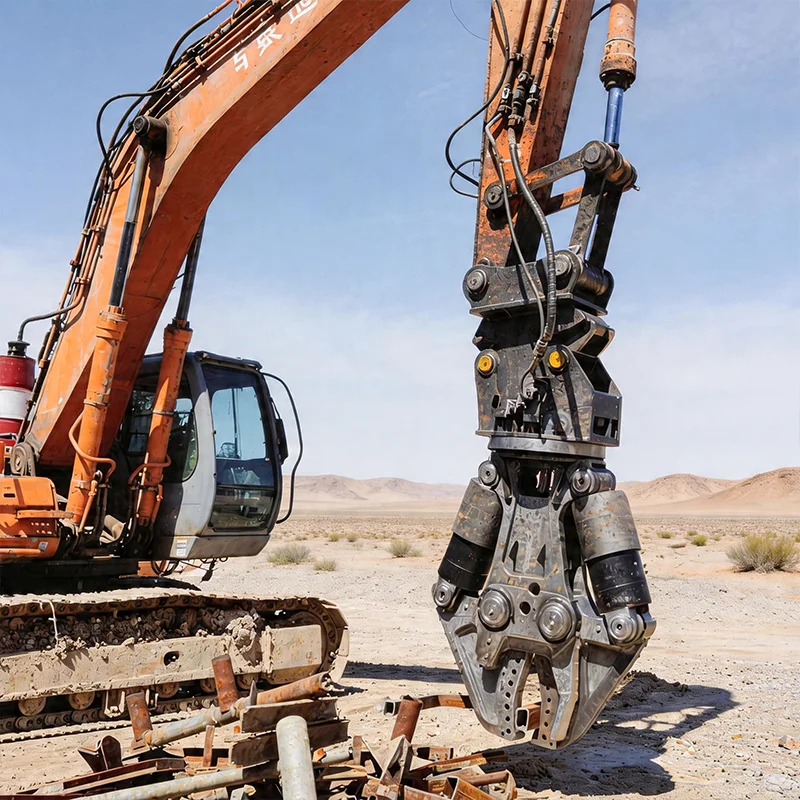
Blade Design Determines Cutting Efficiency
A hydraulic steel shear's cutting performance is determined by its blade design — the shape, material, and arrangement of the upper and lower blades that shear through steel. The blade geometry directly affects what materials can be cut cleanly, how long blades last, and how much force is needed for each cut.
Blade geometry for steel shears follows the guillotine shear design: a moving upper blade and a fixed lower blade, both with sharpened edges. The upper blade typically has a slight offset (5–15 degrees from perpendicular) — this creates a scissor-like cutting action that requires less force than a pure perpendicular chop. The blade opening (gape) is designed to accept structural steel sections (I-beams, H-beams, channels, angles) and scrap steel profiles. A typical shear on a 20-ton excavator has a jaw opening of 400–600 mm wide and 200–400 mm deep — enough to accept standard I-beams up to 400 mm depth and H-beams up to 300 mm width.
Blade material and replaceability affect total cost of ownership. Quality shear blades are made from hardened tool steel (typically H13 or D2 grade) hardened to 50–55 HRC — hard enough to cut structural steel without chipping, but tough enough to resist impact cracking. The blades are bolt-on replaceable — worn or chipped blades can be swapped in 15–30 minutes without removing the entire jaw assembly. Most shears come with two sets of blade edges (4 edges total — upper blade has 2 edges, lower blade has 2 edges) — when one edge wears, you can flip the blade to expose a fresh edge, doubling blade life without replacement. For heavy-duty scrap processing (more than 6 hours per day of cutting), consider carbide-tipped blades that last 3–5 times longer than standard tool steel, though they cost 3–4 times more upfront.
Cutting Force and Material Types
A steel shear's cutting force — measured in tons of force at the blade edge — determines what steel sections it can cut. Too little force and the shear cannot cut thick structural steel; more force than needed adds weight and cost.
Cutting force ratings for excavator-mounted steel shears range from 20 tons (for 10–15 ton excavators) to 100+ tons (for 40+ ton machines). A 20-ton excavator typically uses a shear rated at 40–60 tons of cutting force — enough to cut I-beams up to 400 mm depth (approximately 20–25 mm thick flanges and 12–15 mm thick web), H-beams up to 300 mm, and steel plate up to 30–40 mm thick. The cutting force is generated by a large hydraulic cylinder operating through a lever arm that amplifies force — the cylinder may produce 10–15 tons of push, but the lever arm multiplies this to 40–60 tons at the blade edge.
Material types a steel shear handles efficiently: structural steel (I-beams, H-beams, channels, angles), scrap steel (rebar, pipe, plate, tube), light vehicle bodies (cars, small trucks), and wire mesh and rebar bundles. A steel shear is not designed for cutting very thick steel (over 50 mm plate) or exotic alloys (stainless steel, high-tensile steel) — those require larger shears or specialized cutting equipment. The shear also struggles with irregular, dense scrap (e.g., bundled rebar) — it works best on individual profiles that can be positioned between the blades cleanly.
Scrap Processing Workflow
The steel shear's primary application is scrap processing — cutting structural steel and scrap metal into sizes suitable for transport and recycling. The typical workflow is: (1) the shear picks up a steel section (from the demolition site or scrap pile), (2) positions it between the blades, (3) closes the jaws to shear through the steel, and (4) drops the cut piece, then repeats. One cycle (pick up, cut, drop) takes 5–15 seconds per cut, depending on steel size and section shape. A shear on a 20-ton excavator processes 2–5 tons of structural steel per hour — roughly 20–50 cuts per hour on average I-beam sections.
On a recent steel structure demolition project, one contractor used a 50-ton cutting force shear on a 22-ton excavator to dismantle a 3-story steel frame building. The building's structural frame consisted of approximately 80 tons of H-beams and I-beams (150–300 mm size). The shear cut each beam into 1.5–2.0 meter lengths (suitable for truck loading), separating bolted connections and cutting through welds where needed. The entire 80 tons of steel was cut and stockpiled in 4 working days — roughly 20 tons per day, or about 2.5 tons per hour over an 8-hour shift. The contractor estimated that using a torch (oxy-fuel cutting) would have required 10–12 days for the same work, with additional fire watch and safety costs. The shear also produced cleaner cut pieces (no heat-affected zone, no oxide scale), which fetched a 5–10 percent higher price as scrap steel.
Maintenance That Prevents Blade and Pivot Failure
Three components account for most steel shear downtime. First, the blades — inspect daily for chipping, nicks, and wear. A chipped blade leaves a rough cut edge that requires grinding, and the chip creates a weak point that can propagate into a crack. Replace chipped blades immediately. Inspect blade gap weekly — a gap larger than 0.5 mm between upper and lower blades means the blades are worn and no longer shear cleanly; they bend the material instead of cutting it, which jams the jaws and accelerates wear. Most shears allow blade gap adjustment by shimming behind the blades — check the manufacturer's specification and adjust every 200–400 hours of operation. Keep blades clean — wipe off scale and debris after each shift, which accelerates corrosion and wear.
Second, the main pivot pins and jaw links — the pins that connect the upper and lower jaw links operate under cutting loads. Inspect monthly for play — try to open and close the jaws manually (with hydraulics off); any play beyond 2 mm indicates pin or bushing wear. Worn pivots allow the jaws to shift laterally, causing blade misalignment and accelerated wear. Replace worn pins and bushings promptly. Grease all pivot pins twice weekly (4–5 pumps per pin) — steel shears operate under high, intermittent loads, and inadequate greasing causes rapid pin and bushing wear. The main jaw pivot (which takes the full cutting force) should be greased every 25 hours of operation in heavy-duty use.
Third, the hydraulic cylinder and rotator — the cylinder that closes the jaws operates at very high pressure (35–40 MPa). Inspect weekly for oil leaks at the cylinder rod and fittings. A leaking cylinder loses pressure under load, reducing cutting force and wasting hydraulic oil. Check for drift — hold the jaws closed on a steel beam and observe over 5 minutes; if the jaws open on their own, the cylinder seals are worn. Replace seal kits promptly. If the shear has a 360-degree rotator (to rotate the shear for positioning on irregular steel sections), inspect the rotator weekly for play and leaks — a worn rotator allows the shear to hang at an angle, reducing cutting accuracy. Grease the rotator bearing every 50 hours of operation.
Choose cutting force for your largest steel section, select bolt-on replaceable blades with flip edges for long life, and maintain blades, pivots, and the cylinder religiously. That is the formula for a steel shear that cuts 3 tons of structural steel an hour — and produces clean, recyclable scrap.