

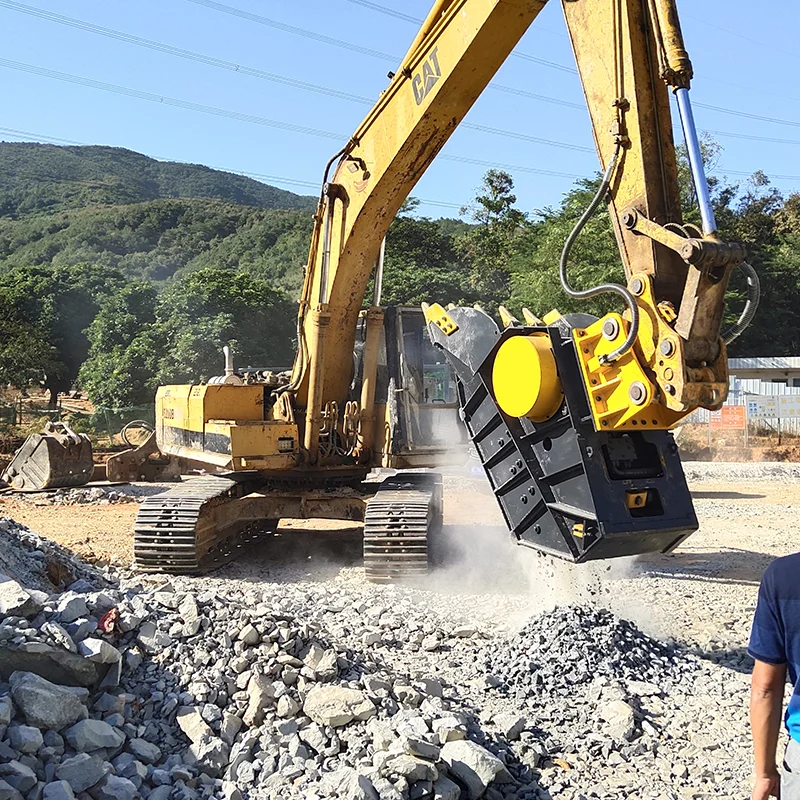
Jaw Design and C.S.S. Determine Output Size
A crusher bucket's output depends on two interrelated variables: jaw design and closed side setting (C.S.S.). The jaw geometry determines how efficiently material is gripped and crushed, while the C.S.S. sets the maximum size of the output particles. Get either wrong and you either produce oversize product that requires re-crushing, or you waste energy crushing material finer than needed.
Jaw design in a crusher bucket follows the classic double-toggle jaw crusher geometry: a fixed jaw plate and a movable jaw plate that pivots to squeeze material against the fixed plate. The jaw angle (nip angle) is critical — typically 20–25 degrees. Too shallow and material slips out without being crushed; too steep and material wedges excessively, stalling the jaw. Quality crusher buckets use high-manganese steel jaw plates (typically Mn13 or Mn18) that work-harden under impact, maintaining a sharp crushing edge even as they wear. The tooth pattern on the jaw plates is also important — corrugated teeth grip irregular concrete and rock better than smooth plates, reducing slippage and improving throughput.
C.S.S. (closed side setting) is the gap between the two jaw plates at their closest point, and it directly determines the maximum size of output material. A C.S.S. of 20–40 mm produces 20–40 mm aggregate, suitable for road base and sub-base. A C.S.S. of 40–80 mm produces 40–80 mm material, suitable for general fill and backfill. Most crusher buckets allow C.S.S. adjustment in 10 mm increments by changing shim plates behind the fixed jaw. The adjustment typically takes 30–60 minutes and requires removing the jaw guard to access the shim stack. For operations that produce multiple product sizes, having a spare set of shims on site lets you change C.S.S. between jobs without losing time.
Production Capacity and Material Types
A crusher bucket's production rate depends on material hardness, input size, and C.S.S. setting. Harder materials and finer C.S.S. settings reduce throughput; softer materials and coarser settings increase it. Understanding these relationships helps you estimate job costs and schedule accurately.
For concrete rubble (20–30 MPa compressive strength), a 20-ton excavator with a 1.0 m³ crusher bucket set to 40 mm C.S.S. produces 20–40 m³ of crushed concrete per hour. This includes loading the bucket, crushing, and depositing the output. For asphalt (softer, less abrasive), production reaches 40–60 m³/h at the same setting. For medium-hard rock (e.g., limestone, 50–80 MPa), production drops to 15–30 m³/h. For hard rock (e.g., granite, 100+ MPa), production drops further to 8–15 m³/h.
The feed size also matters. A crusher bucket can only accept material that fits between the jaw plates at their widest opening (the gape). A typical 1.0 m³ bucket has a gape of 600×400 mm — any material larger than this must be pre-broken (with a hydraulic breaker) before it can be fed into the crusher. This pre-breaking step is often overlooked in production estimates — for heavily reinforced concrete or large boulders, pre-breaking can add 20–30 percent to total job time.
On-Site Recycling Economics
The primary economic benefit of a crusher bucket is on-site recycling — crushing demolition waste on site and reusing it as fill or aggregate, rather than hauling it to a landfill and purchasing new aggregate. The break-even point depends on local hauling costs, landfill tipping fees, and aggregate prices.
On a typical urban demolition project, hauling concrete rubble to a landfill costs $25–$50 per ton (truck hauling + tipping fee). Purchasing new aggregate for backfill costs $15–$30 per ton. A crusher bucket processing 30 tons of concrete per hour at an operating cost of $80–$120 per hour (excavator + operator + fuel) produces crushed aggregate at roughly $3–$4 per ton. Even accounting for pre-breaking and bucket capital cost, on-site crushing saves $20–$40 per ton compared to haul-and-replace — a saving of $600–$1,200 per hour of operation. For a typical demolition project generating 500–2,000 tons of concrete rubble, the total saving is $10,000–$80,000 — typically enough to pay for the crusher bucket itself within 2–5 projects.
Beyond cost savings, on-site crushing reduces truck traffic through urban areas, lowers the project's carbon footprint, and avoids landfill capacity constraints. For green building certifications (LEED, BREEAM), on-site material recycling contributes directly to credits for construction waste management and recycled content.
Maintenance That Prevents Jaw and Hydraulic Failure
Three components account for most crusher bucket downtime. First, the jaw plates — inspect daily for wear and tooth condition. Worn jaw plates (less than 30 percent of tooth height remaining) do not grip material effectively, causing slippage and reduced throughput. Cracked or deformed jaw plates must be replaced immediately — a cracked plate can fail catastrophically under the crushing force. Rotate jaw plates top-to-bottom and left-to-right every 200 hours to distribute wear evenly, extending total plate life by 30–40 percent. When re-tightening jaw plate bolts, follow the manufacturer's torque specification — over-tightening can crack the plate, under-tightening causes the plate to shift and wear unevenly.
Second, the eccentric bearing and toggle plate — the eccentric shaft that drives the movable jaw rotates at 200–300 RPM under heavy impact loads. Inspect the bearing weekly for play and temperature. A bearing that runs hot (over 80°C) or has excessive play needs immediate attention — continuing to run on a worn bearing will destroy the eccentric shaft and the entire jaw frame. Repack the eccentric bearing every 200 hours with a high-pressure lithium grease rated for heavy impact loads. The toggle plate — the simple lever that transmits motion from the eccentric to the jaw — is designed as a safety fuse: it breaks if uncrushable material (e.g., steel rebar) enters the jaw. Always keep a spare toggle plate on site — it is a cheap part that prevents major downtime.
Third, the hydraulic motor and gearbox — the motor that drives the eccentric operates under continuous heavy load. Inspect weekly for oil leaks at the motor shaft seal. A leaking seal indicates worn seals that will worsen under pressure. Check gearbox oil level monthly — low gearbox oil causes rapid gear wear. Change gearbox oil every 500 hours using an extreme-pressure gear oil rated for heavy shock loads. Inspect the drive belts (if equipped) monthly for tension and wear — loose belts slip under load, reducing jaw speed and crushing capacity. Replace belts as a set every 1,500 hours.
Set C.S.S. for your target product size, match bucket capacity to your excavator, and calculate on-site recycling savings against local hauling and aggregate costs. Maintain jaw plates, the eccentric bearing, and the hydraulic drive religiously. That is the formula for a crusher bucket that produces 30 tons of crushed concrete an hour — and pays for itself within its first three projects.