

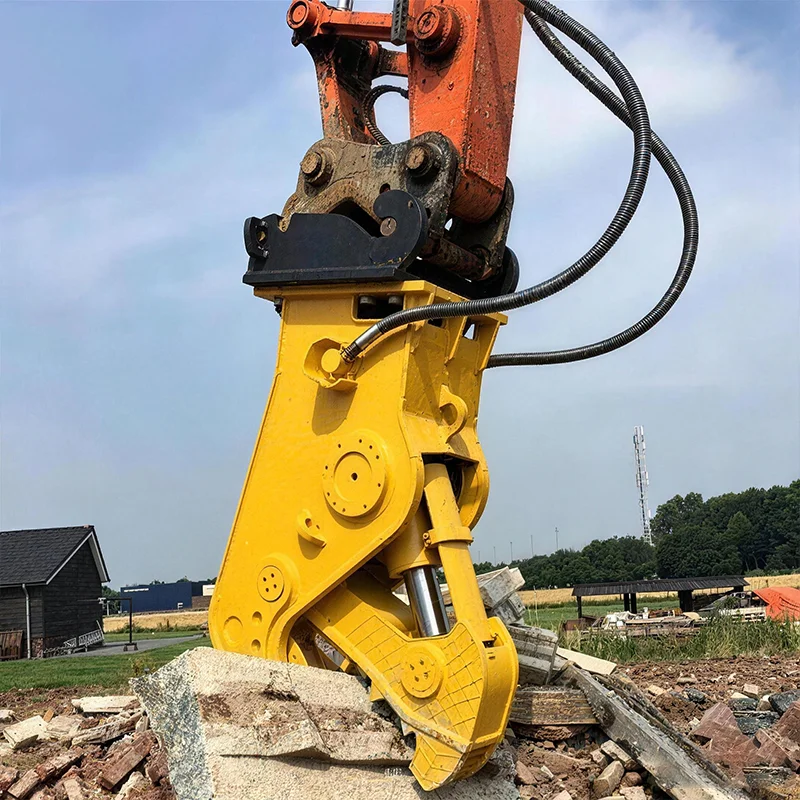
Jaw Tooth Design Determines Breaking Efficiency
A demolition pulverizer's effectiveness at breaking concrete and separating rebar depends entirely on its jaw tooth design — the shape, number, and arrangement of teeth on the upper and lower jaws that grip and crush the material. Get the tooth design wrong and you either cannot grip the material, crush it inefficiently, or fail to separate rebar from concrete.
Jaw tooth arrangement typically follows a three-zone design: a gripping zone at the jaw tips (sharp, pointed teeth that bite into concrete edges to grip), a crushing zone in the middle (wider, flatter teeth that apply compressive force to break the concrete), and a rebar-cutting zone at the jaw base (hardened steel blades that shear through rebar as the jaws close). The gripping zone at the tip is critical — without it, the pulverizer cannot get a purchase on irregular concrete surfaces, and the material slips out before it can be crushed. The crushing zone in the middle applies the main breaking force — the wider surface distributes force across a larger area, reducing the chance that the concrete just cracks locally instead of breaking apart. The rebar-cutting zone at the base ensures that as the jaws close fully, any rebar embedded in the concrete is sheared off cleanly, rather than being bent or torn out.
Tooth material and replaceability affect total cost of ownership. Most pulverizers use high-manganese steel (Mn13 or Mn18) teeth that work-harden under impact, maintaining a sharp edge even as they wear. Quality pulverizers use bolt-on replaceable teeth — worn teeth can be replaced in minutes without welding, keeping the pulverizer in service longer. Cheaper pulverizers use welded-on teeth — when they wear out, you must weld new ones on (2–4 hours of downtime) or replace the entire jaw set. For heavy-duty demolition work (more than 4 hours per day of crushing), bolt-on replaceable teeth are worth the upfront cost — they reduce maintenance downtime and keep the pulverizer working at peak efficiency.
Crushing Force and Material Types
A pulverizer's crushing force — measured in tons of force at the jaw tip — determines what materials it can handle. Too little force and the pulverizer cannot break thick, reinforced concrete; more force than needed adds weight and cost without benefit.
Crushing force ratings for excavator-mounted pulverizers range from 10 tons (for 5–8 ton excavators) to 80+ tons (for 40+ ton machines). A 20-ton excavator typically uses a pulverizer rated at 25–40 tons of crushing force — enough to break 200–400 mm thick reinforced concrete walls and floor slabs. The crushing force is generated by a hydraulic cylinder operating through a lever arm that amplifies the force — the cylinder itself may produce 5–10 tons of push, but the lever arm multiplies this to 25–40 tons at the jaw tip. The jaw opening (gape) also matters — a typical pulverizer on a 20-ton excavator has a jaw opening of 500–800 mm wide, enough to grip concrete slabs and wall sections in one bite.
Material types a pulverizer handles efficiently: solid concrete walls and slabs (100–400 mm thick), reinforced concrete (with rebar up to 25 mm diameter), masonry (brick and block walls), and precast concrete elements. A pulverizer is not designed for primary breaking (breaking sound rock or fresh concrete from the ground) — that is what a hydraulic breaker is for. The pulverizer is a secondary demolition tool — it works on concrete that has already been broken up (by a breaker or by demolition itself), reducing it to rubble size and separating rebar. This distinction is important: using a pulverizer for primary breaking (hitting unbroken concrete) wastes the pulverizer's crushing design and accelerates tooth wear.
Secondary Demolition Workflow
The pulverizer's role in demolition is secondary breaking — after the main structure has been brought down (by a breaker or by controlled demolition), the pulverizer processes the resulting rubble into manageable size and separates rebar for recycling.
The typical workflow is: (1) the pulverizer picks up a section of broken concrete (from the rubble pile), (2) crushes it between the jaws to break it into 50–200 mm rubble, (3) the rebar-cutting blades shear off any embedded rebar, and (4) the operator opens the jaws to drop the concrete rubble, then grips and sets aside the rebar for separate collection. One cycle (pick up, crush, release) takes 10–20 seconds, depending on concrete size and reinforcement density. A pulverizer on a 20-ton excavator processes 30–60 m³ of concrete rubble per hour — roughly 20–40 tons of concrete per hour (at a typical density of 1.5–2.0 tons per m³).
On a recent building demolition project, one contractor used a 30-ton crushing force pulverizer on a 22-ton excavator to process rubble from a 4-story reinforced concrete building. The main structure was brought down by a 20-ton hydraulic breaker, and the pulverizer then processed the resulting rubble pile — an estimated 1,200 m³ of concrete mixed with rebar. The entire rubble was processed to under 200 mm size, with rebar separated and stockpiled for scrap recycling, in about 3 working days — roughly 400 m³ per day, or 50 m³ per hour over an 8-hour shift. The contractor estimated that using a separate breaker for secondary breaking would have taken 6–7 days, and would not have separated rebar as cleanly — the pulverizer's rebar-cutting blades removed 95 percent of rebar from the concrete in one operation, reducing the cost of sorting and recycling scrap steel.
Maintenance That Prevents Tooth and Pivot Failure
Three components account for most pulverizer downtime. First, the jaw teeth and cutting blades — inspect daily for wear and chipping. Worn teeth (less than 50 percent of original height) do not grip concrete effectively, causing material to slip out. Chipped or cracked teeth must be replaced immediately — a broken tooth can fall into the rubble pile and damage downstream equipment (e.g., a crusher bucket processing the rubble). The rebar-cutting blades (at the jaw base) wear faster than crushing teeth — inspect weekly for blade gap. If the blade gap exceeds 3 mm, the blades no longer shear rebar cleanly — they bend it instead, which jams the jaws and accelerates tooth wear. Replace worn blades promptly (most pulverizers use bolt-on blades that take 10–15 minutes to swap).
Second, the main pivot pins and bushings — the pins that connect the pulverizer to the excavator arm and the upper-lower jaw pivot operate under crushing loads. Inspect monthly for play — try to twist the jaws side to side; any play beyond 2 mm indicates pin or bushing wear. Worn pivots allow the jaws to shift, reducing crushing accuracy and increasing stress on the cylinder. Replace worn pins and bushings promptly. Grease all pivot pins weekly (3–4 pumps per pin) — the pulverizer operates under heavy, intermittent loads, and inadequate greasing accelerates pin wear. The main jaw pivot (which takes the full crushing force) should be greased twice weekly in heavy-duty use.
Third, the hydraulic cylinder and rotator — the cylinder that closes the jaws operates at high pressure (30–35 MPa). Inspect weekly for oil leaks at the cylinder rod and fittings. A leaking cylinder loses pressure under load, reducing crushing force. Check for drift — hold the jaws closed on a concrete block and observe over 10 minutes; if the jaws open on their own, the cylinder seals are worn. Replace seal kits promptly (less expensive than replacing the entire cylinder). If the pulverizer has a 360-degree rotator (to rotate the jaws for positioning), inspect the rotator weekly for play and leaks — a worn rotator allows the pulverizer to hang at an angle, reducing crushing accuracy. Grease the rotator bearing weekly (2–3 pumps).
Choose crushing force for your concrete thickness, select bolt-on replaceable teeth for heavy-duty use, and maintain teeth, pivots, and the cylinder religiously. That is the formula for a pulverizer that processes 50 m³ of concrete rubble an hour — and separates rebar cleanly for recycling.