

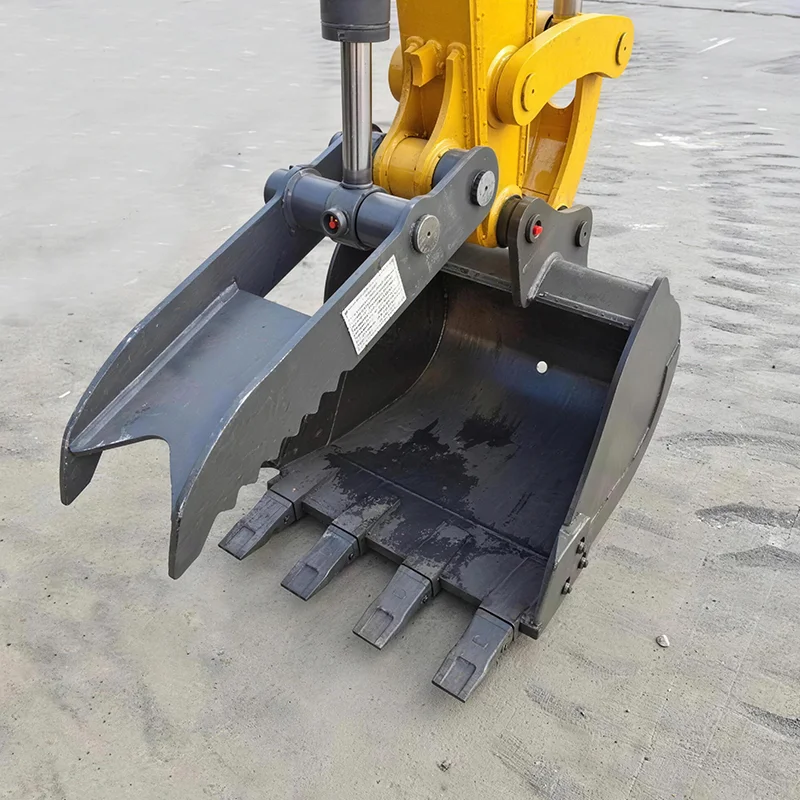
Pin-On vs Quick Hitch: Mounting Method Matters
A thumb grapple bucket combines the digging capability of a standard bucket with the gripping power of a grapple — the thumb (also called a thumb or clamp) pivots over the bucket opening, allowing the operator to pick up and hold irregular, awkward loads. The mounting method — pin-on vs quick hitch — affects how easily you can switch between the grapple bucket and other attachments.
Pin-on mounting bolts the grapple bucket directly to the excavator arm with pins, eliminating the quick hitch coupler between the arm and the bucket. This is the most rigid and reliable mounting — no slop between the coupler and the bucket, no risk of accidental release, and maximum digging force transfer from arm to bucket. The downside: switching to another attachment requires pulling pins (15–30 minutes with a second worker), which is impractical if you need to switch attachments multiple times per day. Pin-on is best for operations where the grapple bucket stays on the machine for extended periods — demolition, land clearing, and utility work where the same attachment is used for days or weeks at a time.
Quick hitch mounting uses the excavator's existing quick coupler to attach the grapple bucket. This lets the operator switch between the grapple bucket, a standard digging bucket, a breaker, and other attachments in under a minute — no pin pulling, no second worker needed. The downsides: the quick coupler adds a small amount of slop (typically 2–5 mm of play) between the arm and the bucket, slightly reducing digging precision. The coupler also adds cost and a potential failure point — a poorly maintained quick hitch can release unexpectedly under load. For operations that switch attachments frequently (landscaping, utility, general construction), quick hitch is essential — the productivity gain from fast attachment changes far outweighs the slight loss in digging precision.
Gripping Force for Irregular Loads
The thumb's gripping force determines what kinds of loads you can safely handle. Too little force and the thumb slips off round or smooth objects; too much force and you crush delicate material you are trying to pick up intact.
Gripping force is generated by a hydraulic cylinder mounted between the bucket back and the thumb arm. The force depends on cylinder bore, system pressure, and thumb arm geometry. A typical thumb on a 20-ton excavator generates 5,000–15,000 N of gripping force at the thumb tip — enough to hold logs up to 400 mm in diameter, but not so much that it crushes softwood or delicate material. The thumb's pivot point (mounted on the bucket back, not the arm) means that gripping force is applied directly through the bucket — the load is held between the thumb and the bucket floor, not between the thumb and the ground. This design lets the operator hold loads securely while moving the excavator arm.
Thumb tooth design affects gripping on specific materials. A curved thumb with 3–4 teeth works well for logs, pipes, and round objects — the teeth dig into the surface, preventing rotation. A flat, smooth thumb plate works better for flat, irregular loads (demolition debris, concrete slabs, scrap metal) — it distributes gripping force over a wider area, preventing the material from being crushed through. Some thumbs offer interchangeable tooth plates — switchable in minutes — letting you adapt the thumb to different load types. For mixed-duty work (logs one day, demolition debris the next), a toothed thumb with a replaceable plate covers most applications.
Versatility Across Applications
The thumb grapple bucket's strength is its versatility — it digs like a standard bucket, grips like a grapple, and dumps like a bucket. This makes it one of the most useful general-purpose attachments on an excavator.
Demolition and cleanup — the thumb grapple bucket picks up concrete rubble, broken masonry, and scrap metal from demolition sites, holds it in the bucket while transporting to a truck or pile, and dumps it when ready. Without a thumb, you would need a separate grapple attachment for this work — switching between digging bucket (for breaking concrete) and grapple (for loading debris) multiple times per day. The thumb grapple bucket does both jobs with one attachment, reducing attachment changes and improving productivity.
Forestry and land clearing — the thumb grapple bucket grabs small trees, brush, and root balls, holds them while the excavator moves to a pile or chipper, and releases when ready. It also digs out stumps and root balls without switching to a dedicated stump puller. For small-scale land clearing (residential lots, fence lines, small woodlots), the thumb grapple bucket handles everything from digging to loading to piling — no separate grapple needed.
Landscaping and nursery work — the thumb grapple bucket picks up boulders, landscape timbers, and large nursery containers, holds them gently (with controlled gripping force), and places them precisely. The thumb's ability to articulate independently lets the operator rotate and tilt the load for placement — similar to a dedicated grapple but with the added digging capability of a bucket. For landscape contractors, the thumb grapple bucket eliminates the need for a separate grapple and a separate digging bucket on small excavator jobs.
Maintenance That Prevents Cylinder and Pivot Failure
Three components account for most thumb grapple bucket downtime. First, the thumb cylinder seals — the cylinder that pivots the thumb operates through thousands of cycles in dirty conditions. Inspect the cylinder rod weekly for scoring and pitting. A damaged rod score destroys seals in hours. Check for drift — hold the thumb closed on a fixed object and observe over 15 minutes; if the thumb opens on its own, the seals are worn. Replace the cylinder seal kit (relatively inexpensive) rather than the entire cylinder, unless the rod itself is damaged. Keep the cylinder rod clean — wipe it weekly to remove dirt and debris.
Second, the thumb pivot pins — the pins that connect the thumb to the bucket back operate under load every time the thumb closes. Inspect monthly for play — try to twist the thumb side to side; any play beyond 1 mm indicates pin or bushing wear. Worn pivots allow the thumb to shift, reducing gripping accuracy. Replace worn pins and bushings promptly. Grease the thumb pivot pins twice weekly (3–4 pumps per pin) — the thumb operates more frequently than other bucket pivots and needs more frequent lubrication. The thumb cylinder mounting pins also need weekly greasing.
Third, the bucket cutting edge and thumb tooth tips — inspect monthly for wear. Worn thumb teeth do not grip round objects securely — they skate off logs and pipes instead of holding them. Replace worn tooth tips (most thumbs use replaceable bolt-on teeth) when worn to 50 percent of original length. The bucket cutting edge wears faster on a thumb grapple bucket than on a standard bucket, because the thumb holds material against the bucket floor during digging, creating additional abrasion. Replace the cutting edge when worn to 40 percent of original height, rather than the 50 percent threshold used for standard buckets.
Choose mounting method based on how often you switch attachments, match gripping force to your typical loads, and maintain the thumb cylinder, pivots, and tooth tips religiously. That is the formula for a thumb grapple bucket that handles logs, rubble, and boulders all day long — and lasts 4,000 hours instead of 800.