

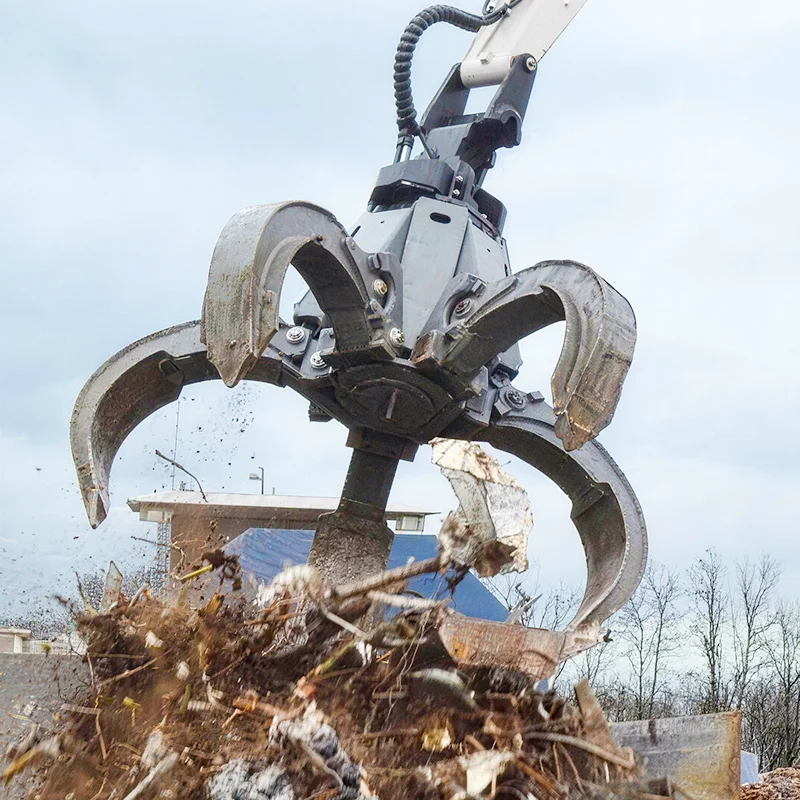
Orange Peel Jaw Design for Irregular Material
A multi-peel grapple (also called an orange peel grapple or clamshell grapple) uses 4–6 independently moving jaws (peels) that close around irregular, bulky material — scrap metal, demolition debris, bulk rock, and refuse. The orange peel design spreads gripping force across multiple points, allowing the grapple to pick up material of varying shapes and sizes that a standard two-jaw grapple cannot handle securely.
Jaw count and geometry — most multi-peel grapples use 4 or 5 jaws. A 4-jaw design provides a wider opening and greater gripping volume per cycle, suitable for bulk materials (refuse, scrap metal, rubble). A 5-jaw design provides more gripping points and better holds on irregular, fragmented material (broken concrete, mixed demolition debris). The jaws are typically curved (spoon-shaped) with pointed tips — the curved shape allows the jaws to close around round and irregular material, while the pointed tips dig into the material surface, preventing it from slipping out. Jaw tips are often replaceable (bolt-on) — when they wear blunt, they no longer grip material securely, and replacement takes minutes without removing the entire jaw.
Jaw material and tooth design affect performance on specific materials. For scrap metal and demolition debris, jaws use hardened manganese steel (Mn13 or Mn18) that resists wear from sharp, abrasive material. For bulk materials (refuse, compost, bark), jaws may use a smoother design with fewer teeth — sharp teeth tear through soft bulk material unnecessarily. The jaw opening (gape) is sized to match the material — a 0.5 m³ grapple on a 15-ton excavator has a jaw opening of 1,000–1,500 mm wide, enough to pick up a full armload of scrap or debris in one cycle.
Rotation Capability and Material Handling
Most multi-peel grapples include a 360-degree hydraulic rotator between the grapple body and the excavator arm. The rotator allows the operator to spin the grapple continuously, positioning the material precisely for placement — dumping into a truck, stacking on a pile, or sorting on a conveyor.
Rotator design affects durability and precision. A gear-driven rotator (hydraulic motor driving a gear ring) provides smooth, continuous rotation and can hold position under load — the operator can stop the grapple at any rotation angle and it stays there. A slewing ring rotator (thrust bearing driven by a hydraulic motor) is simpler and less expensive but may drift under load, requiring constant adjustment. For scrap and demolition work (where precise positioning is less critical), a simple slewing ring rotator is adequate. For sorting and stacking work (where precise placement matters), a gear-driven rotator with position holding is preferred.
Gripping force is generated by 2–4 hydraulic cylinders, each closing one or two jaws. The cylinders operate in parallel — all jaws close simultaneously around the material. Total gripping force depends on cylinder size, system pressure, and jaw geometry. A typical 0.5 m³ multi-peel grapple on a 20-ton excavator generates 10–25 tons of total gripping force — enough to hold dense scrap and heavy rubble without crushing lighter material excessively. The jaws' independent movement means they conform to the material shape — if one jaw encounters resistance first, it stops while the other jaws continue closing, ensuring all jaws engage the material before it is lifted.
Applications: Scrap, Demolition and Bulk Handling
The multi-peel grapple's primary advantage is its ability to handle irregular, fragmented material that other attachments cannot grip securely. This makes it indispensable in several applications.
Scrap metal handling — the multi-peel grapple picks up scrap steel, iron, and non-ferrous metal from scrap yards, demolition sites, and processing facilities. The orange peel design conforms to irregular scrap shapes — I-beam ends, pipe pieces, broken machinery — holding them securely for loading into trucks or feeding into shredders and balers. Compared to a two-jaw grapple, the multi-peel design handles mixed, fragmented scrap more efficiently — it picks up a larger volume per cycle and does not drop irregular pieces as easily. A 0.5 m³ multi-peel grapple on a 20-ton excavator loads 20–40 tons of scrap metal per hour into a standard 20-ton dump truck.
Demolition debris handling — after a building is demolished, the resulting rubble (broken concrete, masonry, wood, scrap metal) is irregular and fragmented. The multi-peel grapple picks up mixed rubble from the ground, holds it securely, and loads it into trucks or stockpiles it for processing. The orange peel design conforms to the irregular rubble shape, holding a mix of concrete chunks, broken bricks, and scrap rebar in one cycle. Compared to a standard bucket, the multi-peel grapple picks up 2–3 times more volume per cycle (because it grips rather than scoops) and handles material that would fall out of a standard bucket.
Bulk material handling — for refuse (municipal solid waste), compost, bark, and scrap wood, the multi-peel grapple picks up and moves bulk material that is too light or fragmented for a standard bucket. The jaws close around the bulk material, holding it securely while the grapple lifts and moves it. This is common in waste transfer stations, composting facilities, and biomass processing plants — the grapple feeds material into shredders and conveyors, sorts different material types, and moves stockpiles without switching attachments.
Maintenance That Prevents Jaw Pivot and Rotator Failure
Three components account for most multi-peel grapple downtime. First, the jaw pivot pins and bushings — each jaw pivots on pins that carry gripping loads. Inspect monthly for play — try to twist each jaw side to side; any play beyond 2 mm indicates pin or bushing wear. Worn pivots allow the jaws to shift laterally, reducing gripping accuracy and causing uneven wear. Replace worn pins and bushings promptly. Grease all jaw pivot pins twice weekly (3–4 pumps per pin) — the jaws operate frequently under load, and inadequate greasing causes rapid pin wear. The cylinder mounting pins also need weekly greasing.
Second, the rotator — the 360-degree hydraulic rotator between the grapple body and the excavator arm operates continuously during material handling. Inspect weekly for play — try to twist the grapple body side to side; any play beyond 3 mm indicates rotator bearing or gear wear. Worn rotators allow the grapple to hang at an angle, reducing gripping accuracy. Inspect the rotator for oil leaks — a leaking rotator seal allows hydraulic oil to escape and contaminates the material being handled. Replace seal kits promptly. Grease the rotator bearing every 50 hours of operation (2–3 pumps) — the rotator rotates continuously and needs regular lubrication. For heavy-duty use (more than 4 hours per day of continuous rotation), grease every 25 hours.
Third, the jaw tips and wear plates — inspect monthly for wear. Worn jaw tips (blunted or less than 50 percent of original length) do not grip material securely — they skate off scrap and rubble instead of holding it. Replace worn jaw tips promptly (most multi-peel grapples use bolt-on replaceable tips). Wear plates (on the inside of each jaw) protect the jaw body from abrasion — when worn through, the jaw body itself begins to wear, shortening the grapple's total life. Replace wear plates when worn to 30 percent of original thickness — they are inexpensive and extend jaw life significantly. For high-abrasion scrap work (handling sharp steel and concrete rubble), consider carbide-tipped jaw tips that last 3–5 times longer than standard steel tips.
Choose jaw count for your material type, select a gear-driven rotator for precise sorting work, and maintain jaw pivots, the rotator, and jaw tips religiously. That is the formula for a multi-peel grapple that handles scrap, rubble, and bulk material all day — and loads 30 tons of scrap per hour into trucks.