

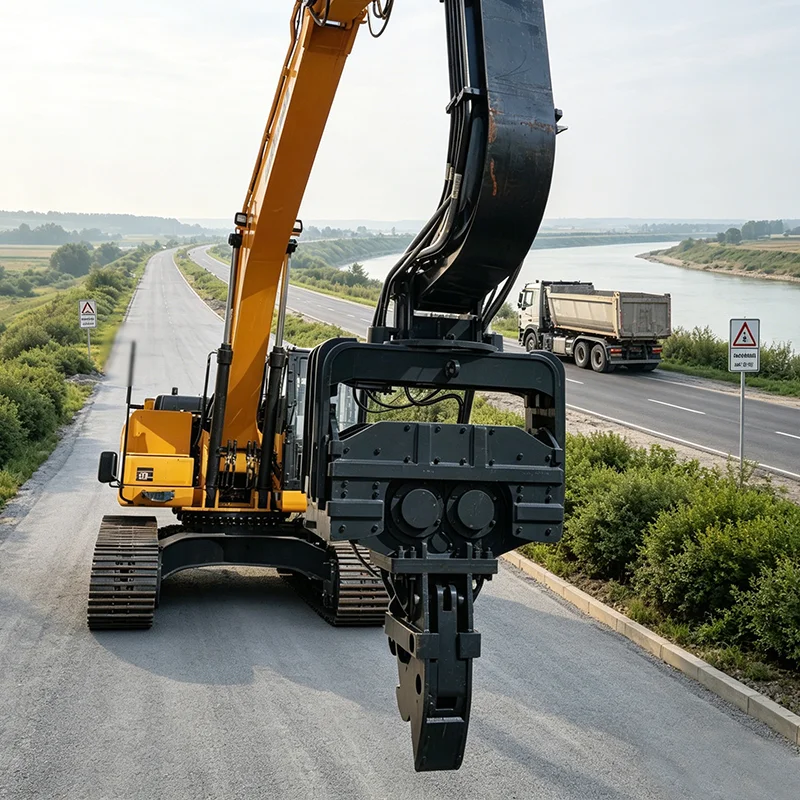
Frequency Drives the Pile — Not Brute Force
Most people picture a pile driver as a heavy weight slamming down on a pile. That is an impact hammer. The vibratory pile driver works on a completely different principle: high-frequency vibration liquefies the soil around the pile, reducing friction and letting the pile sink under its own weight plus the downward force of the excavator arm. In cohesionless soils (sand, gravel), a vibratory driver can install a 6 m sheet pile in 30–60 seconds. An impact hammer might take 5–10 minutes for the same pile.
The key parameter is vibration frequency, measured in Hz (vibrations per second). Most vibratory drivers operate at 20–40 Hz. Higher frequency (30–40 Hz) is more effective in fine-grained soils (silt, fine sand) where the soil particles are smaller and require faster vibration to liquefy. Lower frequency (20–30 Hz) with higher amplitude is better for coarse soils (gravel, cobbles) where larger particle movement is needed. The best vibratory drivers offer variable frequency, allowing the operator to adjust for soil conditions on the fly.
Centrifugal force (the force generated by the rotating eccentric weights) is the second key parameter, typically 50–300 kN. Higher centrifugal force means more vibration energy transmitted to the pile, which means faster driving in dense or hard soils. But higher force also means more stress on the excavator arm and the pile itself — match centrifugal force to the excavator's lift capacity and the pile's strength rating.
Clamping: Sheet Pile, Pipe Pile, and H-Beam
The clamp is what connects the vibratory driver to the pile, and it must match the pile type. A mismatched clamp slips under vibration, wasting energy and damaging the pile.
Sheet pile clamp — designed to grip the interlocking profile of steel sheet piles (typically U-shaped or Z-shaped sections, 400–600 mm wide). The clamp jaws engage the sheet pile's interlock or web, providing a secure grip that transmits vibration without slipping. Sheet pile clamps are the most common type, used for retaining walls, cofferdams, and excavation shoring.
Pipe pile clamp — a circular or V-shaped clamp that grips round pipe piles (typically 200–600 mm diameter). The clamp must accommodate the pipe's curvature and provide even pressure around the circumference to prevent local deformation. Pipe piles are used for deep foundations, bridge piers, and marine structures.
H-beam clamp — designed to grip the flanges of steel H-beams (also called I-beams or universal columns). The clamp engages both flanges simultaneously, ensuring that vibration is transmitted symmetrically to prevent the beam from twisting during driving. H-beams are used for soldier pile walls, deep foundation elements, and structural support.
Many vibratory drivers offer interchangeable clamps, allowing one driver to handle multiple pile types. Clamp swap takes 15–30 minutes with basic tools. If your project involves multiple pile types, an interchangeable clamp system is worth the extra cost.
Excavator Weight Matching and Production Rates
A vibratory pile driver must be matched to the excavator's weight and hydraulic capacity. The most common mistake is mounting a driver that is too large for the excavator — during driving, the vibration and downward force can lift the excavator's tracks off the ground, reducing downward pressure and making driving slower, not faster. As a rule of thumb, the excavator should weigh at least 3–5 times the weight of the vibratory driver plus the pile. For a 500 kg driver driving 100 kg sheet piles, a 15–20 ton excavator is the minimum. For a 1,500 kg driver driving 500 kg pipe piles, a 30–40 ton excavator is required.
Hydraulic flow is equally important. Most vibratory drivers require 80–200 L/min at 250–350 bar. A high-flow auxiliary circuit is strongly recommended — a standard-flow circuit (60–100 L/min) may not deliver enough oil to generate full centrifugal force, effectively running the driver at 50–60 percent capacity.
Production rates vary by pile type and soil: sheet piles in sandy soil install at 4–8 piles per hour (6 m length), or 30–50 piles per day for an experienced crew. Pipe piles in dense clay may install at 2–4 piles per hour, or 15–25 per day. H-beams in mixed soil typically install at 3–6 per hour. A mismatched driver or undersized excavator can cut these rates in half.
Maintenance That Prevents Costly Failures
Three failure modes account for most vibratory driver downtime, and all three are preventable. First, gearbox oil — the vibratory gearbox contains eccentric weights that spin at high speed, generating heat and friction. Check oil level daily and change every 200 hours. Overheated or contaminated oil causes bearing and gear failure within hours, and a gearbox rebuild costs 30–50 percent of the driver's purchase price. Second, clamp jaws — the gripping surfaces wear from repeated clamping and vibration. Worn jaws slip under load, reducing driving efficiency and damaging pile coatings. Inspect jaws daily and replace when wear exceeds 20 percent of original thickness. Third, hydraulic hoses — the hoses to the vibratory driver flex with every arm movement and vibrate continuously, accelerating wear. Replace all driver hoses as a set every 500 hours, even if they look intact — a sudden hose failure under vibration can cause the driver to stop abruptly, potentially damaging the gearbox or dropping the pile.
Match frequency to your soil, choose the right clamp, verify excavator weight and flow, and maintain the gearbox religiously. That is the formula for a pile driver that installs 50 piles a day instead of 20 — and lasts 3,000 hours instead of 500.