

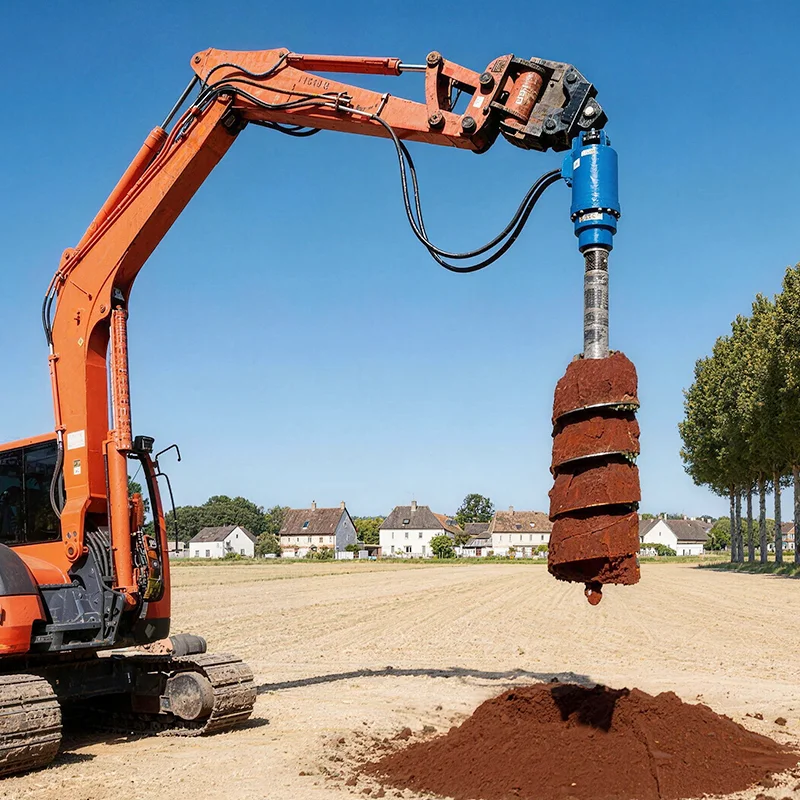
Torque Is What Digs the Hole — Not Speed
Auger buyers often ask about RPM first. But in the field, a high-torque, low-speed auger outdrills a high-speed, low-torque unit every time — especially in compacted or rocky soil. Speed determines how fast the auger spins once it is cutting. Torque determines whether it cuts at all. In hard clay or compacted gravel, a low-torque auger simply stalls, and the operator wastes time rocking the excavator arm to force the bit down. A high-torque auger keeps cutting under load, maintaining steady penetration with minimal operator input.
Typical excavator augers deliver 1,500 to 15,000 Nm of torque, depending on gearbox size and hydraulic flow. For fence posts and sign bases in normal soil, 2,000–4,000 Nm is sufficient. For foundation piers and utility holes in compacted or rocky ground, 6,000 Nm and up is required. Match torque to the hardest soil you expect to encounter, not the easiest.
Bit Selection by Soil Type
Standard earth bit — carbon steel teeth with a pilot screw, designed for topsoil, loam, and soft clay. The most common and least expensive bit ($150–400 depending on diameter). Teeth can be sharpened or replaced individually. Best for fence posts, landscaping, and general construction in non-rocky soil.
Rock bit — carbide-tipped teeth (tungsten carbide, 88–92 HRA) with a heavier pilot. Cuts through compacted gravel, soft rock, and fractured stone where a standard bit would stall or shatter teeth. At $400–800, the premium is justified on any job where rock is encountered even occasionally. Best for foundation work, utility installation, and sites with glacial till or rocky subsoil.
Clay bit — wide-spaced teeth with a tapered design that prevents sticky clay from packing into the auger flights. Standard bits clog in wet clay, requiring the operator to repeatedly lift and spin the auger to clear it — a major productivity killer. Clay bits cost 20–30 percent more than standard bits but can double production in heavy clay conditions.
Hydraulic Flow and the Production Difference
An auger gearbox is essentially a hydraulic motor driving a planetary gear reduction. The motor speed is proportional to hydraulic flow, and the gear reduction multiplies torque. Most augers require 40–120 L/min at 200–300 bar. The common mistake is mounting an auger designed for 80–120 L/min on an excavator that only delivers 50–60 L/min. The auger will run, but at half the designed speed and with reduced torque — effectively drilling at 40 percent capacity.
Match the auger to the upper half of your excavator's auxiliary flow range. With 60–100 L/min available, choose an auger optimized for 70–90. And verify that your auxiliary circuit can sustain the required pressure under load — a circuit that delivers 250 bar at no-load but drops to 180 bar under load will cause the auger to stall in hard soil.
Production rates vary widely: a properly matched 300 mm auger in normal soil drills a 1.5 m post hole in 1–2 minutes, including repositioning — roughly 30–60 holes per day for an experienced operator. In rocky soil with a rock bit, expect 15–30 holes per day. A mismatched auger can drop to 10 holes per day or fewer.
Maintenance That Prevents Gearbox Failure
The gearbox is the most expensive component on an auger, and most failures are preventable. Three habits make the difference. First, check gearbox oil level daily and change it every 200 hours — the oil lubricates the planetary gears and bearings, and contaminated or low oil causes catastrophic gear failure within hours. Second, never force the auger into the ground with the excavator arm — let the auger's weight and torque feed it in. Forcing the bit down causes side loading on the gearbox output shaft, accelerating bearing wear and potentially cracking the gearbox housing. Third, inspect the pilot screw and teeth daily — a worn pilot causes the auger to wander, increasing side loading; a broken tooth can damage the bit body and create vibration that stresses the gearbox.
Match torque to your soil, choose the right bit, verify flow and pressure, and let the auger feed itself. That is the formula for an auger that drills 60 holes a day instead of 20 — and lasts 2,000 hours instead of 500.