

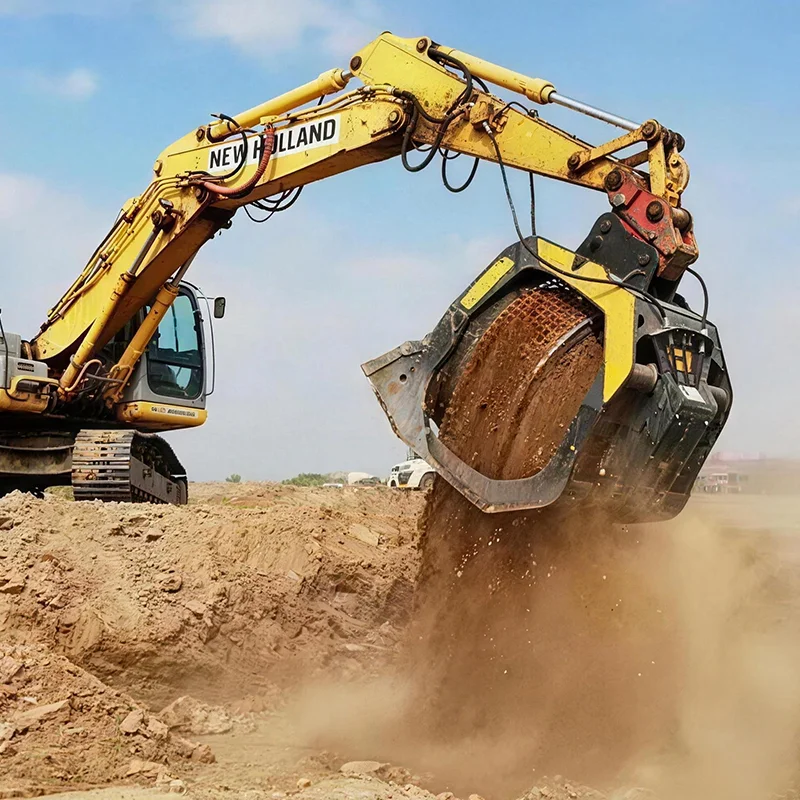
Tine Spacing Determines Output Size
A screening bucket's output size is set by one variable above all: tine spacing — the gap between adjacent tines (also called fingers or rods). Material smaller than the spacing falls through; material larger is retained in the bucket for disposal or further processing. Choosing the right tine spacing for your material and end product is the most important decision when selecting or configuring a screening bucket.
Standard tine spacings range from 20 mm to 100 mm, each suited to a different application. A 20–30 mm spacing produces fine topsoil — ideal for landscaping, turf preparation, and gardens where stones larger than 20 mm are undesirable. A 40–50 mm spacing produces medium-grade screened soil — suitable for general fill, road sub-base, and sports field preparation. A 70–100 mm spacing produces coarse material — used for separating oversize rock from fill material, sorting demolition rubble, and cleaning up construction sites. Some operators use a 50 mm spacing as a general-purpose setting that handles most common screening tasks without frequent tine changes.
Tine material and shape also affect performance. Most screening buckets use round steel tines (20–30 mm diameter) made from hardened manganese steel or high-tensile steel. Round tines allow material to rotate as the bucket vibrates, reducing blinding (clogging) when screening wet or sticky soil. Square or flat tines provide more cutting action in heavy clay but are more prone to blinding. For screening wet clay or root-bound topsoil, round tines with a slightly flexible mounting are preferred — they vibrate individually, breaking up clods and reducing clogging. For screening dry aggregate and clean soil, stiffer, square tines provide longer wear life.
Vibrating vs Static Tine Designs
Screening buckets come in two fundamental designs: static (gravity-fed) and vibrating (actively agitated). Each has its place depending on material type and desired throughput.
Static screening buckets rely on the excavator's motion — tilting the bucket side to side, lifting and dropping, or shaking the arm — to make material flow through the tines. They are simple, inexpensive, and have no moving parts to maintain. The downside: throughput is low (10–20 m³/h for a 1.0 m³ bucket) and screening quality depends entirely on operator skill. Static buckets work well for light-duty work — screening small amounts of topsoil on landscaping jobs, sorting demolition debris, and separating large rocks from fill material. They are not suitable for high-volume screening or for wet, sticky soils that require active agitation to flow through the tines.
Vibrating screening buckets use a hydraulic motor to drive an eccentric shaft that vibrates the tine frame at high frequency (500–1,500 RPM). The vibration agitates the material, causing fine particles to fall through the tines quickly while retaining oversize material. Vibrating buckets achieve 3–5 times higher throughput than static buckets (30–60 m³/h for a 1.0 m³ unit) and handle wet, sticky soils that would blind a static screen. The downsides: higher cost (30–60 percent more than static), more moving parts (motor, bearings, eccentric shaft) that require maintenance, and higher hydraulic oil flow requirements. For high-volume screening work — topsoil production, aggregate sorting, demolition waste processing — the vibrating design pays for itself quickly through higher productivity.
Some vibrating buckets offer variable speed control — the operator can adjust vibration frequency based on material condition. Lower frequency (500–800 RPM) works well for dry, loose material — it prevents oversize particles from bouncing through the tines. Higher frequency (1,000–1,500 RPM) breaks up clods and handles wet, sticky clay that would otherwise blind the screen. Variable speed adds versatility but also adds cost and complexity — for most operators, a single-speed vibrating bucket at 800–1,000 RPM handles 90 percent of common screening tasks adequately.
Throughput and Real-World Expectations
A vibrating screening bucket (1.0 m³ capacity, 50 mm tine spacing) on a 20-ton excavator achieves 30–60 m³ of screened material per hour, depending on soil type and moisture content. For dry, loose topsoil with 10–20 percent rock content, production reaches 40–60 m³/h. For moist loam with 30 percent rock and clay content, production drops to 25–40 m³/h. For wet clay with high silt content, production drops further to 15–25 m³/h as the material tends to stick together and blind the tines.
On a landscaping project, one contractor used a 1.0 m³ vibrating screening bucket on a 15-ton excavator to process 800 m³ of topsoil for a new housing development. The soil had been stockpiled on site and contained roughly 20 percent rock and construction debris. The entire 800 m³ was screened and stockpiled in fine topsoil (under 50 mm) and oversize material (rock and debris) in 3 working days — roughly 267 m³ per day, or about 33 m³ per hour over an 8-hour shift. The contractor estimated that importing screened topsoil from a local supplier would have cost $15–$25 per m³ (including delivery), totaling $12,000–$20,000. Screening on site cost approximately $3,000 (excavator + operator + bucket depreciation), saving $9,000–$17,000 on the project — the bucket paid for itself on this single job.
Maintenance That Prevents Tine Wear and Bearing Failure
Three components account for most screening bucket downtime. First, the tines — inspect daily for bending, wear, and cracking. Bent tines create gaps of inconsistent size, producing oversize material that should have been retained. Worn tines (less than 50 percent of original diameter at the tip) have wider gaps than designed, producing oversize output. Cracked tines must be replaced immediately — a broken tine can fall into the output pile and damage downstream equipment. Replace bent or cracked tines individually — most buckets use bolt-on tines that can be changed in minutes without removing the entire tine frame. For high-wear applications (screening sharp aggregate), consider carbide-tipped tines that last 3–5 times longer than standard steel tines.
Second, the vibrating bearings (on vibrating models) — the bearings that support the eccentric shaft operate at high speed (800–1,500 RPM) under heavy vibration. Inspect weekly for play and temperature. A bearing that runs hot (over 70°C) or has excessive play needs immediate attention. Repack bearings with fresh grease every 50 hours of operation — vibrating bearings run hot and lose grease quickly. Check bearing seals weekly for leakage — a leaking seal allows dust and grit into the bearing, causing rapid wear. For heavy-duty use (more than 4 hours per day of vibrating), consider upgrading to sealed-for-life spherical roller bearings that require no greasing but cost 2–3 times more.
Third, the hydraulic motor — the motor that drives the eccentric (on vibrating models) operates under continuous load. Inspect weekly for oil leaks at the motor shaft. A leaking seal indicates worn seals that will worsen under pressure. Check hydraulic oil temperature after 30 minutes of operation — if the oil temperature exceeds 80°C, the bucket may be consuming more flow than the excavator can supply, causing excessive heat buildup. Match the bucket's required hydraulic flow to your excavator's auxiliary circuit — an undersupplied motor runs hot and wears prematurely, while an oversupplied motor wastes power and generates unnecessary heat.
Choose tine spacing for your target output size, select vibrating design for wet or high-volume material, and maintain tines, bearings, and the hydraulic motor religiously. That is the formula for a screening bucket that produces 40 m³ of clean topsoil an hour — and lasts 4,000 hours instead of 600.