

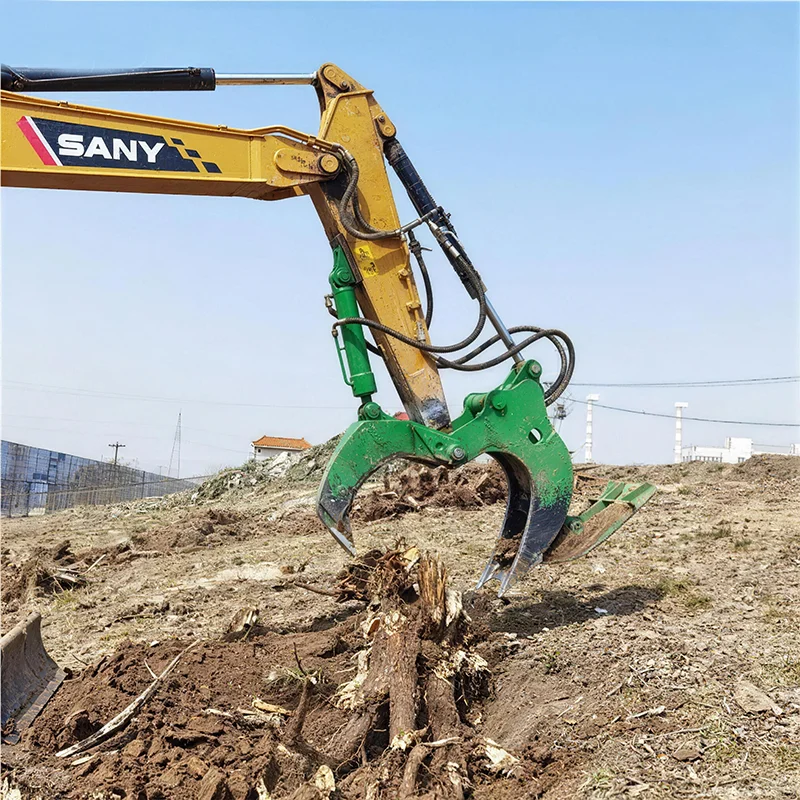
Teeth Design Determines Grinding Efficiency
A stump grinder's ability to efficiently grind tree stumps and root systems depends entirely on its tooth design — the shape, number, and arrangement of cutting teeth on the rotating cutting wheel. Get the tooth design wrong and the grinder either cannot cut through hard wood, wears out teeth quickly, or produces coarse, uneven chips.
Tooth geometry for stump grinders follows the cutting tooth design used in forestry equipment: carbide-tipped teeth mounted on a rotating cutting wheel (also called a flywheel or cutter wheel). The carbide tip (typically 10–15 mm wide) is brazed to a steel tooth holder that bolts onto the wheel. The carbide is extremely hard (85–90 HRC) — hard enough to cut through wood without dulling, even on hard species like oak and hickory. The steel tooth holder absorbs impact and vibration, protecting the brittle carbide tip from breaking under heavy loads.
Tooth arrangement on the cutting wheel affects cutting speed and chip size. Most stump grinder wheels carry 16–36 teeth arranged in a spiral pattern around the wheel circumference. The spiral arrangement ensures that 2–3 teeth are always engaged with the wood at any given time, producing a smooth, continuous cut rather than a chopping action. A wheel with fewer teeth (16–20) cuts faster but produces coarser chips — suitable for grinding stumps below ground level where chip size does not matter. A wheel with more teeth (28–36) cuts more slowly but produces finer chips — suitable for surface grinding where chips need to be fine enough to rake and remove. For general-purpose stump grinding (both below-ground and surface work), a 24-tooth wheel is the standard compromise.
Tooth replacement is a routine maintenance item. Carbide teeth wear gradually as they cut through wood — the tip becomes blunt and the cutting edge becomes rounded. Worn teeth cut more slowly, require more down pressure, and produce uneven chips. Replace teeth when the carbide tip wears to 50 percent of original width — at that point, the tooth can no longer cut cleanly and begins to push wood instead of cutting it. Most stump grinders use bolt-on replaceable teeth — replacement takes 1–2 minutes per tooth with a wrench. Always replace teeth in sets (2–3 adjacent teeth) rather than one at a time — uneven tooth wear on the wheel causes vibration and premature bearing failure.
Cutting Speed and Wood Density
A stump grinder's cutting speed (the rate at which it grinds through wood) depends on wood density, wheel RPM, and the operator's down-pressure technique. Understanding these relationships helps estimate job costs and schedule accurately.
Wood density directly affects grinding speed. Softwoods (pine, spruce, fir) with a density of 300–450 kg/m³ grind quickly — a 1-meter-diameter pine stump can be ground to 30 cm below ground level in 3–5 minutes. Medium-density hardwoods (maple, birch, beech) with a density of 550–700 kg/m³ take 6–10 minutes for the same size stump. Dense hardwoods (oak, hickory, locust) with a density of 750–950 kg/m³ take 10–15 minutes. The grinding rate also depends on stump diameter — a 60 cm oak stump grinds in 5–8 minutes, while a 120 cm oak stump takes 15–25 minutes.
Wheel RPM and hydraulic flow determine how fast the cutting wheel spins. Most excavator stump grinders operate at 500–1,000 RPM — fast enough to cut through wood efficiently, but not so fast that the carbide tips overheat and lose hardness. The wheel is driven by a hydraulic motor connected to the excavator's auxiliary hydraulic circuit. The required hydraulic flow is typically 60–120 L/min (depending on wheel size) — an excavator with an auxiliary flow below this range will spin the wheel too slowly, reducing cutting speed and increasing tooth wear.
Operator technique also affects grinding efficiency. The operator should apply moderate down-pressure — enough to keep the teeth engaged with the wood, but not so much that the wheel bogs down and slows. A wheel that spins at full speed (no load) and engages the wood smoothly cuts most efficiently. Forcing the wheel too hard causes the teeth to dig in deeply and bog down — this stalls the wheel, burns the wood, and accelerates tooth wear. The operator should move the wheel side to side across the stump face, feeding the cutter gradually into the wood rather than forcing it in all at once.
Root Removal Productivity
A stump grinder on a 15–20 ton excavator removes 10–30 average-sized stumps (30–60 cm diameter) per hour, including moving between stumps. For a typical land-clearing project with 50–100 stumps per hectare, one stump grinder clears 0.5–1.0 hectares per day — roughly 40–80 stumps per day over an 8-hour shift.
On a recent residential lot-clearing project, one contractor used a 24-tooth stump grinder on a 16-ton excavator to remove 45 tree stumps from a 0.4-hectare residential lot. The stumps ranged from 20 cm (small landscape trees) to 80 cm (large mature oaks). The entire 45 stumps were ground to 30 cm below ground level in 1.5 working days — roughly 30 stumps per day, or about 4 stumps per hour over an 8-hour shift. The contractor estimated that digging stumps out with a backhoe would have required 3–4 days, and would have left large holes that required backfilling and re-grading. The stump grinder left the ground level — the ground-up wood chips can be left in place as mulch, or raked out and replaced with topsoil for lawn restoration.
Maintenance That Prevents Tooth and Bearing Failure
Three components account for most stump grinder downtime. First, the cutting teeth and holders — inspect daily for tooth condition and tightness. Loose teeth (the bolt holding the tooth to the holder has loosened) cause vibration and can damage the holder. Check tooth tightness at the start of each shift — tighten any loose bolts with a torque wrench to the manufacturer's specification. Replace worn teeth promptly (when carbide tip wears to 50 percent width). Inspect tooth holders weekly for cracks and deformation — a cracked holder allows the tooth to wobble, causing uneven wear and potentially breaking off during operation. Replace damaged holders promptly.
Second, the cutting wheel bearings — the bearings that support the rotating wheel operate at 500–1,000 RPM under heavy load. Inspect weekly for play and temperature. A bearing that runs hot (over 70°C) or has excessive play needs immediate attention — continuing to run on a worn bearing will destroy the wheel and the hydraulic drive. Repack wheel bearings with fresh high-temperature grease every 50 hours of operation — stump grinder bearings run hot and lose grease quickly. Check bearing seals weekly for leakage — a leaking seal allows wood dust and grit into the bearing, causing rapid wear. For heavy-duty use (more than 4 hours per day of grinding), consider upgrading to sealed-for-life bearings that require no greasing but cost 2–3 times more.
Third, the hydraulic motor and drive — the motor that spins the cutting wheel operates under continuous load. Inspect weekly for oil leaks at the motor shaft. A leaking seal indicates worn seals that will worsen under pressure. Check hydraulic oil temperature after 30 minutes of operation — if the oil temperature exceeds 80°C, the grinder may be consuming more flow than the excavator can supply, causing excessive heat buildup. Match the grinder's required hydraulic flow to your excavator's auxiliary circuit — an undersupplied motor runs hot and wears prematurely. Inspect drive belts (if equipped) monthly for tension and wear — loose belts slip under load, reducing wheel speed and cutting efficiency. Replace belts as a set every 1,500 hours.
Choose tooth count for your desired chip size, match hydraulic flow to your excavator's auxiliary circuit, and maintain teeth, bearings, and the hydraulic motor religiously. That is the formula for a stump grinder that removes 4 stumps an hour — and clears a residential lot in 1.5 days instead of a week.