

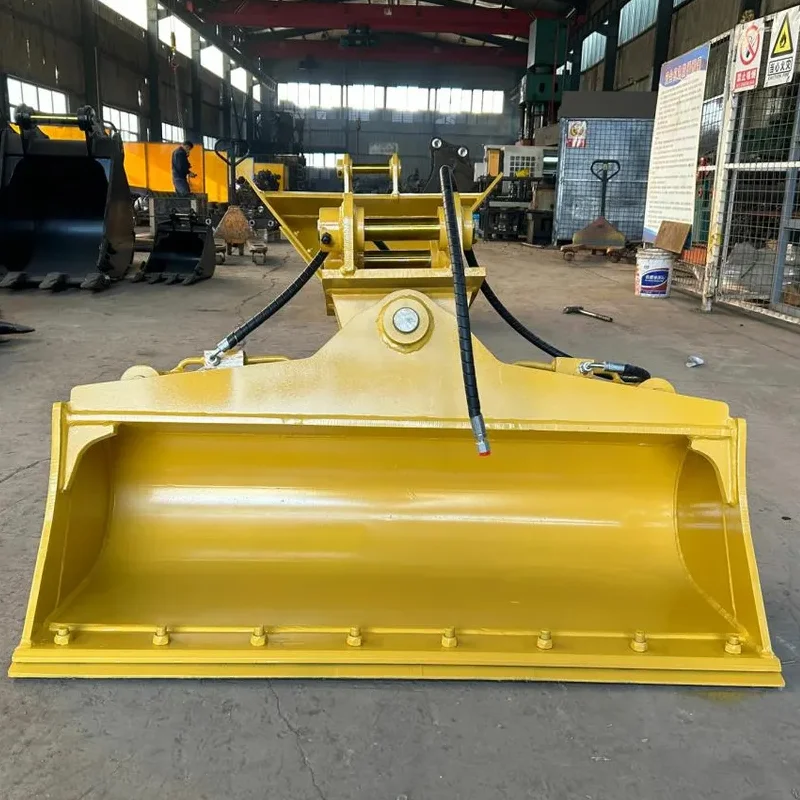
Tilt Angle Determines Grading Versatility
A tilt bucket's versatility is defined by one number above all: maximum tilt angle — the angle through which the bucket can pivot left or right relative to the excavator arm. A wider tilt angle lets you grade slopes, clean ditches, and cut angles without repositioning the entire excavator, saving time and improving accuracy.
Standard tilt angles range from 45 degrees (±22.5°) to 90 degrees (±45°). A 45-degree tilt is sufficient for most general grading work — it lets you finish gentle slopes (up to 2:1 or 3:1), clean roadside ditches, and trim edges along foundations. A 90-degree tilt (±45° each side) handles steeper slopes (up to 1:1), cuts V-shaped ditches, and works in tighter spaces where repositioning the excavator is difficult. For road construction and slope finishing, a 90-degree tilt is preferred — it covers the full range of slopes typically encountered in highway and drainage work.
Tilt mechanism design affects durability and accuracy. Most tilt buckets use one or two hydraulic cylinders mounted between the bucket back and the linkage. A single-cylinder design is simpler and less expensive but provides less holding force — the bucket can drift under load, affecting grading accuracy. A dual-cylinder design (one cylinder on each side) provides balanced, firm holding and finer control, but costs more and adds complexity. For precision grading work, dual cylinders are worth the investment — they hold their angle under load, producing consistent results pass after pass. For general-purpose work, a single cylinder with a good lock valve (which holds angle when hydraulics are not actively being used) is adequate.
Applications: Slope Grading and Ditch Cleaning
The tilt bucket's primary advantage over a standard bucket is its ability to work at angles without repositioning the excavator. This translates directly to faster, more accurate work on specific applications.
Slope grading — finishing road embankments, dam faces, and landscape slopes is where the tilt bucket shines. On a road embankment with a 2:1 slope (33°), the operator tilts the bucket to match the slope angle and then skims across the slope surface with the boom and arm movements. Without a tilt bucket, you would have to position the excavator on the slope itself or use a laser-guided grading system — both slower and less precise. A tilt bucket on a 20-ton excavator can finish 200–400 meters of road embankment per hour to a tolerance of ±2 cm, compared to 50–100 meters per hour with a standard bucket.
Ditch cleaning and shaping — cleaning roadside ditches, irrigation channels, and drainage swales is another ideal application. The tilt bucket can match the ditch's cross-section — V-shaped, trapezoidal, or semicircular — by adjusting the tilt angle on the fly. The operator can clean the bottom of the ditch and trim both sidewalls in one pass, without repositioning. For rectangular box culverts and narrow ditches, a 90-degree tilt lets the bucket enter at the correct angle even when the excavator is positioned off to one side. Ditch cleaning productivity with a tilt bucket is typically 2–3 times faster than with a standard bucket.
Edge trimming and foundation cleanup — trimming edges along foundations, curbs, and sidewalks requires a flat, vertical cut. A tilt bucket can tilt to 90 degrees to cut a vertical face alongside a foundation, removing excess soil without damaging the foundation wall. This is particularly useful for basement excavation, where the excavator must clean soil from foundation walls without striking concrete or rebar. The tilt bucket's ability to work at angles also makes it useful for trimming around obstacles — trees, poles, and existing structures — where the excavator cannot position directly over the work area.
Throughput and Cost Savings
A tilt bucket on a 20-ton excavator handles the same volume per hour as a standard bucket of the same capacity — the tilt function does not reduce digging force or fill capacity. The productivity gain comes from reduced repositioning time and improved finish quality. On a typical road construction project, a tilt bucket reduces grading time by 30–50 percent compared to a standard bucket, because the operator does not need to reposition the excavator for every slope section or ditch side.
On a recent highway reconstruction project, one contractor used a 1.0 m³ tilt bucket on a 22-ton excavator to finish 8 km of roadside ditches and embankment slopes. The work included shaping the ditches to design cross-section (0.6 m deep, 1:1 side slopes), trimming embankment shoulders, and cleaning around culvert inlets. The entire 8 km was completed in 4 working days — roughly 2 km per day. The contractor estimated that using a standard bucket would have required 7–8 days for the same work, because repositioning the excavator for each slope angle added significant time. The tilt bucket paid for itself on this single project through labor savings alone.
Maintenance That Prevents Seal and Pivot Failure
Three components account for most tilt bucket downtime. First, the tilt cylinder seals — the hydraulic cylinders that pivot the bucket operate through thousands of cycles, often in dirty, dusty conditions. Inspect the cylinder rods weekly for scoring, pitting, and chrome plating damage. A damaged rod score destroys seals quickly, causing hydraulic fluid leaks and loss of tilt holding force. Replace damaged cylinders promptly. Check for drift — park the bucket at a set tilt angle and observe over 30 minutes; if the angle changes by more than 5 degrees, the cylinder seals are worn and need replacement. Keep cylinder rods clean — wipe them down weekly to remove dirt and debris that could score the rod during tilting.
Second, the pivot pins and bushings — the pins that connect the tilt mechanism to the bucket back and the excavator linkage operate under constant load and movement. Inspect monthly for play — try to twist the bucket side to side; any play beyond 1 mm indicates pin or bushing wear. Worn pivots allow the bucket to shift under load, affecting grading accuracy. Replace worn pins and bushings promptly. Grease all pivot pins weekly (2–3 pumps per pin) using a high-pressure grease rated for heavy loads and wet conditions. The main tilt pivot (which carries the full bucket load) should be greased twice weekly in heavy-duty use.
Third, the bucket cutting edge and side cutters — inspect monthly for wear. A worn cutting edge reduces digging efficiency and leaves an uneven finish on graded surfaces. Side cutters (welded or bolted along the bucket sides) protect the bucket structure during ditch cleaning and slope work — worn side cuters allow the bucket sides to wear directly, shortening bucket life. Replace the cutting edge when worn to 50 percent of original height. For bolt-on cutting edges, replacement takes minutes; for welded edges, plan on 2–4 hours of welding time. Consider carbide-edge cutting edges for high-abrasion applications (grading on hard gravel or crushed rock) — they last 3–5 times longer than standard steel edges.
Choose tilt angle for your steepest slope or tightest ditch, select dual cylinders for precision grading work, and maintain cylinders, pivots, and the cutting edge religiously. That is the formula for a tilt bucket that finishes 300 meters of slope an hour to ±2 cm — and lasts 5,000 hours instead of 1,000.