

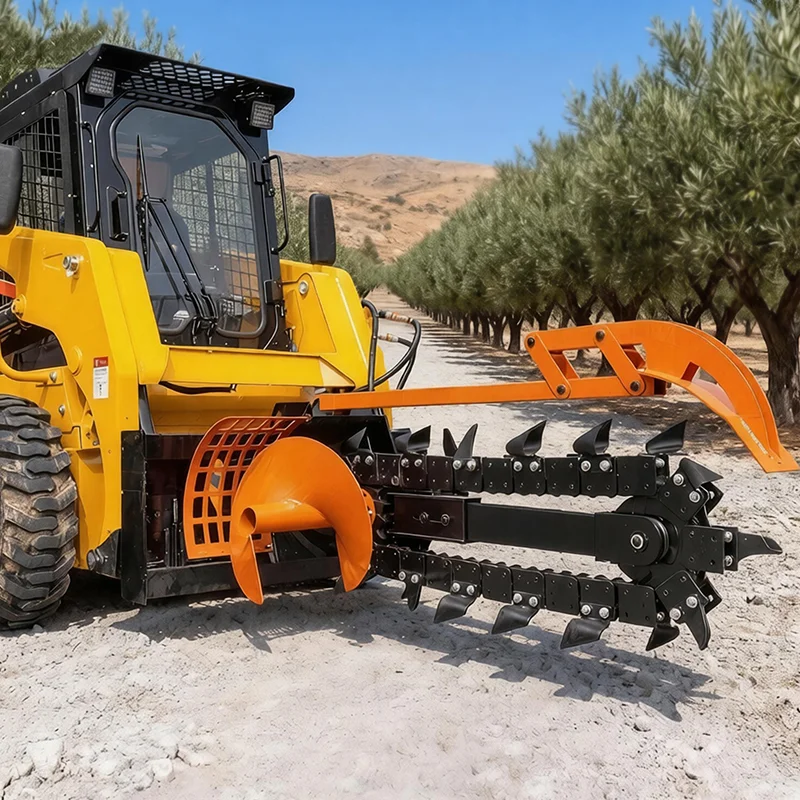
Chain Speed Is What Moves the Dirt — Not Excavator Size
A trencher looks simple: a rotating chain with teeth cuts a narrow trench, and an auger or conveyor moves the spoil to the side. But production rate varies by a factor of three between a well-matched trencher and a poorly matched one. The variable that matters most is chain speed — the linear speed of the cutting chain, measured in m/s. Too slow and the teeth rub instead of cut, generating heat and wearing teeth prematurely. Too fast and the teeth bounce off hard soil, reducing penetration and causing vibration. The optimal chain speed is 2.5–4 m/s for most soil conditions, with harder soils requiring slower speeds (2–3 m/s) and softer soils tolerating faster speeds (3.5–5 m/s).
Chain speed is determined by the hydraulic motor displacement and the excavator's auxiliary flow. A trencher designed for 100–150 L/min will achieve optimal chain speed on a high-flow excavator. On a standard-flow machine delivering 60–80 L/min, chain speed drops to 1.5–2.5 m/s — below the cutting threshold for most soils. The trencher will still dig, but at 30–50 percent of its rated production, with accelerated tooth wear from rubbing instead of cutting.
Tooth Configuration by Soil Type
Standard cup teeth — the most common tooth type, with a cup-shaped cutting face that scoops soil. Effective in topsoil, loam, and soft clay. Produces a clean trench wall with minimal fracturing. Teeth are inexpensive ($5–15 each) and easy to replace. Best for general utility trenching, drainage, and landscaping in non-rocky soil.
Rock teeth — carbide-tipped teeth with a pointed or chisel shape that fractures rock instead of scooping it. Required for compacted gravel, soft rock, and fractured stone where standard cup teeth would shatter or wear away in hours. Rock teeth cost 3–5x more than standard teeth ($20–50 each) but are the only option for rocky ground. Best for utility installation in glacial till, road cuts, and rocky terrain.
Combination teeth — a mix of cup teeth and rock teeth spaced along the chain, providing moderate performance in mixed soil conditions. Useful when the trench passes through variable soil — topsoil in some sections, compacted gravel in others — and changing chains mid-job is impractical. Combination setups sacrifice 10–20 percent production in uniform soil compared to a matched tooth set, but eliminate the need for chain changes on variable ground.
Depth Control and Trench Quality
Over-digging is the most common and costly mistake in trenching. Every 50 mm of extra depth means 10–15 percent more soil to excavate and dispose of, plus additional backfill material. A 100 m trench at 1.0 m depth versus 1.2 m depth generates roughly 20 percent more spoil — a difference that adds up quickly on long utility runs.
Modern trenchers offer several depth control systems. The simplest is a manual depth gauge — a pointer or scale mounted on the trencher frame that shows current depth relative to the boom angle. The operator adjusts the excavator arm to maintain the desired depth. This requires constant operator attention and is prone to over-digging on uneven terrain.
Better systems use a depth wheel or skid — a wheel or pad that rides on the ground surface ahead of the cutting chain, maintaining a fixed distance between the ground surface and the chain. As the terrain rises or falls, the depth wheel follows it, keeping trench depth constant without operator input. Depth wheel systems reduce over-digging to less than 25 mm and improve production by 15–25 percent because the operator can focus on forward speed rather than depth adjustment.
The most advanced systems use laser or GPS depth control — a receiver mounted on the trencher communicates with a laser transmitter or GPS base station, automatically adjusting the boom angle to maintain a precise depth and grade. These systems are standard on large pipeline projects where grade accuracy is critical, but are increasingly common on utility and drainage projects where consistent depth reduces backfill costs and ensures proper pipe slope.
Production Rates and Real-World Expectations
A properly matched 150 mm wide trencher on a 15–20 ton excavator, digging 1.0–1.5 m deep in normal soil, achieves 150–300 m of trench per day for an experienced operator. In rocky soil with rock teeth, expect 50–150 m/day. In hard clay with standard teeth, 100–200 m/day. A mismatched trencher on a low-flow excavator may achieve only 50–100 m/day even in good soil.
On a recent 800 m utility trench project (150 mm wide, 1.2 m deep, mixed soil with occasional rock), one contractor using a 20-ton excavator with a high-flow circuit and a depth-wheel-equipped trencher completed the job in 4 days — roughly 200 m/day. The same contractor's previous trencher, mounted on a standard-flow 15-ton machine without depth control, would have taken an estimated 8–10 days at 80–100 m/day, with significantly more tooth replacement cost.
Maintenance That Prevents Chain and Bearing Failure
Three components account for most trencher downtime. First, the cutting chain — inspect daily for worn or broken teeth, and check chain tension. A loose chain derails easily, causing costly downtime and potential damage to the boom and sprockets. A tight chain accelerates bearing wear and can cause the chain to snap under load. Follow the manufacturer's tension specification — typically 20–30 mm of sag at the midpoint of the boom. Second, boom bearings — the chain rides on bearings or wear strips along the boom. These wear continuously, especially in abrasive sandy soil. Inspect weekly and replace when wear exceeds 30 percent of original thickness. Worn bearings allow the chain to wander, increasing trench width and accelerating chain wear. Third, hydraulic motor and gearbox — check oil level daily and change every 200 hours. The gearbox reduces motor speed and increases torque to drive the chain; contaminated or low oil causes gear and bearing failure. Keep the radiator and oil cooler clear of dust and spoil — trenching generates fine dust that clogs coolers rapidly.
Match chain speed to your soil, choose the right teeth, use depth control to prevent over-digging, and maintain chain tension and bearings daily. That is the formula for a trencher that digs 300 m a day instead of 100 — and lasts 2,000 hours instead of 500.