

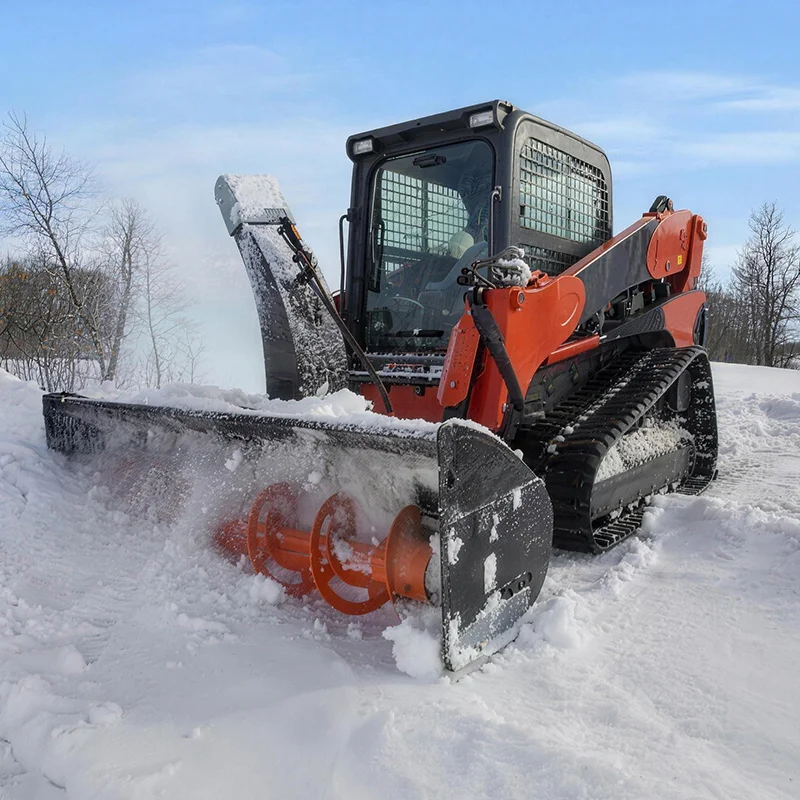
Throw Distance Is About Impeller Speed — Not Just Size
When buyers compare snow blowers, the first number they look at is width — a 2 m blower clears more than a 1.5 m blower, right? Not necessarily. A wider blower ingests more snow per pass, but if the impeller cannot throw that snow far enough, it piles up at the discharge chute and spills back into the cleared path. The result: you end up making two passes to clear what one pass should handle, and your effective production drops by 40–50 percent despite the wider machine.
Throw distance is determined by impeller tip speed — the linear speed of the impeller blades at their outer edge, measured in m/s. Most snow blowers achieve impeller tip speeds of 25–45 m/s. At 25 m/s, snow travels roughly 5–8 m from the chute. At 35 m/s, 10–15 m. At 45 m/s, 15–25 m. The impeller tip speed is a function of impeller diameter and rotational speed: a 600 mm impeller at 1,000 RPM achieves roughly 31 m/s tip speed; the same impeller at 1,500 RPM achieves 47 m/s.
Impeller speed is driven by the hydraulic motor, which means it depends on the carrier's auxiliary flow. A blower designed for 100–150 L/min will achieve full impeller speed on a high-flow skid steer. On a standard-flow machine delivering 60–80 L/min, impeller speed drops to 60–70 percent of rated, and throw distance drops accordingly — from 15 m to 8–10 m. For parking lots and driveways where snow can be piled close by, 8 m may be sufficient. For roadways and large lots where you need to throw snow into a truck or over a snowbank, 15 m+ is required.
Ingestion Rate: The Real Production Metric
Throw distance gets the attention, but ingestion rate is what determines how many acres you clear per hour. Ingestion rate is the volume of snow the blower can process per minute, measured in m³/min. It depends on three factors: intake width, intake height, and forward speed. A 1.8 m wide blower with a 0.9 m intake height, traveling at 3 km/h, ingests roughly 1.8 × 0.9 × (3000/60) = 81 m³/min — assuming the impeller can keep up.
The catch is that the impeller has a maximum processing rate, and if you feed snow faster than the impeller can throw it, the blower clogs. A clogged blower means stopping, reversing, and clearing the impeller — a 2–5 minute delay that can happen every 50–100 m in heavy, wet snow. The key is matching forward speed to snow density and impeller capacity. In light, dry snow (50–100 kg/m³), you can travel at full speed (4–6 km/h) without clogging. In heavy, wet snow (200–400 kg/m³), you must slow to 1.5–3 km/h to avoid clogging. In slush or packed snow (400+ kg/m³), you may need to make two passes at half depth.
Real-world production: a 1.8 m high-flow blower on a 75 hp skid steer, clearing 150 mm of average snow from a parking lot, achieves roughly 3–5 acres per hour for an experienced operator. In heavy wet snow, 1.5–3 acres/hour. A standard-flow blower of the same width may achieve only 1.5–2.5 acres/hour in average snow due to reduced impeller speed and throw distance. On a recent 40-acre commercial lot clearing after a 200 mm snowfall, one contractor using two high-flow 1.8 m blowers completed the job in 6 hours — roughly 3.3 acres per hour per machine. The same contractor's older standard-flow blowers would have taken an estimated 12–16 hours.
Chute Design and Directional Control
The discharge chute is where thrown snow is directed, and its design affects both throw distance and placement accuracy. A straight vertical chute throws snow straight up, which maximizes height but reduces horizontal distance — the snow goes up, then comes down close to the machine. A curved or angled chute (typically 30–45 degrees from vertical) directs snow at an angle, maximizing horizontal distance while maintaining enough height to clear obstacles.
Chute rotation is equally important. Most blowers offer 180–270 degrees of hydraulic chute rotation, allowing the operator to direct snow to either side or behind the machine without repositioning the carrier. Chute rotation speed matters too — a slow-rotating chute (5–10 seconds for full rotation) forces the operator to plan ahead, while a fast-rotating chute (2–3 seconds) allows on-the-fly adjustment as conditions change. For tight spaces like sidewalks and loading docks, fast chute rotation is essential for placing snow precisely without hitting buildings or vehicles.
Some blowers offer a deflector at the chute outlet — a hydraulically adjustable flap that controls the vertical angle of the discharged snow. With the deflector fully open, snow travels at maximum distance. With it partially closed, snow is directed lower and closer, useful for placing snow in a specific pile or avoiding overhead obstacles like power lines or building eaves. A hydraulic deflector adds cost but significantly improves placement precision, especially in urban environments.
Maintenance That Prevents Impeller and Gearbox Failure
Snow blowers operate in harsh conditions — cold temperatures, moisture, abrasive road salt, and occasional impact with hidden debris. Three maintenance habits prevent the most common failures. First, impeller and auger bearings — the rotating components run at high speed in cold, wet conditions. Grease all bearings daily before operation; cold grease thickens and does not lubricate effectively until the bearings warm up, so a few minutes of warm-up at low speed before full operation extends bearing life significantly. Inspect bearings weekly for play or noise; replace at the first sign of wear to avoid catastrophic failure on the job. Second, gearbox oil — the gearbox reduces hydraulic motor speed and increases torque to drive the auger and impeller. Check oil level daily and change every 100 hours (more frequently than other attachments because cold starts and moisture contamination accelerate oil degradation). Use the manufacturer's specified cold-weather oil viscosity — a standard-weight oil thickens at -20°C and can cause gearbox damage on startup. Third, shear pins or torque limiters — most blowers use shear pins (designed to break when the impeller hits a hidden obstacle like a curb or manhole cover) or hydraulic torque limiters (which slip under overload) to protect the gearbox and impeller. Always carry spare shear pins on the truck — a broken shear pin stops the blower completely, and replacing one takes 5 minutes if you have a spare, or ends the shift if you do not. Never replace a shear pin with a bolt or weld — this defeats the protection and can cause catastrophic gearbox or impeller damage when the next obstacle is hit.
Match impeller speed to your carrier's flow, match forward speed to snow density, use chute rotation and deflector for precise placement, and maintain bearings and gearbox religiously in cold weather. That is the formula for a snow blower that clears 5 acres an hour instead of 2 — and starts reliably on the coldest morning of the year.