

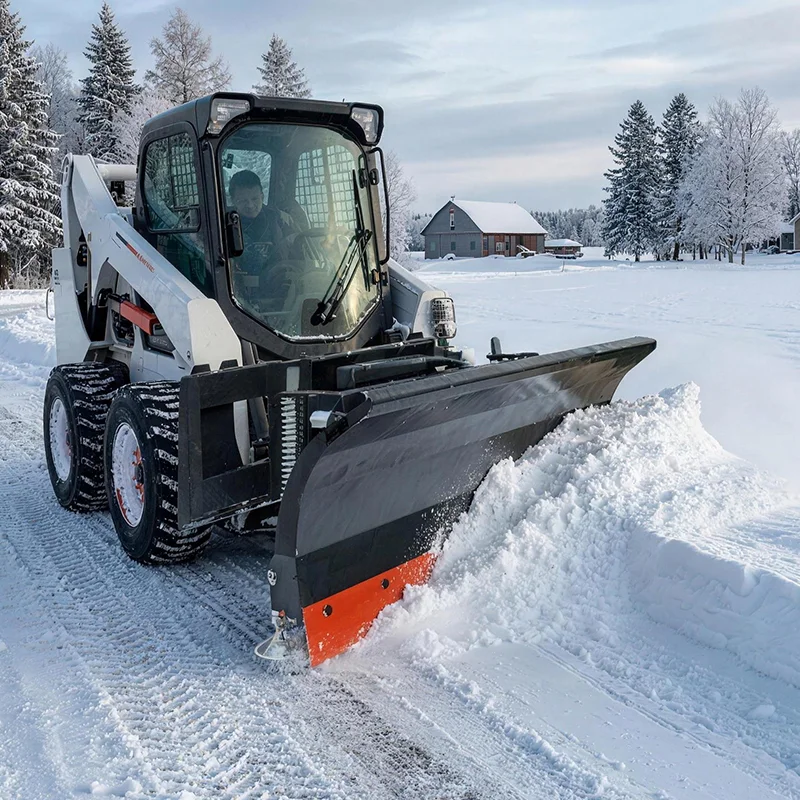
Blade Material Determines Wear Life and Surface Protection
The cutting edge is the part of a snow plow that actually contacts the ground, and its material determines both how long it lasts and how much damage it does to the surface below. Three materials dominate the market, each with distinct tradeoffs.
Steel cutting edges — the traditional choice, made from hardened steel (typically 400–500 Brinell hardness). Steel edges are aggressive, cutting through packed snow and ice that softer edges would ride over. They are also the most durable on rough surfaces like gravel roads and unpaved lots, where abrasive conditions wear softer edges rapidly. The downside: steel edges scrape and scratch paved surfaces, especially asphalt. On a new asphalt parking lot, a steel edge can leave visible scratch marks after a single season. Steel edges also transmit more vibration to the operator, increasing fatigue during long shifts. Expected wear life: 2–4 seasons on paved surfaces, 1–2 seasons on gravel.
Polyurethane cutting edges — made from high-density polyurethane (typically 90–95 Shore A hardness). Poly edges are gentler on paved surfaces, leaving no scratches on asphalt or concrete. They also absorb vibration, reducing operator fatigue and making the plow quieter. The downside: poly edges are less aggressive on packed snow and ice, tending to ride over hard-packed layers rather than cutting through. On gravel surfaces, poly edges wear 2–3x faster than steel. Expected wear life: 3–5 seasons on paved surfaces, 1 season on gravel.
Rubber cutting edges — made from reinforced rubber (typically 60–70 Shore A). Rubber edges are the gentlest on surfaces, making them ideal for decorative concrete, brick pavers, and other sensitive surfaces where even poly edges might cause scuffing. They are also the quietest and most vibration-dampening. The downside: rubber edges are the least aggressive, struggling with anything beyond light, fresh snow. They wear fastest on abrasive surfaces and require the most frequent replacement. Expected wear life: 2–3 seasons on paved surfaces, less than 1 season on gravel.
Many operators use interchangeable edges — steel for gravel roads and heavy ice, poly for paved parking lots, rubber for sensitive surfaces. Edge swap takes 15–30 minutes with basic tools. If your operation covers multiple surface types, an interchangeable edge system is worth the extra cost.
Trip Edge vs Fixed Edge: Impact Protection vs Cutting Performance
When a plow hits an obstacle — a manhole cover, curb, expansion joint, or hidden debris — the force must go somewhere. Two design philosophies handle this differently.
Trip edge plows — the bottom cutting edge is mounted on springs or hydraulic cylinders that allow it to trip backward when it hits an obstacle. The blade stays in position while the edge gives way, reducing impact force on the plow, the carrier, and the obstacle. Trip edges are essential for plowing over surfaces with hidden obstacles — manhole covers, storm drains, curbs, and uneven pavement. Without a trip edge, hitting a manhole cover at 15 km/h can bend the plow frame, damage the carrier's front axle, or launch the obstacle into the air — a serious safety hazard. The downside: trip edges have moving parts (springs, pins, hinges) that wear and require maintenance. Springs lose tension over time, pins wear, and hinges seize if not lubricated. A trip edge that is not maintained may not trip when needed, defeating its purpose.
Fixed edge plows — the cutting edge is rigidly mounted to the blade frame. When the plow hits an obstacle, the full force transmits to the plow, the carrier, and the obstacle. Fixed edges are simpler and more durable — no springs, pins, or hinges to wear or maintain. They also provide more consistent cutting performance because the edge does not move or flex during normal plowing. The downside: fixed edges transmit full impact force to the carrier and operator, increasing fatigue and potential damage. On surfaces with hidden obstacles, fixed edges are risky — a single impact with a manhole cover can bend the plow or damage the carrier. Fixed edges are best for large, open, obstacle-free surfaces — airport runways, large parking lots, and new construction sites where the surface is uniform and clean.
For most commercial plowing operations — where surfaces vary and hidden obstacles are common — a trip edge plow is the safer, more versatile choice. The maintenance overhead is modest (lubricate hinges monthly, inspect springs each season), and the impact protection prevents costly damage to both the plow and the surfaces being cleared.
Floating Angle: The Adjustment 90 Percent of Operators Get Wrong
Most snow plows offer a floating angle or "float" position — a hydraulic setting that allows the plow to follow the contour of the ground rather than being held at a fixed height by the operator. When float is engaged, the plow's own weight keeps the cutting edge in contact with the surface, and the hydraulic system allows the plow to rise and fall as the terrain changes. This is the correct setting for almost all plowing conditions.
Yet 90 percent of operators run their plows in the fixed-down position — holding the plow at a set height with the hydraulic system — because they believe it provides more down pressure and better cutting. This is a mistake. In the fixed-down position, the operator must constantly adjust the plow height to match the terrain. On an uneven surface, this means the plow either digs in (scraping the surface and potentially damaging the edge) or floats above the surface (leaving a layer of snow). The result: inconsistent clearing, accelerated edge wear, and operator fatigue from constant height adjustment.
In the float position, the plow follows the ground automatically, maintaining consistent contact without operator input. The plow's weight provides sufficient down pressure for most snow conditions — a typical 2 m plow weighs 200–400 kg, which is enough to keep the cutting edge engaged even in packed snow. For heavy, wet snow or ice, some plows offer adjustable down pressure — a hydraulic setting that adds 50–200 kg of additional downward force while still allowing the plow to float. This combines the benefits of float (automatic terrain following) with extra down pressure for difficult conditions.
The only time fixed-down is appropriate is when plowing very light, fluffy snow on a perfectly flat surface — conditions where the plow's weight might cause the edge to dig in slightly. Even then, float with reduced down pressure is usually better than fixed-down. If you are currently running your plow in fixed-down, try float for one shift — most operators report less fatigue, more consistent clearing, and significantly longer edge life.
Production Rates and Real-World Expectations
A 2.4 m trip-edge plow on a 75 hp skid steer, clearing 100–150 mm of average snow from a paved parking lot, achieves roughly 4–6 acres per hour for an experienced operator. In heavy wet snow, 2–4 acres/hour. In light dry snow, 6–8 acres/hour. A 3 m plow on a 120 hp wheel loader achieves 6–10 acres/hour in average snow. Production rates are highly dependent on site layout — obstacles, narrow aisles, and tight turns reduce effective speed and increase the number of passes required.
On a recent 25-acre commercial plaza clearing after a 150 mm snowfall, one contractor using a 2.4 m trip-edge plow on a skid steer (with float position and poly edge) completed the job in 5 hours — roughly 5 acres per hour. The same contractor's previous approach, using a fixed-edge steel plow in fixed-down position, took an estimated 8–10 hours for the same lot, with significantly more operator fatigue and edge wear.
Maintenance That Determines Service Life
A well-maintained snow plow can last 10–15 seasons. A neglected plow fails in 3–5 seasons — usually from a bent frame, seized trip mechanism, or worn-through cutting edge that damages the blade. Three maintenance habits make the difference. First, cutting edge inspection — check the edge weekly during the plowing season. A worn edge (less than 10 mm remaining thickness) does not cut effectively and can allow the blade frame to contact the ground, causing expensive damage. Replace the edge before it wears through — the cost of a new edge ($100–300) is trivial compared to repairing a damaged blade frame ($1,000–3,000). Second, trip mechanism lubrication — if your plow has a trip edge, lubricate all hinges, pins, and springs monthly during the season. Use a high-quality grease rated for cold temperatures (down to -30°C or lower). A seized trip mechanism does not protect the plow when it hits an obstacle — the first impact after seizure can bend the frame or break the trip springs. Third, hydraulic hose and cylinder inspection — check all hoses and cylinders weekly for leaks, abrasion, or kinks. The hoses to the plow angle and lift cylinders flex with every movement, and cold temperatures make rubber hoses brittle and prone to cracking. Replace any hose that shows signs of wear — a sudden hose failure in the middle of a snowstorm can take the plow out of service for hours. At the end of each season, wash the plow thoroughly (road salt and magnesium chloride accelerate corrosion), touch up any paint chips, and store it indoors or under a waterproof cover.
Choose the right edge material for your surfaces, use a trip edge for obstacle protection, run in float position instead of fixed-down, and maintain the edge and trip mechanism religiously. That is the formula for a plow that clears 6 acres an hour instead of 3 — and lasts 15 seasons instead of 5.