

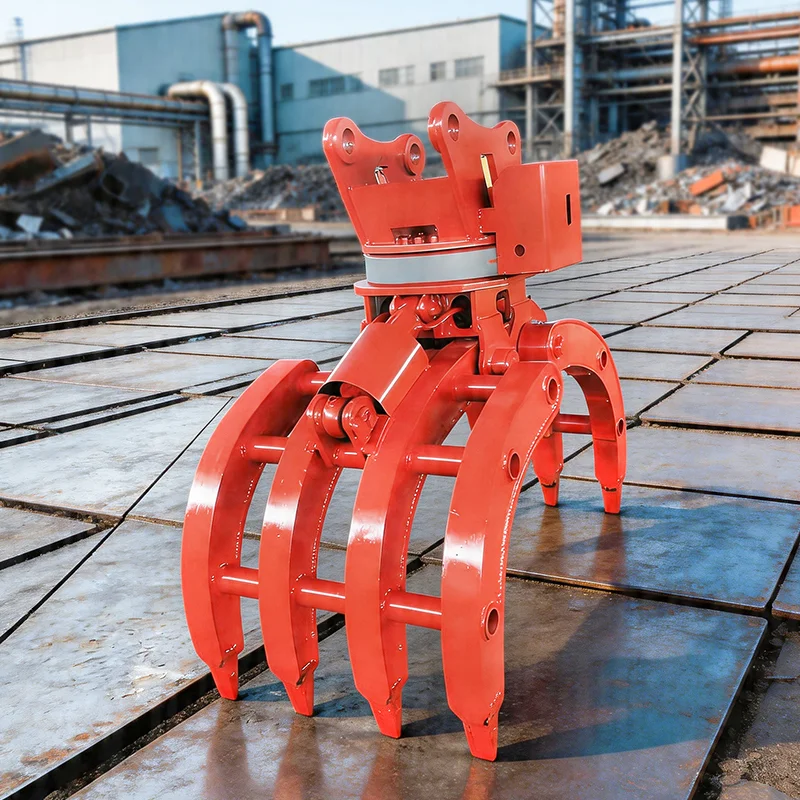
Tine Configuration Determines Grip on Irregular Scrap
Scrap metal is not uniform — it comes as tangled rebar, flat sheet, I-beam offcuts, and mixed demolition debris. A grapple that handles one type well may spill another. The variable that matters most is tine configuration: how many tines, how far apart they are, and how they are shaped.
Five-tine grapples are the most common general-purpose design. Five tines (three on one shell, two on the other, interlocking when closed) provide a good balance of grip strength and material retention. The interlocking tines wrap around irregular shapes, preventing flat sheet and small pieces from slipping through. Five-tine grapples are ideal for mixed scrap yards, demolition sites, and recycling facilities where the material varies load by load.
Three-tine or four-tine grapples have wider tine spacing, which allows them to penetrate deeper into dense piles of large material — I-beams, heavy pipe, structural steel. The wider spacing also means less tine drag when closing, so the grapple can clamp faster on large loads. The downside: small pieces and flat sheet can slip between widely spaced tines, requiring multiple grabs to clean up. Three- or four-tine grapples are best for heavy structural steel, large demolition debris, and scrap yards that primarily handle large sections.
Tine shape matters too. Straight tines provide maximum penetration into dense piles but may allow material to slide out during lifting. Curved or hooked tines wrap around material and hold it more securely during travel, but penetrate less effectively into dense piles. Most modern grapples use a slightly curved tine profile — enough curve to hold material during lifting, enough straightness to penetrate piles. For operations that primarily load trucks (where material retention during travel is critical), curved tines are the better choice. For operations that primarily sort and stockpile (where penetration is more important), straight tines may be preferable.
Clamping Force: Match It to the Heaviest Load
A grapple's clamping force is determined by the hydraulic cylinder bore, system pressure, and the mechanical advantage of the tine pivot geometry. The formula is straightforward: cylinder force = pressure × area (π × bore² / 4). A 100 mm bore cylinder at 250 bar generates roughly 19,600 N (2,000 kgf) of force. With a 2:1 mechanical advantage at the tine tips, that becomes 4,000 kgf of clamping force per shell — sufficient for most general scrap handling.
The common mistake is selecting a grapple based on bucket size or excavator weight alone, without considering clamping force. A 0.5 m³ grapple with an 80 mm cylinder at 200 bar may look adequate on paper, but when clamping a slippery load of flat sheet or oily pipe, it may not hold securely — the load shifts during travel, potentially spilling material and creating a safety hazard. Always match clamping force to the heaviest, most slippery load you handle, not the average load.
For general scrap handling (mixed material, average load 500–1,000 kg), 3,000–5,000 kgf of clamping force per shell is sufficient. For heavy structural steel and large pipe (loads 1,000–2,000 kg), 5,000–8,000 kgf may be required. For very heavy or slippery loads (oily pipe, wet sheet, large I-beams), 8,000–12,000 kgf provides the security needed for safe travel and loading.
Production Rates and Real-World Expectations
A properly matched steel grapple on a 20-ton excavator, handling mixed scrap in a yard environment, achieves 40–60 truck loads per 8-hour shift — roughly 5–8 loads per hour, including travel time between the pile and the truck, plus loading and positioning. In a demolition site where material is scattered and requires sorting, production drops to 25–40 loads per shift. In a scrap yard with organized piles and a dedicated loading zone, an experienced operator can achieve 60–80 loads per shift.
On a recent demolition project involving a 5,000 m² industrial building, one contractor using a 25-ton excavator with a five-tine steel grapple cleared and loaded 1,200 tonnes of structural steel and rebar in 12 working days — roughly 100 tonnes per day, or 12–15 truck loads per day (at 8 tonnes per truck). The grapple's interlocking tines handled both large I-beam sections and tangled rebar without requiring manual sorting, and the clamping force held slippery, paint-coated steel securely during travel. The contractor estimated that using a standard bucket instead of a grapple would have taken 20+ days and required additional labor for manual handling of rebar and small pieces.
Maintenance That Prevents Tine and Pivot Failure
Three components account for most steel grapple downtime. First, tines — inspect daily for cracks, bends, or excessive wear at the tips. A cracked tine can fail catastrophically under load, potentially dropping a full grab of steel from height. A bent tine reduces clamping force and may prevent the grapple from closing fully. Replace damaged tines immediately — do not attempt to weld or straighten a cracked tine, as the weld heat can weaken the surrounding steel. Tine tips can be rebuilt with hardfacing welding when worn, extending tine life by 30–50 percent.
Second, pivot pins and bushings — the pins that connect the tines to the grapple frame and to the hydraulic cylinders operate under extreme load and constant movement. Inspect weekly for wear — grab a tine and try to move it side to side; any play beyond 1 mm indicates pin or bushing wear. A worn pivot allows the tine to misalign, causing uneven clamping and accelerated wear on other components. Replace worn pins and bushings promptly. Pivot pins should be greased daily (2–3 pumps per pin) using a high-pressure grease rated for heavy loads and wet, dirty conditions.
Third, hydraulic cylinders and hoses — the cylinders that open and close the grapple operate under high pressure and frequent cycling, often in abrasive conditions (metal dust, rust, dirt). Inspect cylinder rods daily for scoring, pitting, or chrome plating damage — a damaged rod score will destroy the rod seal in hours, causing hydraulic fluid leakage and loss of clamping force. Replace a damaged cylinder immediately. Inspect hydraulic hoses weekly for abrasion, kinks, or leaks — the hoses to the grapple flex with every movement and are exposed to sharp metal edges. Use hose protectors or sleeving where hoses rub against the grapple frame. Replace all grapple hoses as a set every 2,000 hours, even if they look intact.
Match tine configuration to your material, size clamping force for the heaviest load, and maintain tines, pivots, and hydraulics religiously. That is the formula for a steel grapple that handles 60 loads a shift without downtime — and lasts 5,000 hours instead of 1,000.